Technical and Macromolecular Chemistry, Paderborn University, Warburger Strasse 100, 33098, Paderborn, Germany.
Biohybrid Materials, Department of Bioproducts and Biosystems, Aalto University, P. O. Box 16100, 00076, Aalto, Finland.
Angew Chem Int Ed Engl. 2020 Sep 7;59(37):15818-15833. doi: 10.1002/anie.201916390. Epub 2020 Jun 3.
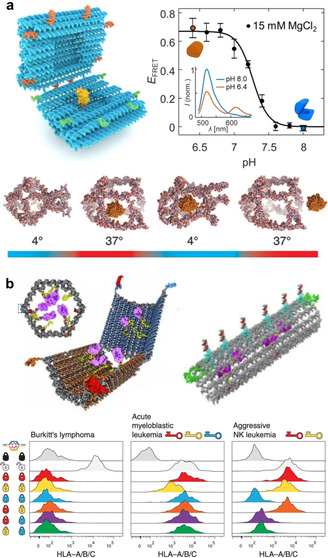
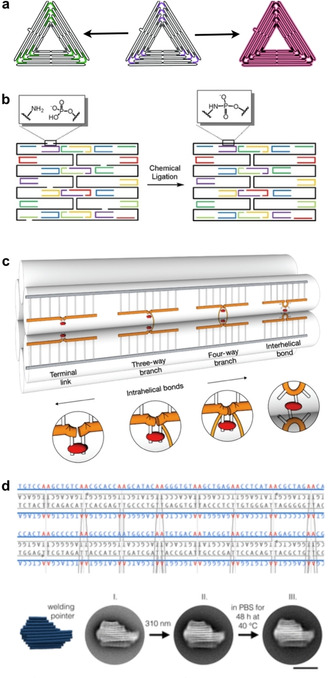
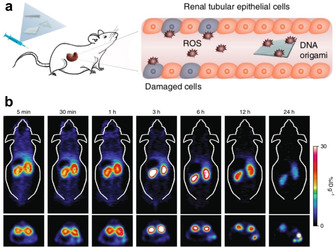
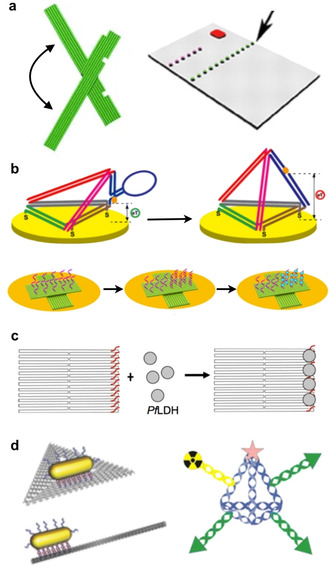
DNA nanotechnology holds substantial promise for future biomedical engineering and the development of novel therapies and diagnostic assays. The subnanometer-level addressability of DNA nanostructures allows for their precise and tailored modification with numerous chemical and biological entities, which makes them fit to serve as accurate diagnostic tools and multifunctional carriers for targeted drug delivery. The absolute control over shape, size, and function enables the fabrication of tailored and dynamic devices, such as DNA nanorobots that can execute programmed tasks and react to various external stimuli. Even though several studies have demonstrated the successful operation of various biomedical DNA nanostructures both in vitro and in vivo, major obstacles remain on the path to real-world applications of DNA-based nanomedicine. Here, we summarize the current status of the field and the main implementations of biomedical DNA nanostructures. In particular, we focus on open challenges and untackled issues and discuss possible solutions.
DNA 纳米技术在未来的生物医学工程和新型治疗方法和诊断分析的发展方面具有巨大的潜力。DNA 纳米结构的亚纳米级寻址能力允许对其进行精确和定制的修饰,结合许多化学和生物实体,这使得它们适合作为精确的诊断工具和多功能载体,用于靶向药物输送。对形状、大小和功能的绝对控制使得可以制造定制的和动态的设备,例如 DNA 纳米机器人,可以执行编程任务并对各种外部刺激做出反应。尽管有几项研究已经证明了各种生物医学 DNA 纳米结构在体外和体内的成功运作,但在 DNA 纳米医学的实际应用方面仍存在重大障碍。在这里,我们总结了该领域的现状和生物医学 DNA 纳米结构的主要应用。特别是,我们专注于开放的挑战和未解决的问题,并讨论可能的解决方案。