MRC Integrative Epidemiology Unit at the University of Bristol United Kingdom.
Population Health Sciences Bristol Medical School University of Bristol United Kingdom.
J Am Heart Assoc. 2020 Mar 3;9(5):e013131. doi: 10.1161/JAHA.119.013131. Epub 2020 Mar 2.
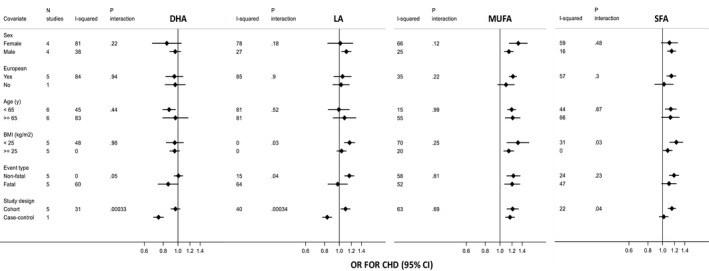
Background We aimed at investigating the association of circulating fatty acids with coronary heart disease (CHD) and stroke risk. Methods and Results We conducted an individual-participant data meta-analysis of 5 UK-based cohorts and 1 matched case-control study. Fatty acids (ie, omega-3 docosahexaenoic acid, omega-6 linoleic acid, monounsaturated and saturated fatty acids) were measured at baseline using an automated high-throughput serum nuclear magnetic resonance metabolomics platform. Data from 3022 incident CHD cases (13 104 controls) and 1606 incident stroke cases (13 369 controls) were included. Logistic regression was used to model the relation between fatty acids and odds of CHD and stroke, adjusting for demographic and lifestyle variables only (ie, minimally adjusted model) or with further adjustment for other fatty acids (ie, fully adjusted model). Although circulating docosahexaenoic acid, but not linoleic acid, was related to lower CHD risk in the fully adjusted model (odds ratio, 0.85; 95% CI, 0.76-0.95 per standard unit of docosahexaenoic acid), there was evidence of high between-study heterogeneity and effect modification by study design. Stroke risk was consistently lower with increasing circulating linoleic acid (odds ratio for fully adjusted model, 0.82; 95% CI, 0.75-0.90). Circulating monounsaturated fatty acids were associated with higher CHD risk across all models and with stroke risk in the fully adjusted model (odds ratio, 1.22; 95% CI, 1.03-1.44). Saturated fatty acids were not related to increased CHD risk in the fully adjusted model (odds ratio, 0.94; 95% CI, 0.82-1.09), or stroke risk. Conclusions We found consistent evidence that linoleic acid was associated with decreased risk of stroke and that monounsaturated fatty acids were associated with increased risk of CHD. The different pattern between CHD and stroke in terms of fatty acids risk profile suggests future studies should be cautious about using composite events. Different study designs are needed to assess which, if any, of the associations observed is causal.
背景 我们旨在研究循环脂肪酸与冠心病(CHD)和中风风险的关系。
方法和结果 我们对 5 个英国队列和 1 个匹配病例对照研究进行了个体参与者数据荟萃分析。使用自动化高通量血清核磁共振代谢组学平台在基线时测量脂肪酸(即 ω-3 二十二碳六烯酸、ω-6 亚油酸、单不饱和和饱和脂肪酸)。纳入 3022 例新发 CHD 病例(13104 例对照)和 1606 例新发中风病例(13369 例对照)的数据。使用逻辑回归模型来模拟脂肪酸与 CHD 和中风的几率之间的关系,仅调整人口统计学和生活方式变量(即最小调整模型),或进一步调整其他脂肪酸(即完全调整模型)。虽然在完全调整模型中,循环二十二碳六烯酸与较低的 CHD 风险相关(比值比,0.85;95%CI,0.76-0.95 每标准单位二十二碳六烯酸),但存在研究间高度异质性和研究设计的效应修饰的证据。随着循环亚油酸的增加,中风风险持续降低(完全调整模型的比值比,0.82;95%CI,0.75-0.90)。在所有模型中,循环单不饱和脂肪酸与较高的 CHD 风险相关,在完全调整模型中与中风风险相关(比值比,1.22;95%CI,1.03-1.44)。在完全调整模型中,饱和脂肪酸与增加的 CHD 风险无关(比值比,0.94;95%CI,0.82-1.09),也与中风风险无关。
结论 我们发现一致的证据表明,亚油酸与中风风险降低有关,单不饱和脂肪酸与 CHD 风险增加有关。CHD 和中风在脂肪酸风险特征方面的不同模式表明,未来的研究应该谨慎使用复合事件。需要不同的研究设计来评估观察到的关联中哪些(如果有的话)是因果关系。