Department of Public Health and Caring Sciences, Clinical Nutrition and Metabolism, Uppsala University, Sweden (M.M., U.R.).
The George Institute for Global Health and the Faculty of Medicine, University of New South Wales, Sydney, Australia (M.M., J.H.Y.W., M. Woodward).
Circulation. 2019 May 21;139(21):2422-2436. doi: 10.1161/CIRCULATIONAHA.118.038908.
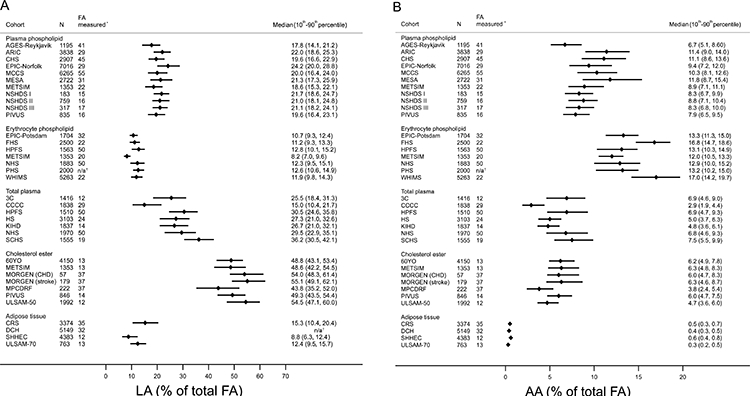
Global dietary recommendations for and cardiovascular effects of linoleic acid, the major dietary omega-6 fatty acid, and its major metabolite, arachidonic acid, remain controversial. To address this uncertainty and inform international recommendations, we evaluated how in vivo circulating and tissue levels of linoleic acid (LA) and arachidonic acid (AA) relate to incident cardiovascular disease (CVD) across multiple international studies.
We performed harmonized, de novo, individual-level analyses in a global consortium of 30 prospective observational studies from 13 countries. Multivariable-adjusted associations of circulating and adipose tissue LA and AA biomarkers with incident total CVD and subtypes (coronary heart disease, ischemic stroke, cardiovascular mortality) were investigated according to a prespecified analytic plan. Levels of LA and AA, measured as the percentage of total fatty acids, were evaluated linearly according to their interquintile range (ie, the range between the midpoint of the first and fifth quintiles), and categorically by quintiles. Study-specific results were pooled using inverse-variance-weighted meta-analysis. Heterogeneity was explored by age, sex, race, diabetes mellitus, statin use, aspirin use, omega-3 levels, and fatty acid desaturase 1 genotype (when available).
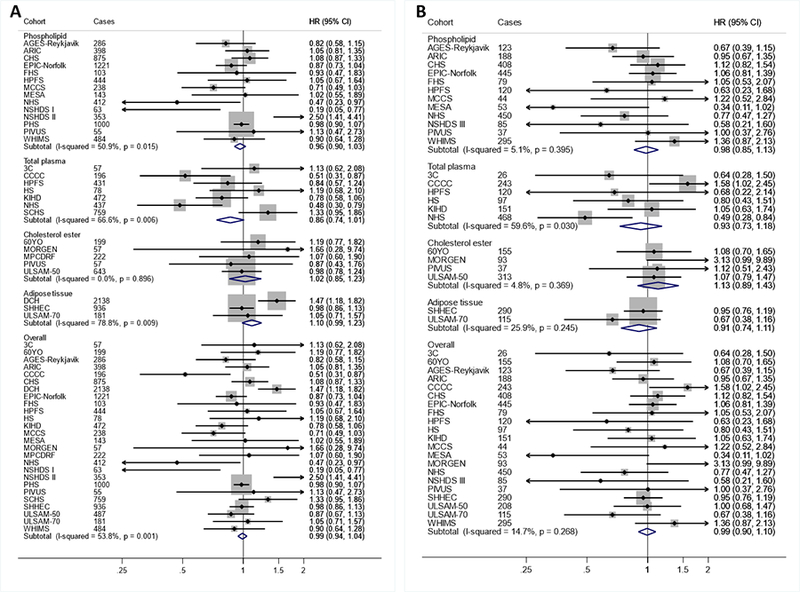
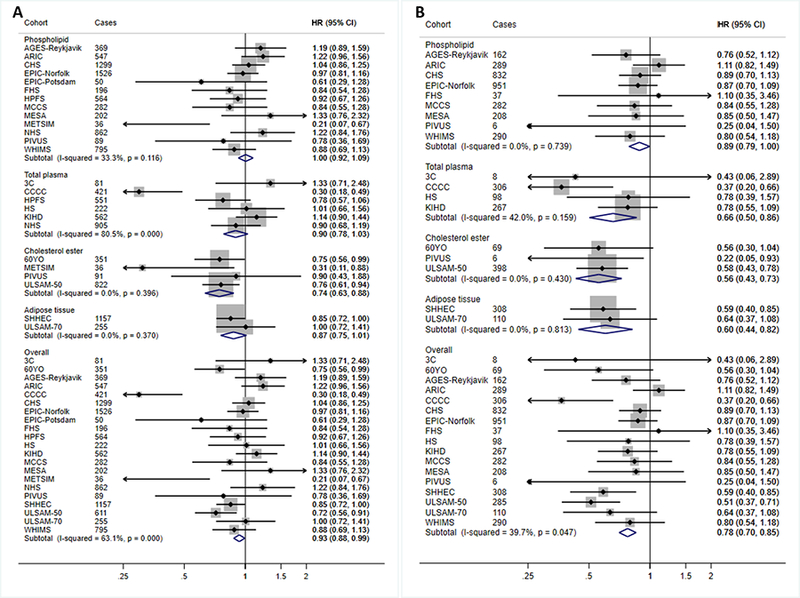
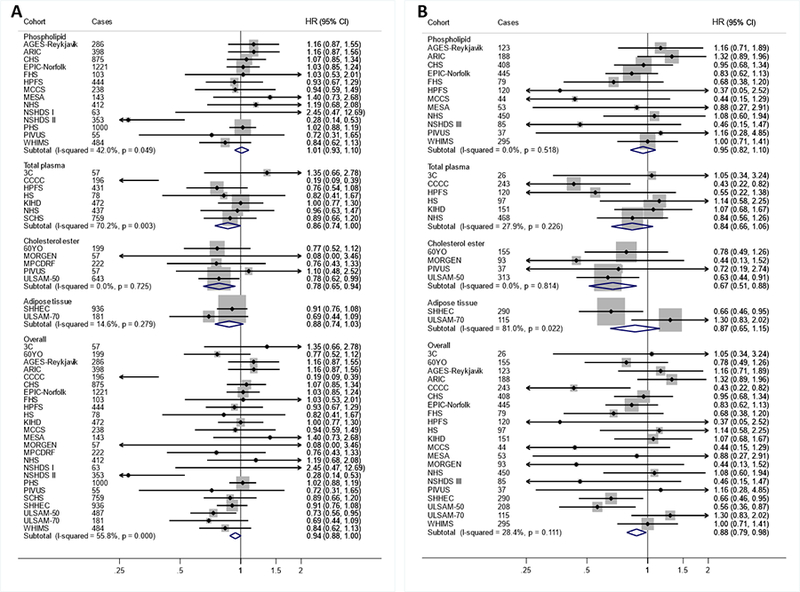
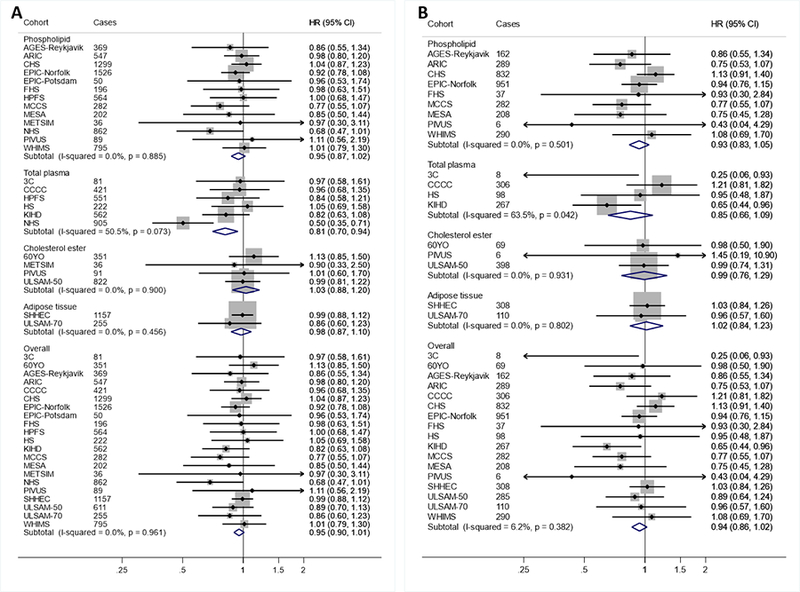
In 30 prospective studies with medians of follow-up ranging 2.5 to 31.9 years, 15 198 incident cardiovascular events occurred among 68 659 participants. Higher levels of LA were significantly associated with lower risks of total CVD, cardiovascular mortality, and ischemic stroke, with hazard ratios per interquintile range of 0.93 (95% CI, 0.88-0.99), 0.78 (0.70-0.85), and 0.88 (0.79-0.98), respectively, and nonsignificantly with lower coronary heart disease risk (0.94; 0.88-1.00). Relationships were similar for LA evaluated across quintiles. AA levels were not associated with higher risk of cardiovascular outcomes; in a comparison of extreme quintiles, higher levels were associated with lower risk of total CVD (0.92; 0.86-0.99). No consistent heterogeneity by population subgroups was identified in the observed relationships.
In pooled global analyses, higher in vivo circulating and tissue levels of LA and possibly AA were associated with lower risk of major cardiovascular events. These results support a favorable role for LA in CVD prevention.
全球对亚油酸(主要的膳食ω-6 脂肪酸)及其主要代谢产物花生四烯酸的膳食推荐量及其对心血管的影响仍存在争议。为了解决这一不确定性,并为国际建议提供信息,我们评估了体内循环和组织中亚油酸(LA)和花生四烯酸(AA)的水平与多种国际研究中发生的心血管疾病(CVD)之间的关系。
我们在来自 13 个国家的 30 项前瞻性观察性研究的全球联盟中进行了协调的、全新的个体水平分析。根据预先规定的分析计划,研究了循环和脂肪组织 LA 和 AA 生物标志物与总 CVD 及亚型(冠心病、缺血性卒中和心血管死亡率)的发生之间的多变量调整关联。LA 和 AA 的水平以总脂肪酸的百分比表示,根据其五分位区间(即第一和第五五分位区间中点之间的范围)进行线性评估,并按五分位区间进行分类。使用逆方差加权荟萃分析汇总研究特异性结果。通过年龄、性别、种族、糖尿病、他汀类药物使用、阿司匹林使用、ω-3 水平和脂肪酸去饱和酶 1 基因型(如果有)探索异质性。
在中位随访时间为 2.5 至 31.9 年的 30 项前瞻性研究中,68659 名参与者中有 15198 例心血管事件发生。LA 水平较高与总 CVD、心血管死亡率和缺血性卒中等风险降低显著相关,每五分位区间的危险比分别为 0.93(95%CI,0.88-0.99)、0.78(0.70-0.85)和 0.88(0.79-0.98),与冠心病风险降低无显著相关性(0.94;0.88-1.00)。LA 按五分位区间评估的关系相似。AA 水平与心血管结局的高风险无关;在极端五分位区间的比较中,较高的水平与总 CVD 风险降低相关(0.92;0.86-0.99)。在观察到的关系中,没有发现人群亚组的一致性异质性。
在全球汇总分析中,体内循环和组织中较高的 LA 和可能的 AA 水平与主要心血管事件风险降低相关。这些结果支持 LA 在 CVD 预防中的有利作用。