China Academy of Chinese Medicine Sciences, Xiyuan Hospital, Beijing, China.
NMPA Key Laboratory for Clinical Research and Evaluation of Traditional Chinese Medicine, Beijing, China.
PLoS One. 2023 Dec 20;18(12):e0294861. doi: 10.1371/journal.pone.0294861. eCollection 2023.
Omega-3 has been extensively studied for its cardiovascular disease (CVD) benefits. However, the results of this evidence are inconsistent. Therefore, in this study, dietary omega-3 intake was investigated further in relation to coronary heart disease (CHD) risk among U.S. adults.
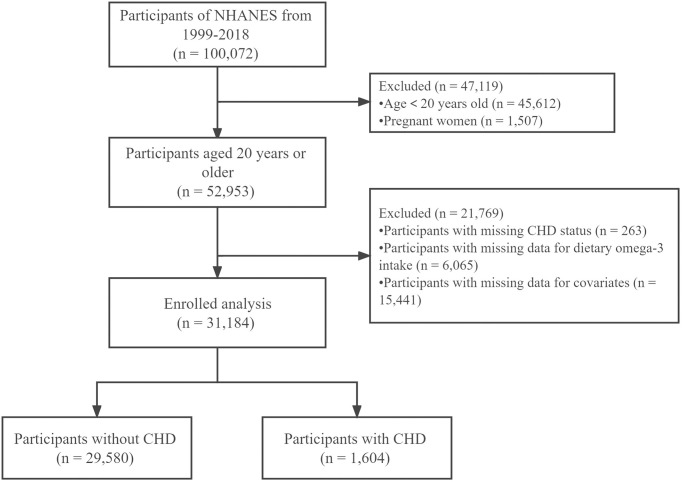
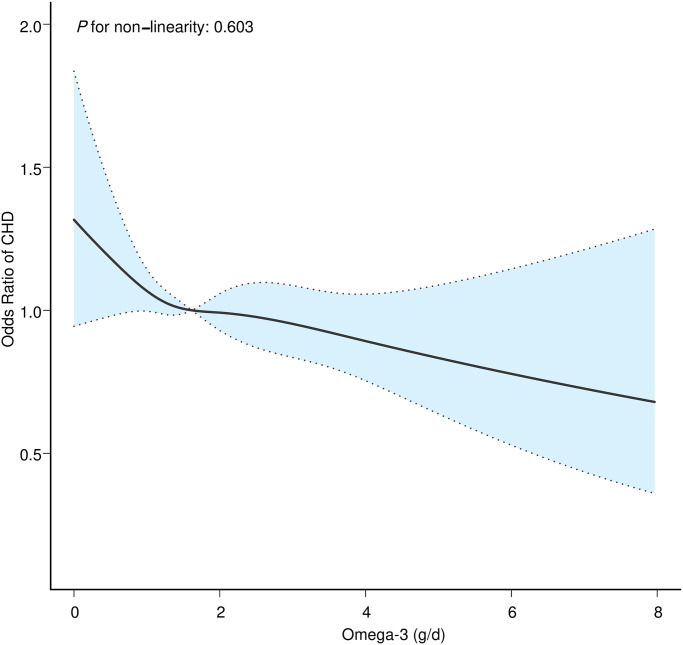
We used data from the National Health and Nutrition Examination Survey (NHANES) database for people ages 20 years and older between 1999 and 2018 to conduct a cross-sectional survey. The Medical Condition Questionnaire (MCQ) was used to determine CHD status. We measured dietary omega-3 intake using two 24-hour dietary recall interviews. Multivariate logistic regression and subgroup analysis were used to explore the correlation between dietary omega-3 intake and CHD. The dose-response relationship between the two was analyzed with a restricted cubic spline (RCS).
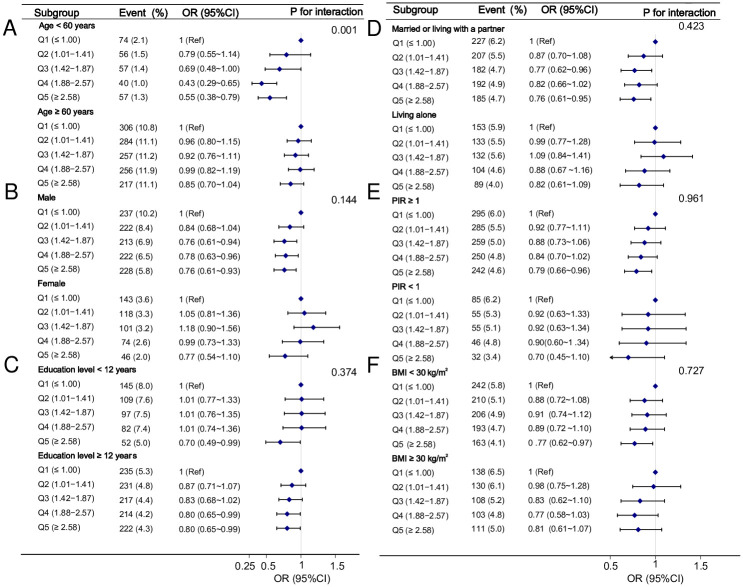
31,184 study subjects were included, of whom 1,604 (5.14%) were patients with CHD. By quintile (Q) of dietary omega-3 intake, after adjusting for all confounding factors, compared with Q1, when total dietary omega-3, alpha-linolenic acid (ALA), docosapentaenoic acid (DPA), eicosatetraenoic acid (ETA), eicosapentaenoic acid (EPA), and docosahexenoic acid (DHA) intake reached Q5, the odds ratio (95% confidence interval, CI) of CHD were 0.76 (0.60, 0.96), 0.73 (0.57, 0.94), 0.70 (0.54, 0.92), 0.66 (0.50, 0.85), 0.84 (0.69, 1.02), and 0.83 (0.64, 1.07), respectively, while EPA and DHA were not significantly associated with the disease (Trend p > 0.05). Intake of omega-3 and CHD were linearly related (P for nonlinear = 0.603). No significant interactions were found within subgroups except for the age group (P for interaction = 0.001). Sensitivity analysis and multivariate logistic regression results are generally in agreement.
Total dietary omega-3, ALA, DPA, and ETA intake were negatively associated with CHD risk. In contrast, EPA and DHA had no significant correlation with CHD.
ω-3 脂肪酸在心血管疾病(CVD)方面的益处已得到广泛研究。然而,这些证据的结果并不一致。因此,在这项研究中,我们进一步研究了美国成年人的饮食 ω-3 摄入量与冠心病(CHD)风险之间的关系。
我们使用了 1999 年至 2018 年期间年龄在 20 岁及以上的美国国家健康和营养调查(NHANES)数据库中的数据进行了横断面调查。使用医学状况问卷(MCQ)确定 CHD 状况。我们使用两次 24 小时膳食回忆访谈来测量饮食 ω-3 的摄入量。多变量逻辑回归和亚组分析用于探索饮食 ω-3 摄入量与 CHD 之间的相关性。使用限制立方样条(RCS)分析两者之间的剂量-反应关系。
共纳入 31184 名研究对象,其中 1604 名(5.14%)为 CHD 患者。按饮食 ω-3 摄入量的五分位数(Q)进行分层,在调整了所有混杂因素后,与 Q1 相比,当总饮食 ω-3、α-亚麻酸(ALA)、二十二碳五烯酸(DPA)、二十碳五烯酸(ETA)、二十碳六烯酸(EPA)和二十二碳六烯酸(DHA)摄入量达到 Q5 时,CHD 的比值比(95%置信区间,CI)分别为 0.76(0.60,0.96)、0.73(0.57,0.94)、0.70(0.54,0.92)、0.66(0.50,0.85)、0.84(0.69,1.02)和 0.83(0.64,1.07),而 EPA 和 DHA 与疾病无显著相关性(趋势 P > 0.05)。ω-3 摄入量与 CHD 呈线性相关(非线性 P 值 = 0.603)。除年龄组(交互作用 P 值 = 0.001)外,各亚组内未发现显著交互作用。敏感性分析和多变量逻辑回归结果基本一致。
总饮食 ω-3、ALA、DPA 和 ETA 摄入量与 CHD 风险呈负相关。相比之下,EPA 和 DHA 与 CHD 无显著相关性。