Brault Marie A, Mwinga Kasonde, Kipp Aaron M, Kennedy Stephen B, Maimbolwa Margaret, Moyo Precious, Ngure Kenneth, Haley Connie A, Vermund Sten H
Department of Social and Behavioral Sciences, Yale School of Public Health, New Haven, CT, USA.
Rwanda Country Office, World Health Organization, Kigali, Rwanda (Formerly, WHO African Regional Office, Brazzaville, Congo).
Glob Health Action. 2020;13(1):1732668. doi: 10.1080/16549716.2020.1732668.
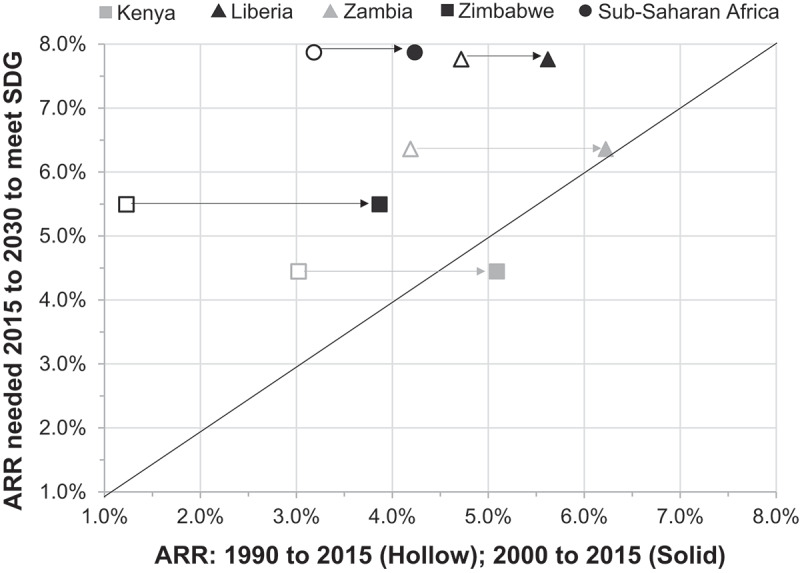
Reducing child mortality is a key global health challenge. We examined reasons for greater or lesser success in meeting under-five mortality rate reductions, i.e. Millennium Development Goal #4, between 1990 and 2015 in Sub-Saharan Africa where child mortality remains high. We first examined factors associated with child mortality from all World Health Organization African Region nations during the Millennium Development Goal period. This analysis was followed by case studies of the facilitators and barriers to Millennium Development Goal #4 in four countries - Kenya, Liberia, Zambia, and Zimbabwe. Quantitative indicators, policy documents, and qualitative interviews and focus groups were collected from each country to examine factors within and across countries related to child mortality. We found familiar themes that highlighted the need for both specific services (e.g. primary care access, emergency obstetric and neonatal care) and general management (e.g. strong health governance and leadership, increasing community health workers, quality of care). We also identified methodological opportunities and challenges to assessing progress in child health, which can provide insights to similar efforts during the Sustainable Development Goal period. Specifically, it is important for countries to adapt general international goals and measurements to their national context, considering baseline mortality rates and health information systems, to develop country-specific goals. It will also be critical to develop more rigorous measurement tools and indicators to accurately characterize maternal, neonatal, and child health systems, particularly in the area of governance and leadership. Valuable lessons can be learned from Millennium Development Goal successes and failures, as well as how they are evaluated. As countries seek to lower child mortality further during the Sustainable Development Goal period, it will be necessary to prioritize and support countries in quantitative and qualitative data collection to assess and contextualize progress, identifying areas needing improvement.
降低儿童死亡率是一项关键的全球卫生挑战。我们研究了1990年至2015年期间撒哈拉以南非洲地区在实现五岁以下儿童死亡率降低(即千年发展目标4)方面成败各异的原因,该地区儿童死亡率仍然很高。我们首先研究了千年发展目标期间世界卫生组织非洲区域所有国家与儿童死亡率相关的因素。在此分析之后,对肯尼亚、利比里亚、赞比亚和津巴布韦四个国家实现千年发展目标4的促进因素和障碍进行了案例研究。从每个国家收集了定量指标、政策文件以及定性访谈和焦点小组资料,以研究国家内部和国家之间与儿童死亡率相关的因素。我们发现了一些常见主题,这些主题强调了对特定服务(如获得初级保健、紧急产科和新生儿护理)以及总体管理(如强有力的卫生治理和领导、增加社区卫生工作者、护理质量)的需求。我们还确定了评估儿童健康进展的方法学机遇和挑战,这可为可持续发展目标期间的类似努力提供见解。具体而言,各国根据本国情况调整一般国际目标和衡量标准非常重要,要考虑基线死亡率和卫生信息系统,以制定具体国家目标。开发更严格的衡量工具和指标以准确描述孕产妇、新生儿和儿童卫生系统,特别是在治理和领导领域,也将至关重要。可以从千年发展目标的成败以及对其评估方式中学到宝贵经验。随着各国在可持续发展目标期间寻求进一步降低儿童死亡率,有必要优先考虑并支持各国进行定量和定性数据收集,以评估进展并结合背景情况进行分析,确定需要改进的领域。