Saesen Robbe, Lejeune Stéphane, Quaglio Gianluca, Lacombe Denis, Huys Isabelle
European Organisation for Research and Treatment of Cancer, Brussels, Belgium.
Department of Pharmaceutical and Pharmacological Sciences, Clinical Pharmacology and Pharmacotherapy, Katholieke Universiteit Leuven, Leuven, Belgium.
Front Pharmacol. 2020 Feb 5;11:43. doi: 10.3389/fphar.2020.00043. eCollection 2020.
The current drug development paradigm has been criticized for being too drug-centered and for not adequately focusing on the patients who will eventually be administered the therapeutic interventions it generates. The drug-driven nature of the present framework has led to the emergence of a research gap between the pre-approval development of anticancer medicines and their post-registration use in real-life clinical practice. This gap could potentially be bridged by transitioning toward a patient-centered paradigm that places a strong emphasis on treatment optimization, which strives to optimize the way health technologies are applied in a real-world environment. However, questions remain concerning the ideal features of treatment optimization studies and their acceptability among key stakeholders.
The aim of this study was to explore the views of key stakeholders in the drug development process regarding the concept of treatment optimization.
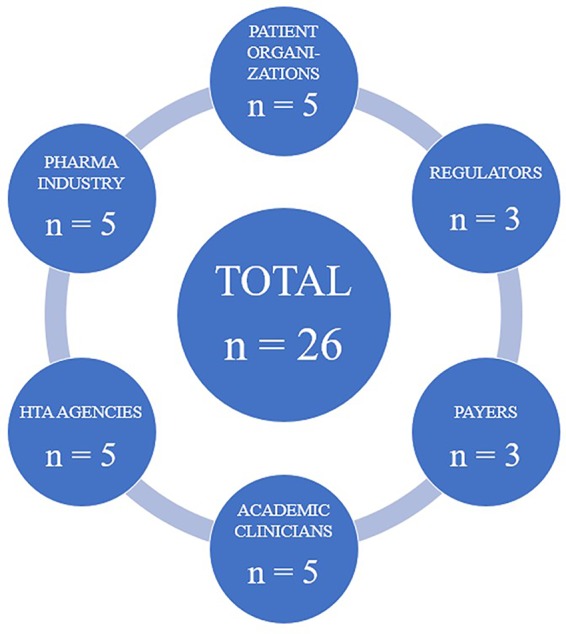
Semi-structured interviews were conducted between December 2018 and May 2019 with 26 participants across ten EU Member States and six different stakeholder groups, including academic clinicians as well as representatives of patient organizations, regulatory authorities, health technology assessment agencies, payers, and industry.
Based on the input of the experts interviewed, clarification was obtained regarding the optimal features of treatment optimization studies in terms of their conduct, funding, timing, design, and setting. Moreover, a number of opportunities and challenges of undertaking such trials were identified. Inter-stakeholder discussion during their design was seen as desirable. There was also broad support among the participants for regulatory measures to facilitate treatment optimization, although there was no agreement on the optimal scale and nature of these initiatives. Furthermore, the interviewees believed that the evidence strength of well-designed treatment optimization studies performed according to rigorous quality standards is greater than or at least equal to that of classical clinical trials. In addition, there was a strong consensus that the results of treatment optimization studies should be taken into account during the decision-making of regulators, payers, and/or clinicians.
Stakeholders involved in drug development consider treatment optimization studies to be valuable tools to address current evidence gaps and support their implementation into the existing research framework.
当前的药物研发模式因过于以药物为中心,且未充分关注最终将接受其研发的治疗干预措施的患者而受到批评。当前框架的药物驱动性质导致抗癌药物的批准前研发与其在实际临床实践中的注册后使用之间出现了研究差距。通过向以患者为中心的模式转变,有可能弥合这一差距,该模式高度重视治疗优化,力求优化卫生技术在现实世界环境中的应用方式。然而,关于治疗优化研究的理想特征及其在关键利益相关者中的可接受性,仍存在问题。
本研究旨在探讨药物研发过程中关键利益相关者对治疗优化概念的看法。
2018年12月至2019年5月,对来自十个欧盟成员国的26名参与者和六个不同利益相关者群体进行了半结构化访谈,这些群体包括学术临床医生以及患者组织、监管机构、卫生技术评估机构、支付方和行业的代表。
根据受访专家的意见,在治疗优化研究的开展、资金、时间、设计和环境等方面的最佳特征得到了明确。此外,还确定了开展此类试验的一些机遇和挑战。在其设计过程中的利益相关者间讨论被认为是可取的。参与者们也广泛支持促进治疗优化的监管措施,尽管对于这些举措的最佳规模和性质没有达成一致。此外,受访者认为,按照严格质量标准进行的精心设计的治疗优化研究的证据强度大于或至少等同于经典临床试验。此外,强烈共识是,监管机构、支付方和/或临床医生在决策过程中应考虑治疗优化研究的结果。
参与药物研发的利益相关者认为治疗优化研究是解决当前证据差距并支持将其纳入现有研究框架的宝贵工具。