Vogel Olivia A, Manicassamy Balaji
Department of Microbiology, The University of Chicago, Chicago, IL, United States.
Department of Microbiology and Immunology, The University of Iowa, Iowa City, IA, United States.
Front Microbiol. 2020 Feb 7;11:135. doi: 10.3389/fmicb.2020.00135. eCollection 2020.
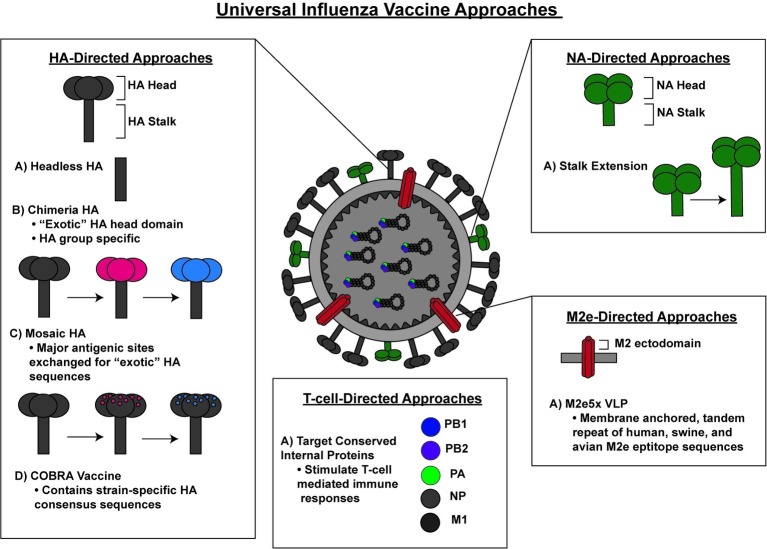
Influenza virus is a respiratory pathogen that can cause disease in humans, with symptoms ranging from mild to life-threatening. The vast majority of influenza virus infections in humans are observed during seasonal epidemics and occasional pandemics. Given the substantial public health burden associated with influenza virus infection, yearly vaccination is recommended for protection against seasonal influenza viruses. Despite vigilant surveillance for new variants and careful selection of seasonal vaccine strains, the efficacy of seasonal vaccines can vary widely from year to year. This often results in lowered protection within the population, regardless of vaccination status. In order to broaden the protection afforded by seasonal influenza vaccines, the National Institute of Allergy and Infectious Diseases (NIAID) has deemed the development of a universal influenza virus vaccine to be a priority in influenza virus vaccine research. This universal vaccine would provide protection against all influenza virus strains, eliminating the need for the yearly reformulations of seasonal influenza vaccines. In addition to universal influenza vaccine efforts, substantial progress has been made in developing novel influenza virus therapeutics that utilize broadly neutralizing antibodies to provide protection against influenza virus infection and to mitigate disease outcomes during infection. In this review, we discuss various approaches toward the goal of improving influenza virus vaccine efficacy through a universal influenza virus vaccine. We also address the novel methods of discovery and utilization of broadly neutralizing antibodies to improve influenza disease outcomes.
流感病毒是一种呼吸道病原体,可导致人类患病,症状从轻微到危及生命不等。人类中绝大多数流感病毒感染发生在季节性流行和偶尔的大流行期间。鉴于流感病毒感染带来的巨大公共卫生负担,建议每年接种疫苗以预防季节性流感病毒。尽管对新变种进行了密切监测,并仔细挑选季节性疫苗毒株,但季节性疫苗的效力每年可能会有很大差异。这通常会导致人群中的保护作用降低,无论疫苗接种状况如何。为了扩大季节性流感疫苗提供的保护范围,美国国立过敏与传染病研究所(NIAID)已将开发通用流感病毒疫苗视为流感病毒疫苗研究的优先事项。这种通用疫苗将提供针对所有流感病毒毒株的保护,无需每年重新配制季节性流感疫苗。除了通用流感疫苗的研发工作外,在开发新型流感病毒治疗方法方面也取得了重大进展,这些方法利用广泛中和抗体来预防流感病毒感染并减轻感染期间的疾病后果。在本综述中,我们讨论了通过通用流感病毒疫苗提高流感病毒疫苗效力这一目标的各种方法。我们还探讨了发现和利用广泛中和抗体以改善流感疾病结局的新方法。