Chilambi Gayatri Shankar, Hinks Jamie, Matysik Artur, Zhu Xinyi, Choo Pei Yi, Liu Xianghui, Chan-Park Mary B, Bazan Guillermo C, Kline Kimberly A, Rice Scott A
Interdisciplinary Graduate School, Nanyang Technological University, Singapore, Singapore.
Singapore Centre for Environmental Life Sciences Engineering, Nanyang Technological University, Singapore, Singapore.
Front Microbiol. 2020 Feb 14;11:155. doi: 10.3389/fmicb.2020.00155. eCollection 2020.
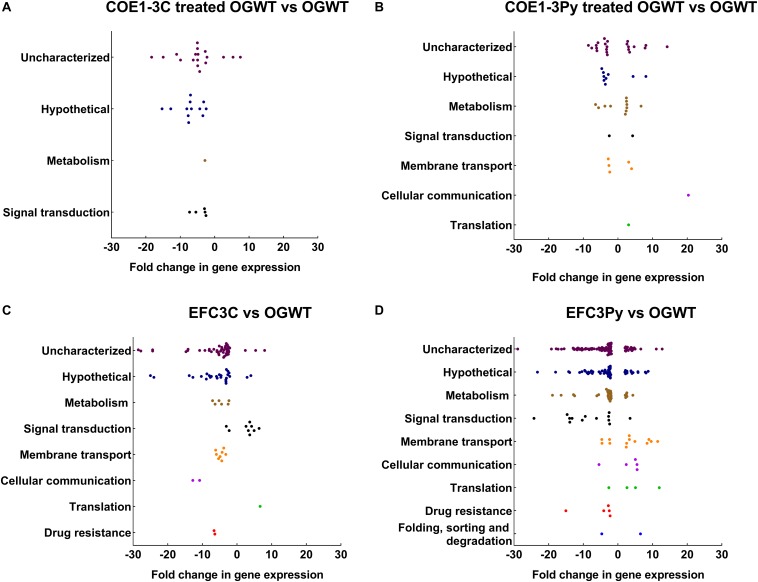
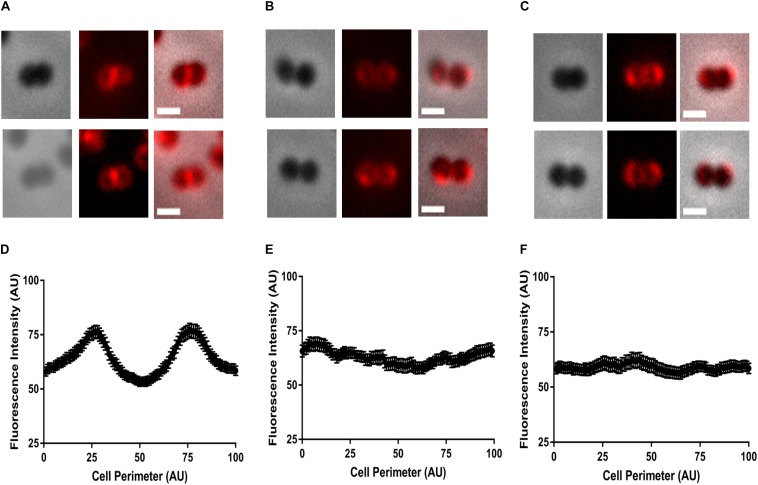
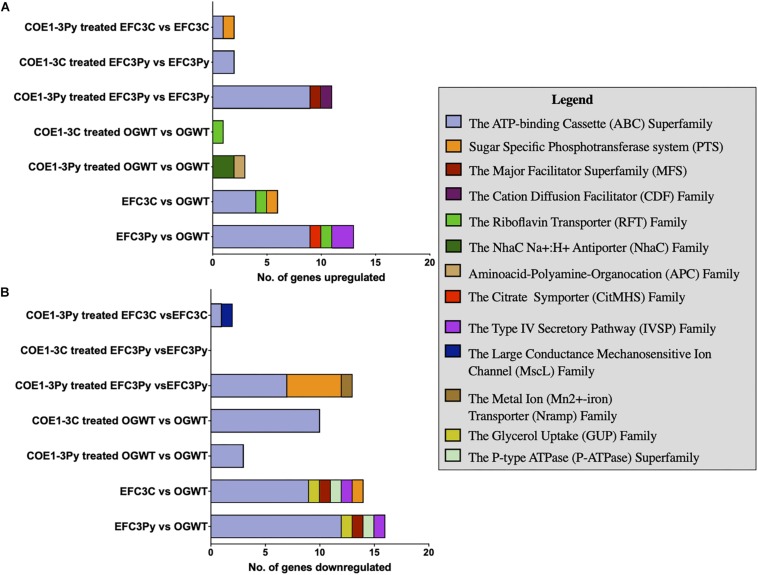
Conjugated oligoelectrolytes (COEs) are emerging antimicrobials with broad spectrum activity against Gram positive and Gram negative bacteria as well as fungi. Our previous evolution studies using grown in the presence of two related COEs (COE1-3C and COE1-3Py) led to the emergence of mutants (changes in and ) with a moderate 4- to16-fold increased resistance to COEs. The contribution of and mutations to COE resistance was confirmed by complementation of the mutants, which restored sensitivity to COEs. To better understand the cellular target of COEs, and the mechanism of resistance to COEs, transcriptional changes associated with resistance in the evolved mutants were investigated in this study. The differentially transcribed genes encoded membrane transporters, in addition to proteins associated with cell envelope synthesis and stress responses. Genes encoding membrane transport proteins from the ATP binding cassette superfamily were the most significantly induced or repressed in COE tolerant mutants compared to the wild type when exposed to COEs. Additionally, differences in the membrane localization of a lipophilic dye in exposed to COEs suggested that resistance was associated with lipid rearrangement in the cell membrane. The membrane adaptation to COEs in EFC3C and EFC3Py resulted in an improved tolerance to bile salt and sodium chloride stress. Overall, this study showed that bacterial cell membranes are the primary target of COEs and that adapts to membrane interacting COE molecules by both lipid rearrangement and changes in membrane transporter activity. The level of resistance to COEs suggests that does not have a specific response pathway to elicit resistance against these molecules and this is supported by the rather broad and diverse suite of genes that are induced upon COE exposure as well as cross-resistance to membrane perturbing stressors.
共轭寡电解质(COEs)是一种新兴的抗菌剂,对革兰氏阳性菌、革兰氏阴性菌以及真菌具有广谱活性。我们之前在两种相关的COEs(COE1 - 3C和COE1 - 3Py)存在的情况下进行的进化研究导致了突变体( 和 发生变化)的出现,这些突变体对COEs的抗性适度增加了4至16倍。通过对突变体的互补实验证实了 和 突变对COE抗性的贡献,互补实验恢复了对COEs的敏感性。为了更好地理解COEs的细胞靶点以及对COEs的抗性机制,本研究调查了进化突变体中与抗性相关的转录变化。差异转录的基因除了编码与细胞壁合成和应激反应相关的蛋白质外,还编码膜转运蛋白。与野生型相比,当暴露于COEs时,来自ATP结合盒超家族的编码膜转运蛋白的基因在COE耐受突变体中诱导或抑制最为显著。此外,暴露于COEs的 中亲脂性染料膜定位的差异表明,抗性与细胞膜中的脂质重排有关。EFC3C和EFC3Py中对COEs的膜适应性导致对胆盐和氯化钠应激的耐受性提高。总体而言,本研究表明细菌细胞膜是COEs的主要靶点,并且 通过脂质重排和膜转运蛋白活性的变化来适应与膜相互作用的COE分子。对COEs的抗性水平表明, 没有特定的反应途径来引发对这些分子的抗性,这得到了COE暴露时诱导的相当广泛和多样的基因套件以及对膜扰动应激源的交叉抗性的支持。