Immunology Unit, Department of Chemistry and Biotechnology, Tallinn University of Technology, Tallinn, Estonia.
Department of Chemistry and Biotechnology, Tallinn University of Technology, Tallinn, Estonia.
Front Immunol. 2020 Feb 6;11:113. doi: 10.3389/fimmu.2020.00113. eCollection 2020.
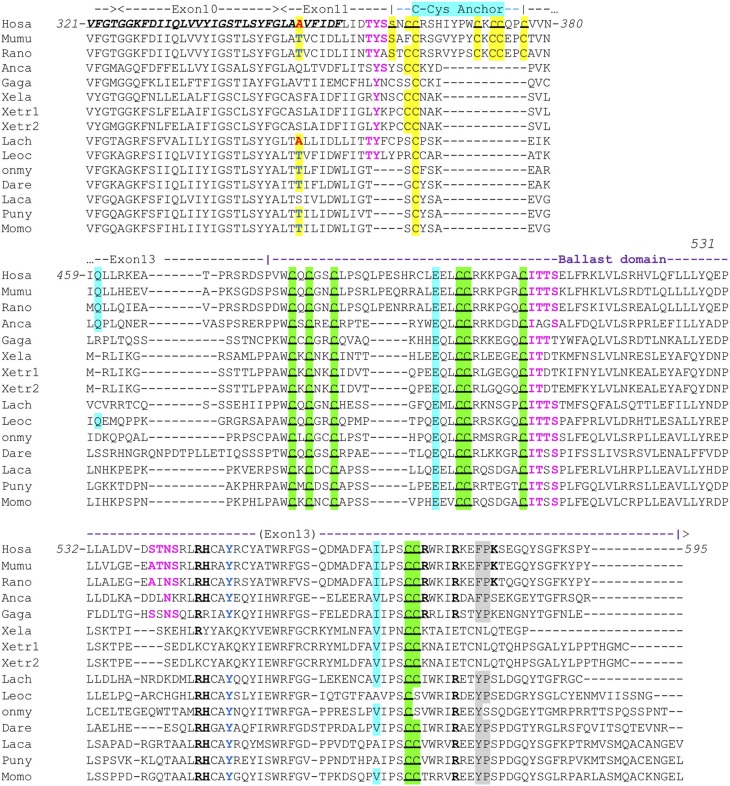
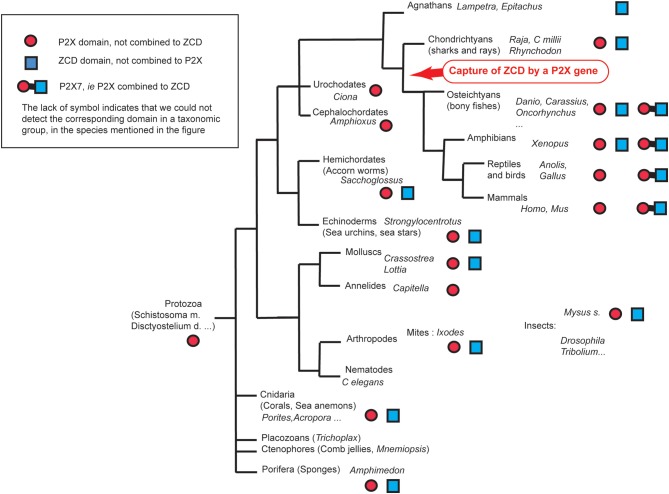
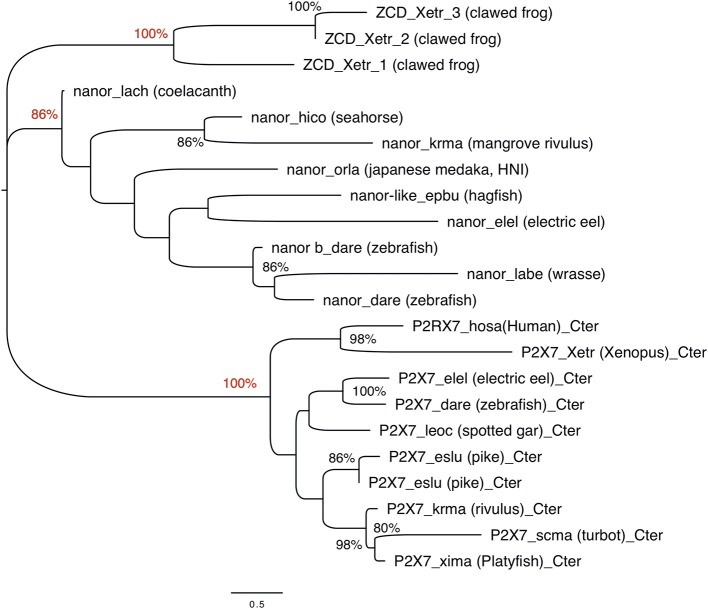
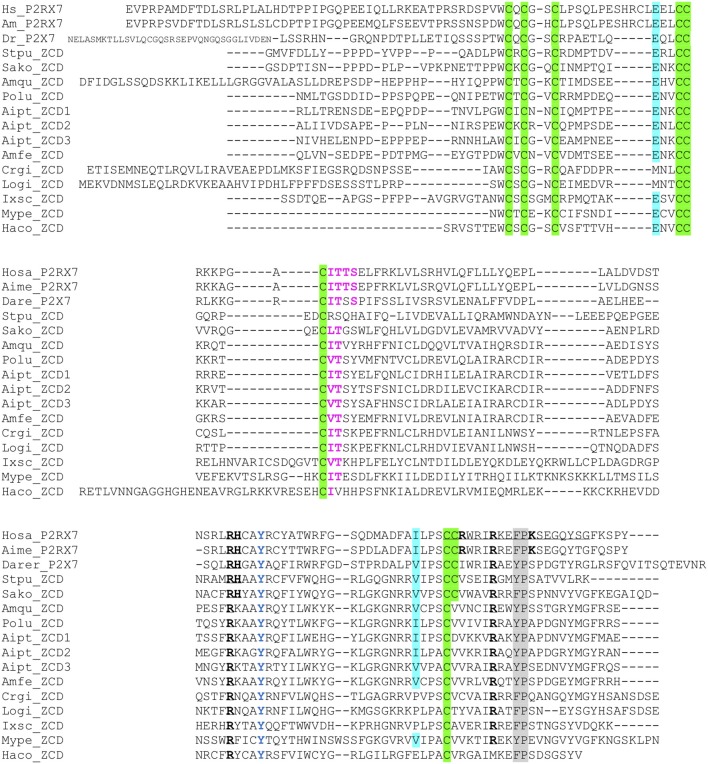
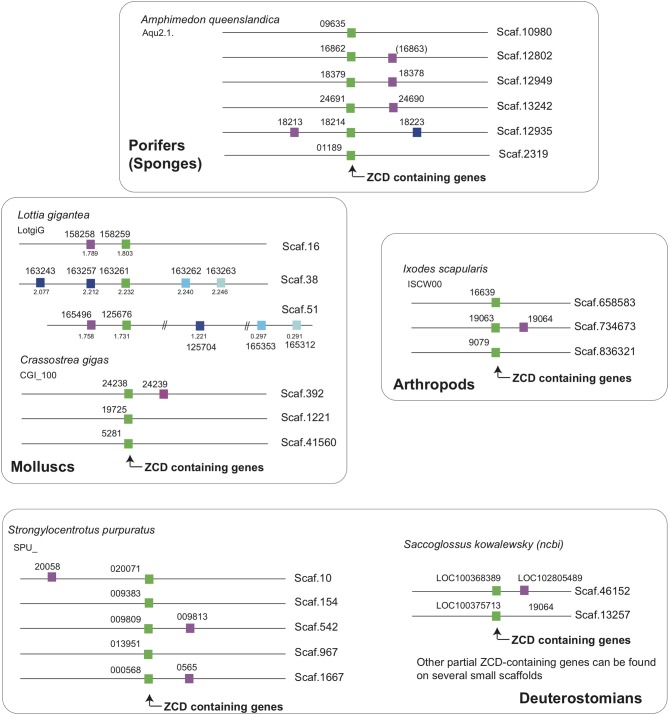
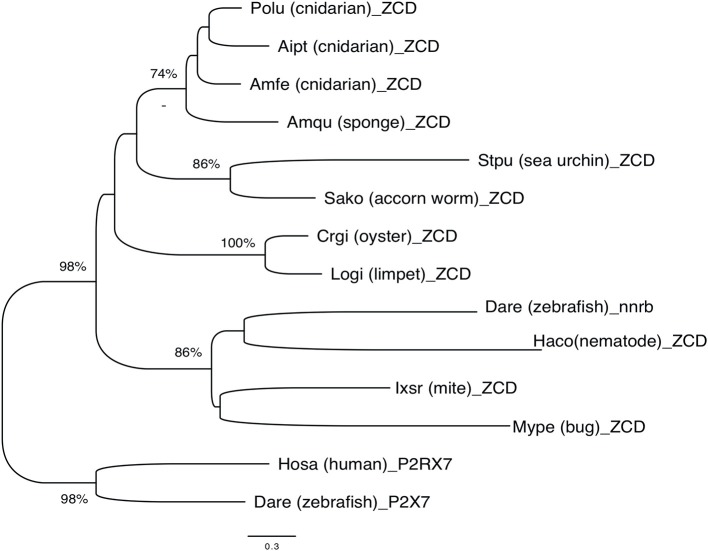
P2X purinergic receptors are extracellular ATP-gated ion channel receptors present on the cell plasma membrane. P2X receptors have been found in Metazoa, fungi, amoebas, and in plants. In mammals, P2X7 is expressed by a large number of cell types and is involved in inflammation and immunity. Remarkably, P2X7 does not desensitize as other P2X do, a feature linked to a "C-cysteine anchor" intra-cytoplasmic motif encoded by exon 11. Another specific feature of P2X7 is its C-terminal cytoplasmic ballast domain (exon 13) which contains a zinc (Zn) coordinating cysteine motif and a GDP-binding region. To determine the origin of P2X7, we analyzed and compared sequences and protein motifs of the C-terminal intra-cytoplasmic region across all main groups of Metazoa. We identified proteins with typical ballast domains, sharing a remarkably conserved Zn-coordinating cysteine motif. Apart from vertebrates, these ballast domains were not associated with a typical P2X architecture. These results strongly suggest that P2X7 resulted from the fusion of a P2X gene, highly similar to P2X4, with an exon encoding a ballast domain. Our work brings new evidence on the origin of the P2X7 purinergic receptor and identifies the Zn-coordinating cysteine domain as the fundamental feature of the ancient ballast fold.
P2X 嘌呤能受体是位于细胞质膜上的细胞外 ATP 门控离子通道受体。P2X 受体已在后生动物、真菌、变形虫和植物中发现。在哺乳动物中,大量细胞类型表达 P2X7,参与炎症和免疫。值得注意的是,P2X7 不像其他 P2X 那样脱敏,这一特征与由外显子 11 编码的“C-半胱氨酸锚”细胞内基序有关。P2X7 的另一个特有特征是其 C 端细胞质压舱物域(外显子 13),其中包含一个锌(Zn)配位半胱氨酸基序和一个 GDP 结合区域。为了确定 P2X7 的起源,我们分析并比较了后生动物所有主要类群中跨膜内 C 末端区域的序列和蛋白基序。我们确定了具有典型压舱物域的蛋白,这些蛋白共享一个非常保守的 Zn 配位半胱氨酸基序。除了脊椎动物外,这些压舱物域与典型的 P2X 结构没有关联。这些结果强烈表明 P2X7 是由与 P2X4 高度相似的 P2X 基因与编码压舱物域的外显子融合产生的。我们的工作为 P2X7 嘌呤能受体的起源提供了新的证据,并将 Zn 配位半胱氨酸基序确定为古老压舱物折叠的基本特征。