Stefanova Eva E, Scott Angela L
Department of Pathology and Molecular Medicine, McMaster University, Hamilton, ON, Canada.
Neural Regen Res. 2022 Nov;17(11):2391-2398. doi: 10.4103/1673-5374.338993.
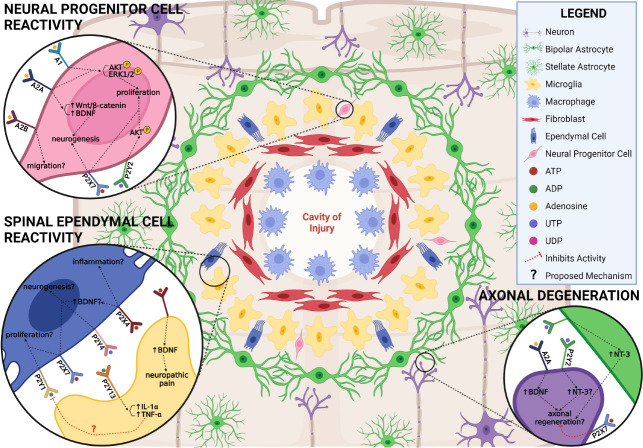
Within the last several decades, the scientific community has made substantial progress in elucidating the complex pathophysiology underlying spinal cord injury. However, despite the many advances using conventional mammalian models, both cellular and axonal regeneration following spinal cord injury have remained out of reach. In this sense, turning to non-mammalian, regenerative species presents a unique opportunity to identify pro-regenerative cues and characterize a spinal cord microenvironment permissive to re-growth. Among the signaling pathways hypothesized to be dysregulated during spinal cord injury is the purinergic signaling system. In addition to its well-known role as energy currency in cells, ATP and its metabolites are small molecule neurotransmitters that mediate many diverse cellular processes within the central nervous system. While our understanding of the roles of the purinergic system following spinal cord injury is limited, this signaling pathway has been implicated in all injury-induced secondary processes, including cellular death, inflammation, reactive gliosis, and neural regeneration. Given that the purinergic system is also evolutionarily conserved between mammalian and non-mammalian species, comparisons of these roles may provide important insights into conditions responsible for recovery success. Here, we compare the secondary processes between key model species and the influence of purinergic signaling in each context. As our understanding of this signaling system and pro-regenerative conditions continues to evolve, so does the potential for the development of novel therapeutic interventions for spinal cord injury.
在过去几十年里,科学界在阐明脊髓损伤背后复杂的病理生理学方面取得了重大进展。然而,尽管使用传统哺乳动物模型取得了许多进展,但脊髓损伤后的细胞再生和轴突再生仍然难以实现。从这个意义上说,转向非哺乳动物的再生物种提供了一个独特的机会,以识别促进再生的线索,并描绘出有利于再生的脊髓微环境。在脊髓损伤期间被假设失调的信号通路中,嘌呤能信号系统是其中之一。除了其在细胞中作为能量货币的众所周知的作用外,ATP及其代谢产物还是小分子神经递质,介导中枢神经系统内许多不同的细胞过程。虽然我们对脊髓损伤后嘌呤能系统作用的理解有限,但这条信号通路已涉及所有损伤诱导的继发过程,包括细胞死亡、炎症、反应性胶质增生和神经再生。鉴于嘌呤能系统在哺乳动物和非哺乳动物物种之间也是进化保守的,比较这些作用可能为导致恢复成功的条件提供重要见解。在这里,我们比较了关键模型物种之间的继发过程以及嘌呤能信号在每种情况下的影响。随着我们对这个信号系统和促进再生条件的理解不断发展,脊髓损伤新型治疗干预措施的开发潜力也在不断发展。