Yang Xiaonan, Kui Ling, Tang Min, Li Dawei, Wei Kunhua, Chen Wei, Miao Jianhua, Dong Yang
Guangxi Key Laboratory of Medicinal Resources Protection and Genetic Improvement, Guangxi Botanical Garden of Medicinal Plants, Nanning, China.
Dana-Farber Cancer Institute, Harvard Medical School, Brookline, MA, United States.
Front Genet. 2020 Feb 5;11:19. doi: 10.3389/fgene.2020.00019. eCollection 2020.
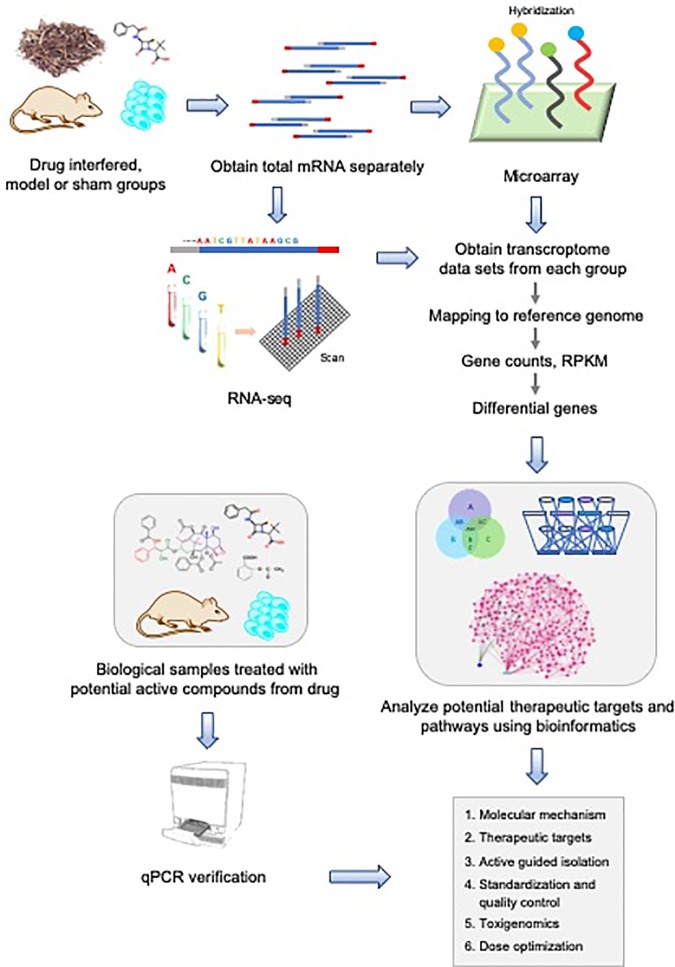
The development of new drugs is multidisciplinary and systematic work. High-throughput techniques based on "-omics" have driven the discovery of biomarkers in diseases and therapeutic targets of drugs. A transcriptome is the complete set of all RNAs transcribed by certain tissues or cells at a specific stage of development or physiological condition. Transcriptome research can demonstrate gene functions and structures from the whole level and reveal the molecular mechanism of specific biological processes in diseases. Currently, gene expression microarray and high-throughput RNA-sequencing have been widely used in biological, medical, clinical, and drug research. The former has been applied in drug screening and biomarker detection of drugs due to its high throughput, fast detection speed, simple analysis, and relatively low price. With the further development of detection technology and the improvement of analytical methods, the detection flux of RNA-seq is much higher but the price is lower, hence it has powerful advantages in detecting biomarkers and drug discovery. Compared with the traditional RNA-seq, scRNA-seq has higher accuracy and efficiency, especially the single-cell level of gene expression pattern analysis can provide more information for drug and biomarker discovery. Therefore, (sc)RNA-seq has broader application prospects, especially in the field of drug discovery. In this overview, we will review the application of these technologies in drug, especially in natural drug and biomarker discovery and development. Emerging applications of scRNA-seq and the third generation RNA-sequencing tools are also discussed.
新药研发是一项多学科的系统性工作。基于“组学”的高通量技术推动了疾病生物标志物的发现以及药物治疗靶点的确定。转录组是指在特定发育阶段或生理状态下,由某些组织或细胞转录的所有RNA的完整集合。转录组研究能够从整体层面展示基因的功能和结构,并揭示疾病中特定生物学过程的分子机制。目前,基因表达微阵列和高通量RNA测序已广泛应用于生物学、医学、临床及药物研究领域。前者因其高通量、检测速度快、分析简单且价格相对低廉,已应用于药物筛选和药物生物标志物检测。随着检测技术的进一步发展和分析方法的改进,RNA测序的检测通量更高但价格更低,因此在生物标志物检测和药物研发方面具有强大优势。与传统RNA测序相比,单细胞RNA测序具有更高的准确性和效率,尤其是对单细胞水平基因表达模式的分析能够为药物和生物标志物的发现提供更多信息。因此,(单)细胞RNA测序具有更广阔的应用前景,尤其是在药物研发领域。在本综述中,我们将回顾这些技术在药物研发中的应用,特别是在天然药物以及生物标志物发现与开发方面的应用。同时还将讨论单细胞RNA测序和第三代RNA测序工具的新兴应用。