Vikhe Pratik P, Tateossian Hilda, Bharj Gurpreet, Brown Steve D M, Hood Derek W
Mammalian Genetics Unit, MRC Harwell Institute, Oxfordshire, United Kingdom.
Front Genet. 2020 Feb 11;11:50. doi: 10.3389/fgene.2020.00050. eCollection 2020.
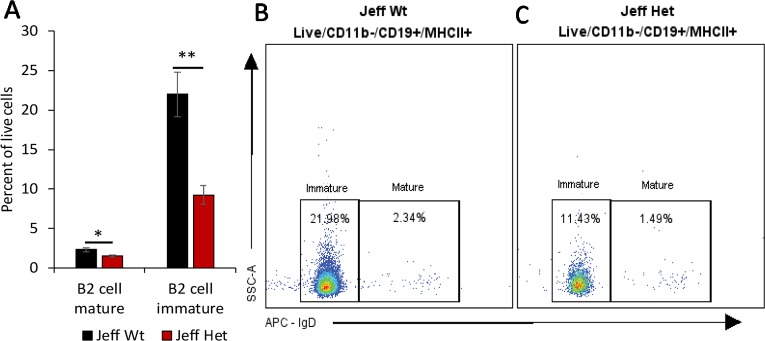
The mouse mutant carries a mutation in the F-box only 11 gene () and heterozygous animals display conductive deafness due to the development of otitis media (OM). The locus is also associated with chronic otitis media with effusion (COME) and recurrent OM in humans. The mutation affects the ability of FBXO11 to stabilize p53 that leads to perturbation in the TGF-beta/Smad2 signaling pathway important in immunity and inflammation. In the current study, we evaluated the effect of the mutation on the immune cell content using multicolor flow cytometry. In blood of heterozygotes, we observed a significant increase in the number of NK, dendritic (CD11b+), neutrophils, and natural killer T (NKT) cells and a significant decrease in effector T-helper and B-lymphocytes compared to wild-type controls. The percentage of NK cells significantly decreased in the lungs of heterozygotes, with a concomitant reduction in B-lymphocytes and T-cytotoxic cells. In the spleen, heterozygotes displayed a significant decrease in mature B-lymphocytes, effector T-helper, and naïve T-cytotoxic cells. Neutrophils, dendritic, and NKT cells dominated bulla fluid in heterozygote mice. Similar analysis carried out on heterozygotes, which carry a null allele, showed no difference when compared to wild-type. Cytokine/chemokine analysis revealed a significant increase in the G-CSF, GM-CSF, sTNFRI, TPO, and IL-7 levels in heterozygote serum compared to wild-type. This analysis increases our understanding of the role played by , a gene associated with human OM, in the systemic and localized cellular immune response associated with increased susceptibility to OM.
该小鼠突变体在F-box仅11基因()中携带一个突变,杂合动物因中耳炎(OM)的发展而表现出传导性耳聋。该基因座也与人类的慢性渗出性中耳炎(COME)和复发性OM相关。该突变影响FBXO11稳定p53的能力,这导致在免疫和炎症中重要的TGF-β/Smad2信号通路受到干扰。在当前研究中,我们使用多色流式细胞术评估了该突变对免疫细胞含量的影响。与野生型对照相比,在杂合子的血液中,我们观察到自然杀伤细胞(NK)、树突状细胞(CD11b+)、中性粒细胞和自然杀伤T细胞(NKT)的数量显著增加,而效应性辅助性T细胞和B淋巴细胞显著减少。杂合子小鼠肺部的NK细胞百分比显著降低,同时B淋巴细胞和细胞毒性T细胞减少。在脾脏中,杂合子的成熟B淋巴细胞、效应性辅助性T细胞和幼稚细胞毒性T细胞显著减少。中性粒细胞、树突状细胞和NKT细胞在杂合子小鼠的中耳积液中占主导。对携带无效等位基因的杂合子进行的类似分析显示,与野生型相比没有差异。细胞因子/趋化因子分析显示,与野生型相比,杂合子血清中的G-CSF、GM-CSF、sTNFRI、TPO和IL-7水平显著升高。该分析增加了我们对与人类OM相关的基因在与OM易感性增加相关的全身和局部细胞免疫反应中所起作用的理解。