Mazza Tommaso, Gioffreda Domenica, Fontana Andrea, Biagini Tommaso, Carella Massimo, Palumbo Orazio, Maiello Evaristo, Bazzocchi Francesca, Andriulli Angelo, Tavano Francesca
Laboratory of Bioinformatics, Fondazione IRCCS Casa Sollievo della Sofferenza, Foggia, Italy.
Division of Gastroenterology and Research Laboratory, Fondazione IRCCS Casa Sollievo della, Foggia, Italy.
Front Oncol. 2020 Feb 4;10:44. doi: 10.3389/fonc.2020.00044. eCollection 2020.
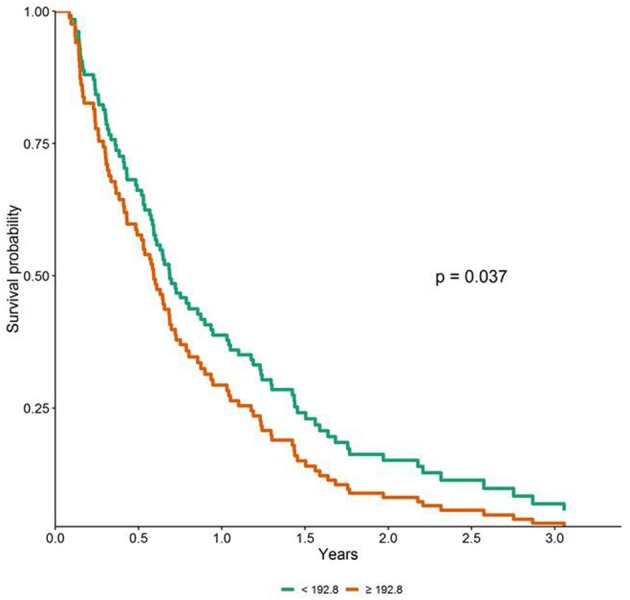
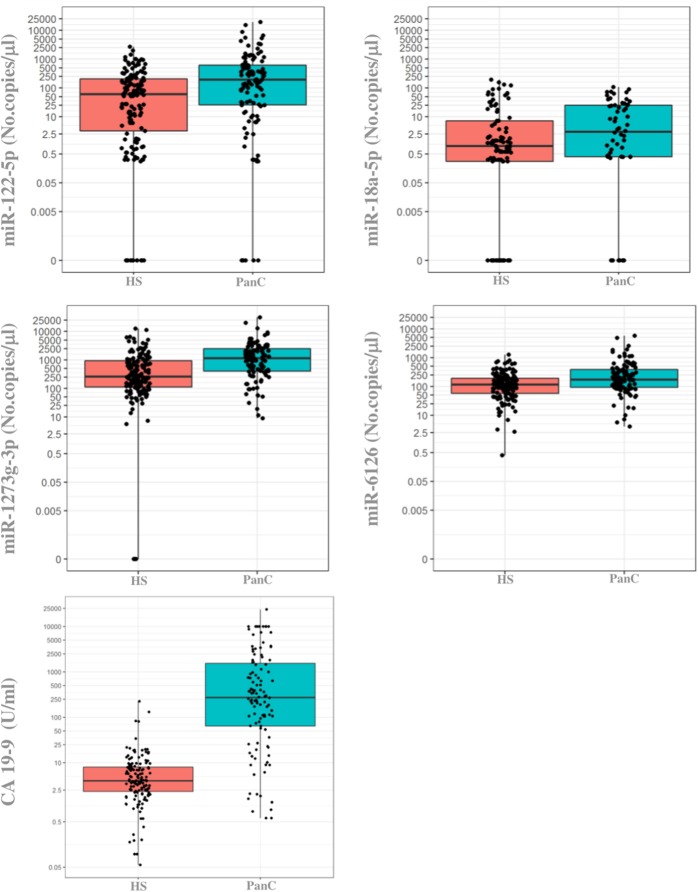
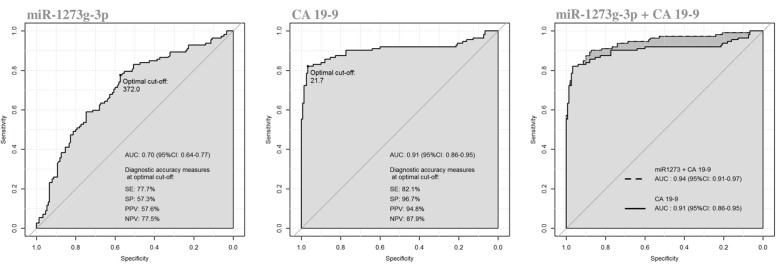
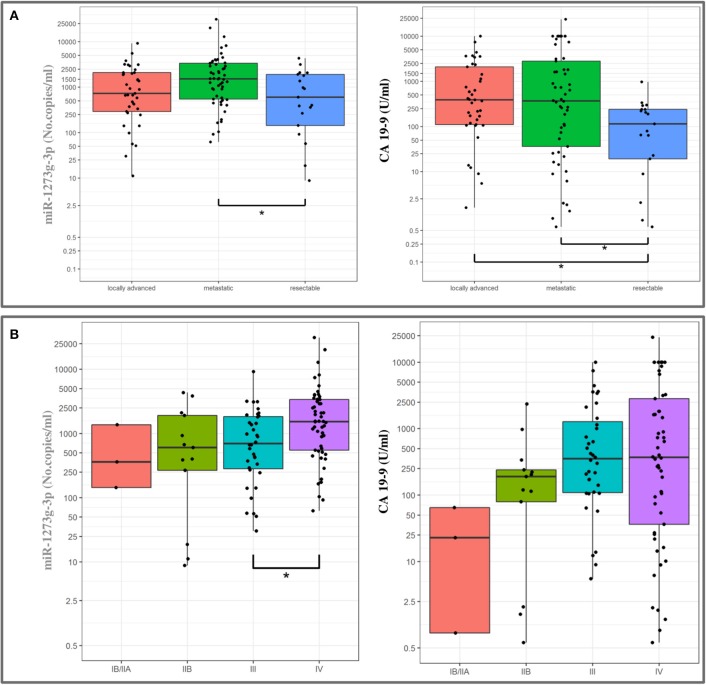
The burden of pancreatic cancer (PanC) requires innovation in the current diagnostic approach. This study aimed to uncover new circulating microRNAs (miRNAs) that would distinguish patients with PanC from healthy subjects (HS) compared with the cancer antigen 19-9 (CA 19-9), and predict patients' clinical phenotypes and outcomes. MiRNA expression profiles in plasma were investigated by using a two-stage process. In a discovery phase, miRNAs levels were analyzed using the GeneChip™ miRNA 4.0 Affymetrix assay in 10 pools of plasma samples from PanC patients and HS; in a validation phase, significantly altered miRNAs were re-tested in independent cohorts of cancer patients and controls by droplet digital PCR (ddPCR). The diagnostic performance of the resulting miRNAs was compared to CA 19-9 determinations, and the associations of miRNAs plasma levels with patients' clinical phenotypes and outcomes were also taken into account. Bioinformatics selection of miRNAs differentially expressed in plasma uncovered miR-18a-5p, miR-122-5p, miR-1273g-3p, and miR-6126 as candidate oncogenic miRNAs in PanC. The ddPCR technology confirmed the significant over-expression of miR-122-5p, miR-1273g-3p, and miR-6126 in PanC compared to HS, in line with the trend of the CA 19-9 levels. Plasma levels of miR-1273g-3p, in combination with CA 19-9, showed higher power in distinguishing PanC patients from HS compared to the CA 19-9 tested alone, with a gain in both sensitivity and negative predictive value indicating a low false-negative rate (SE = 90.2% and NPV = 92.3% vs. SE = 82.1% and NPV = 87.9%). None of the oncogenic miRNAs were able to distinguish between a neoplastic and a proliferative/inflammatory disease of the pancreas, and were not able to stratify subjects according to the clinical risk for the disease. The only valuable association in PanC patients was found between miR-1273g-3p and tumor stage, and increased miR-122-5p levels emerged as independent negative prognostic factor for PanC patients (HR = 1.58, 95% CI = 1.03-2.43, = 0.037). Our data highlighted a role for circulating miR-1273g-3p and miR-122-5p as new diagnostic and prognostic biomarkers for PanC.
胰腺癌(PanC)的负担要求当前的诊断方法有所创新。本研究旨在发现新的循环微RNA(miRNA),与癌抗原19-9(CA 19-9)相比,这些miRNA能够区分胰腺癌患者与健康受试者(HS),并预测患者的临床表型和预后。通过两阶段过程研究血浆中的miRNA表达谱。在发现阶段,使用基因芯片™miRNA 4.0 Affymetrix检测法分析来自胰腺癌患者和HS的10组血浆样本中的miRNA水平;在验证阶段,通过液滴数字PCR(ddPCR)在癌症患者和对照的独立队列中对显著改变的miRNA进行重新检测。将所得miRNA的诊断性能与CA 19-9测定结果进行比较,并考虑miRNA血浆水平与患者临床表型和预后的关联。对血浆中差异表达的miRNA进行生物信息学筛选,发现miR-18a-5p、miR-122-5p、miR-1273g-3p和miR-6126是胰腺癌中候选的致癌miRNA。ddPCR技术证实,与HS相比,miR-122-5p、miR-1273g-3p和miR-6126在胰腺癌中显著过表达,与CA 19-9水平的趋势一致。与单独检测CA 19-9相比,miR-1273g-3p的血浆水平与CA 19-9联合使用时,在区分胰腺癌患者与HS方面表现出更高的效能,敏感性和阴性预测值均有所提高,表明假阴性率较低(SE = 90.2%,NPV = 92.3%,而单独检测CA 19-9时SE = 82.1%,NPV = 87.9%)。没有一种致癌miRNA能够区分胰腺的肿瘤性疾病与增殖性/炎性疾病,也无法根据疾病的临床风险对受试者进行分层。在胰腺癌患者中,仅发现miR-1273g-3p与肿瘤分期之间存在有价值的关联,而miR-122-5p水平升高是胰腺癌患者独立的不良预后因素(HR = 1.58,95%CI = 1.03 - 2.43,P = 0.037)。我们的数据突出了循环miR-1273g-3p和miR-122-5p作为胰腺癌新的诊断和预后生物标志物的作用。