Lee Jin-Young, Park Sung-Hyun, Oh So-Hyung, Lee Jin-Ju, Kwon Kil Koang, Kim Su-Jin, Choi Minjeong, Rha Eugene, Lee Hyewon, Lee Dae-Hee, Sung Bong Hyun, Yeom Soo-Jin, Lee Seung-Goo
Synthetic Biology and Bioengineering Research Center, Korea Research Institute of Bioscience and Biotechnology, Daejeon, South Korea.
Department of Biosystems and Bioengineering, KRIBB School of Biotechnology, University of Science and Technology, Daejeon, South Korea.
Front Bioeng Biotechnol. 2020 Feb 14;8:67. doi: 10.3389/fbioe.2020.00067. eCollection 2020.
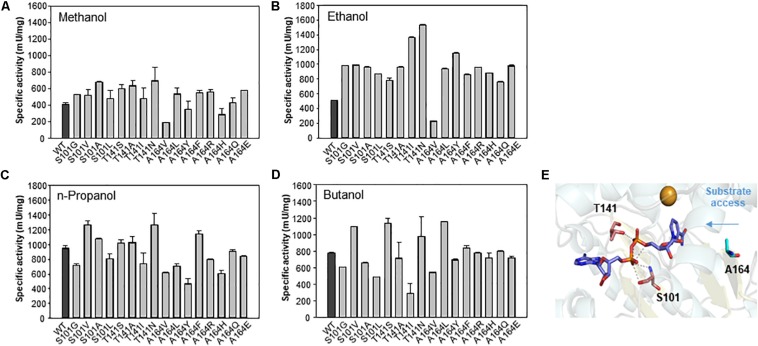
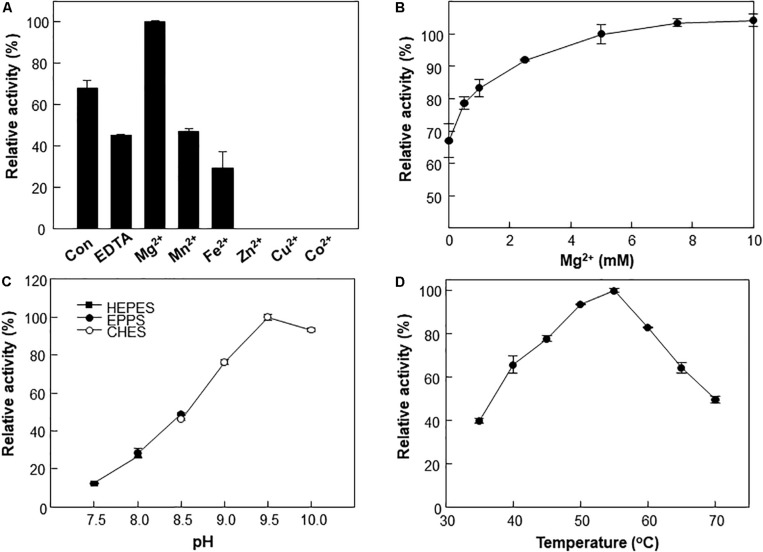
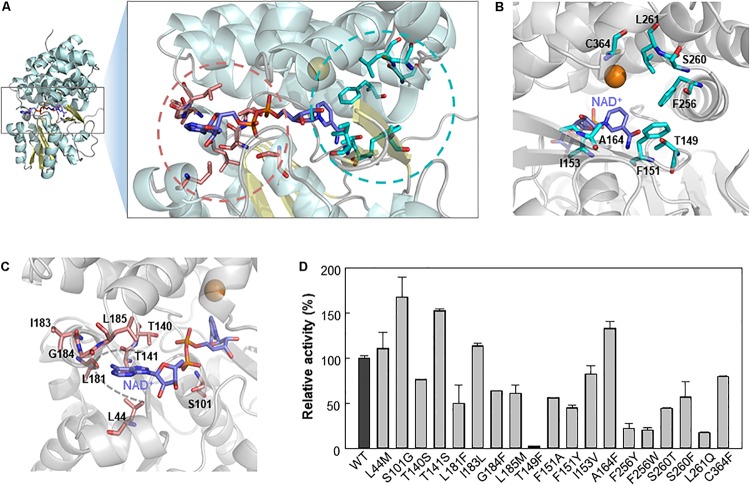
Bioconversion of C1 chemicals such as methane and methanol into higher carbon-chain chemicals has been widely studied. Methanol oxidation catalyzed by methanol dehydrogenase (Mdh) is one of the key steps in methanol utilization in bacterial methylotrophy. In bacteria, few NAD-dependent Mdhs have been reported that convert methanol to formaldehyde. In this study, an uncharacterized Mdh gene from (Lxmdh) was cloned and expressed in . The maximum alcohol oxidation activity of the recombinant enzyme was observed at pH 9.5 and 55°C in the presence of 10 mM Mg. To improve oxidation activity, rational approach-based, site-directed mutagenesis of 16 residues in the putative active site and NAD-binding region was performed. The mutations S101V, T141S, and A164F improved the enzyme's specific activity toward methanol compared to that of the wild-type enzyme. These mutants show a slightly higher turnover rate than that of wild-type, although their values were increased compared to that of wild-type. Consequently, according the kinetic results, S101, T141, and A164 positions may related to the catalytic activity in the active site for methanol dehydrogenation. It should be further studied other mutant variants with high activity for methanol. In conclusion, we characterized a new Lxmdh and its variants that may be potentially useful for the development of synthetic methylotrophy in the future.
将甲烷和甲醇等C1化学物质生物转化为更高碳链的化学物质已得到广泛研究。甲醇脱氢酶(Mdh)催化的甲醇氧化是细菌甲基营养中甲醇利用的关键步骤之一。在细菌中,很少有将甲醇转化为甲醛的依赖NAD的Mdh被报道。在本研究中,从[具体来源未提及]克隆了一个未表征的Mdh基因(Lxmdh)并在[具体宿主未提及]中表达。在10 mM Mg存在的情况下,重组酶在pH 9.5和55°C时观察到最大醇氧化活性。为了提高氧化活性,对假定活性位点和NAD结合区域中的16个残基进行了基于理性方法的定点诱变。与野生型酶相比,突变体S101V、T141S和A164F提高了酶对甲醇的比活性。这些突变体的周转速率比野生型略高,尽管它们的Km值与野生型相比有所增加。因此,根据动力学结果,S101、T141和A164位点可能与甲醇脱氢活性位点的催化活性有关。对于甲醇具有高活性的其他突变变体应进一步研究。总之,我们表征了一种新的Lxmdh及其变体,它们可能在未来合成甲基营养的发展中具有潜在用途。