Garcia-Barcena Cristina, Osinalde Nerea, Ramirez Juanma, Mayor Ugo
Department of Biochemistry and Molecular Biology, Faculty of Science and Technology, University of the Basque Country (UPV/EHU), Leioa, Spain.
Department of Biochemistry and Molecular Biology, Faculty of Pharmacy, University of the Basque Country (UPV/EHU), Vitoria-Gasteiz, Spain.
Front Cell Dev Biol. 2020 Feb 4;8:39. doi: 10.3389/fcell.2020.00039. eCollection 2020.
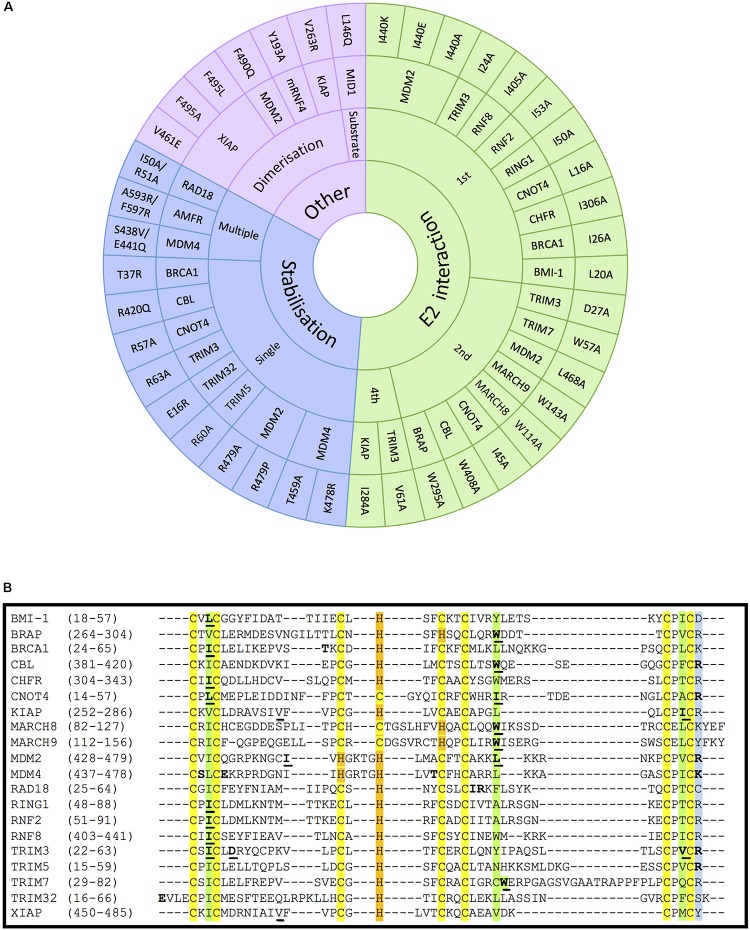
E3 ubiquitin ligases are the ultimate enzymes involved in the transfer of ubiquitin to substrate proteins, a process that determines the fate of the modified protein. Numerous diseases are caused by defects in the ubiquitin-proteasome machinery, including when the activity of a given E3 ligase is hampered. Thus, inactivation of E3 ligases and the resulting effects at molecular or cellular level have been the focus of many studies during the last few years. For this purpose, site-specific mutation of key residues involved in either protein interaction, substrate recognition or ubiquitin transfer have been reported to successfully inactivate E3 ligases. Nevertheless, it is not always trivial to predict which mutation(s) will block the catalytic activity of a ligase. Here we review over 250 site-specific inactivating mutations that have been carried out in 120 human E3 ubiquitin ligases. We foresee that the information gathered here will be helpful for the design of future experimental strategies.
E3泛素连接酶是参与将泛素转移至底物蛋白的最终酶类,这一过程决定了被修饰蛋白的命运。许多疾病是由泛素-蛋白酶体机制的缺陷引起的,包括当特定E3连接酶的活性受到阻碍时。因此,E3连接酶的失活及其在分子或细胞水平上产生的影响在过去几年一直是许多研究的重点。为此,据报道,对参与蛋白质相互作用、底物识别或泛素转移的关键残基进行位点特异性突变可成功使E3连接酶失活。然而,预测哪种突变会阻断连接酶的催化活性并非总是轻而易举的。在此,我们综述了在120种人类E3泛素连接酶中进行的250多种位点特异性失活突变。我们预计,此处收集的信息将有助于未来实验策略的设计。