Lv Yunyun, Li Yanping, Li Jia, Bian Chao, Qin Chuanjie, Shi Qiong
Key Laboratory of Sichuan Province for Fishes Conservation and Utilization in the Upper Reaches of the Yangtze River, College of Life Sciences, Neijiang Normal University, Neijiang, China.
Shenzhen Key Lab of Marine Genomics, Guangdong Provincial Key Lab of Molecular Breeding in Marine Economic Animals, BGI Academy of Marine Sciences, BGI Marine, BGI, Shenzhen, China.
Front Mol Biosci. 2020 Feb 4;7:11. doi: 10.3389/fmolb.2020.00011. eCollection 2020.
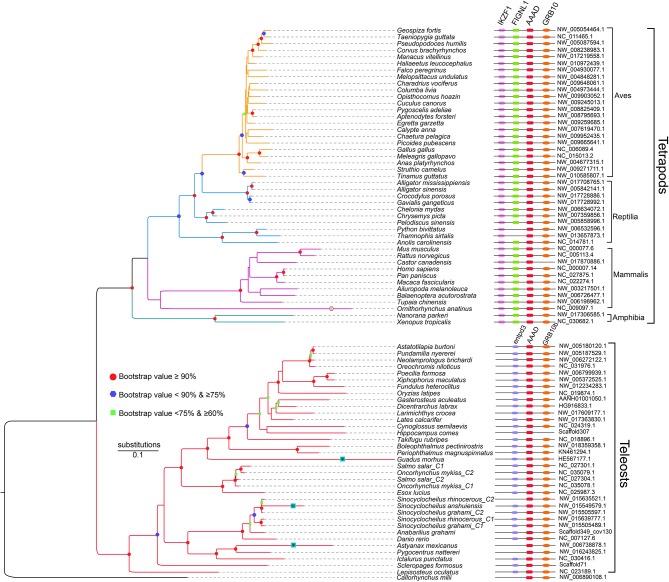
Serotonin is important in vertebrates for its crucial roles in regulation of various physiological functions. Investigations on how the biosynthesizing enzymes mediate serotonin production and conversion during biological processes have been active in the past decades. However, a clear-cut picture of these enzymes in molecular evolution is very limited, particularly when the complexity is imaginable in fishes since teleosts had experienced additional whole genome duplication (WGD) event(s) than tetrapods. Since serotonin is the main intermediate product during melatonin biosynthesis from tryptophan, we therefore summarize an overview of recent discoveries about molecular evolution of the four melatonin biosynthesizing enzymes, especially the L-aromatic amino acid decarboxylase (AAAD) for serotonin production and aralkylamine N-acetyltransferase (AANAT) for serotonin conversion in vertebrates. Novel copies of these genes, possibly due to WGD, were discovered in fishes. Detailed sequence comparisons revealed various variant sites in these newly identified genes, suggesting functional changes from the conventional recognition of these enzymes. These interesting advances will benefit readers to obtain new insights into related genomic differences between mammals and fishes, with an emphasis on the potential specificity for AANAT in naturally cave-restricted and deep-sea fishes.
血清素在脊椎动物中很重要,因为它在调节各种生理功能方面发挥着关键作用。在过去几十年里,关于生物合成酶如何在生物过程中介导血清素的产生和转化的研究一直很活跃。然而,这些酶在分子进化方面的清晰图景非常有限,特别是考虑到硬骨鱼经历了比四足动物更多的全基因组复制(WGD)事件,其复杂性可想而知。由于血清素是色氨酸合成褪黑素过程中的主要中间产物,因此我们总结了关于四种褪黑素生物合成酶分子进化的最新发现概述,特别是用于产生血清素的L-芳香族氨基酸脱羧酶(AAAD)和用于脊椎动物血清素转化的芳烷基胺N-乙酰转移酶(AANAT)。在鱼类中发现了这些基因的新拷贝,可能是由于WGD。详细的序列比较揭示了这些新鉴定基因中的各种变异位点,表明这些酶的功能与传统认知有所不同。这些有趣的进展将有助于读者获得关于哺乳动物和鱼类相关基因组差异的新见解,重点是天然洞穴限制和深海鱼类中AANAT的潜在特异性。