Lubanyana Hlengekile, Arvidsson Per I, Govender Thavendran, Kruger Hendrik G, Naicker Tricia
Catalysis and Peptide Research Unit, University of KwaZulu-Natal, Durban 4000, South Africa.
Science for Life Laboratory, Drug Discovery & Development Platform & Division of Translational Medicine, and Chemical Biology, Department of Medical Biochemistry and Biophysics, Karolinska Institutet, Stockholm 17177, Sweden.
ACS Omega. 2020 Feb 17;5(7):3607-3611. doi: 10.1021/acsomega.9b04037. eCollection 2020 Feb 25.
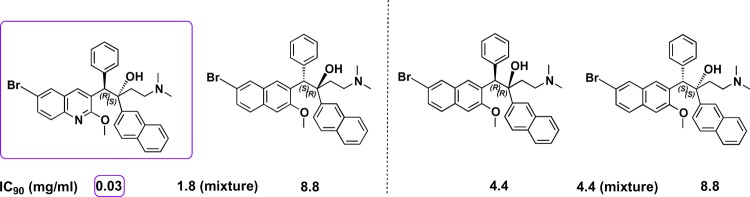
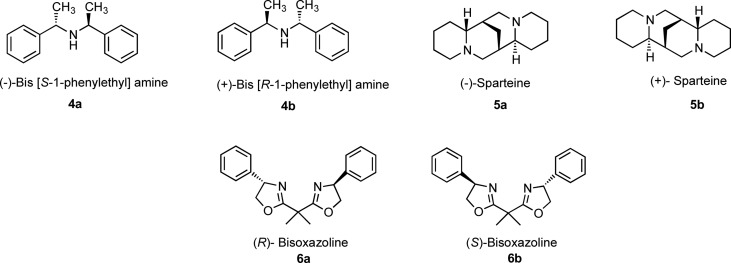
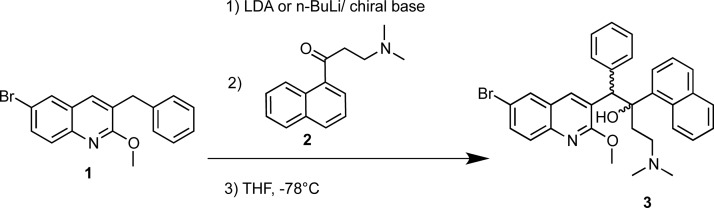
Bedaquiline (BDQ) is the most critical pharmaceutical in the world for treating multidrug-resistant . Despite it being highly effective, BDQ asymmetric synthesis remains a challenge. Herein, the influence of chiral bases, namely, bis(1-phenylethyl)amine, bisoxazoline, and sparteine on the diastereoselective lithiation reaction to obtain BDQ was investigated. The highest diastereoselective ratio (dr) emerged as 90:10 from the (+)-bis[()-1-phenylethyl] lithium amide. This is a significant improvement from the 50:50 dr achieved from the commercial synthesis. Thereafter, the desired (90:10 , ) diastereomeric mixture was easily isolated via a gravity column and subjected to chiral supercritical fluid chromatography (SFC) to access the desired enantiomer (1, 2)-BDQ. The advantages of this procedure are enhanced diastereoselection as well as a greener, faster way to achieve excellent enantioseparation (up to 1.0 g scale).
贝达喹啉(BDQ)是世界上治疗耐多药疾病最重要的药物。尽管它非常有效,但BDQ的不对称合成仍然是一个挑战。在此,研究了手性碱,即双(1-苯乙基)胺、双恶唑啉和鹰爪豆碱对获得BDQ的非对映选择性锂化反应的影响。从(+)-双[()-1-苯乙基]锂酰胺中获得的最高非对映选择性比率(dr)为90:10。这比商业合成中实现的50:50的dr有了显著提高。此后,通过重力柱很容易分离出所需的(90:10,)非对映体混合物,并进行手性超临界流体色谱(SFC)以获得所需的对映体(1,2)-BDQ。该方法的优点是增强了非对映选择性,以及一种更绿色、更快的方法来实现优异的对映体分离(规模可达1.0 g)。