Department of Biomedical Sciences, Neurochemistry and Behaviour, Institute Born-Bunge (IBB), University of Antwerp, Wilrijk, Antwerp, Belgium.
Department of Neurology, Alzheimer Center Groningen, University Medical Center Groningen (UMCG) and University of Groningen, Hanzeplein 1, 9713 GZ, Groningen, The Netherlands.
Neurochem Res. 2020 May;45(5):1191-1201. doi: 10.1007/s11064-020-03002-5. Epub 2020 Mar 4.
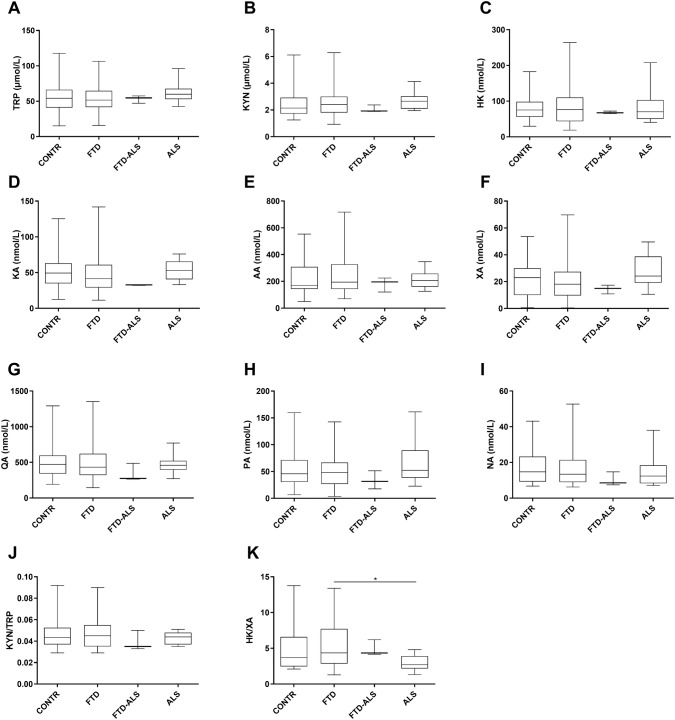
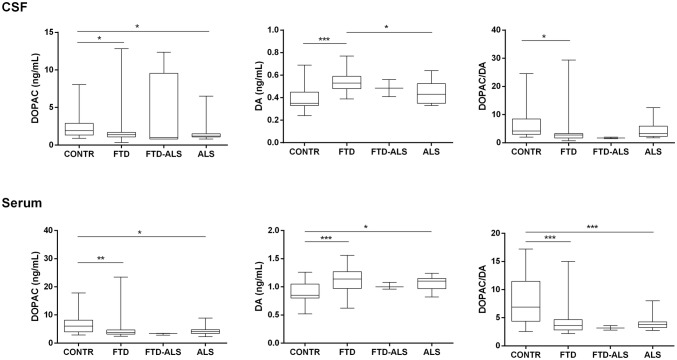
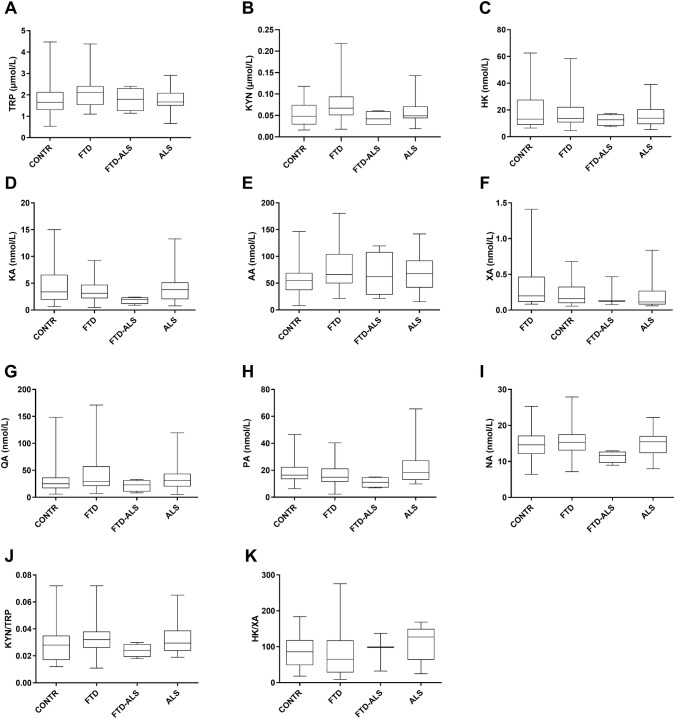
Exploring the neurochemical continuum between frontotemporal dementia (FTD) and amyotrophic lateral sclerosis (ALS) with respect to monoamines and kynurenines in cerebrospinal fluid (CSF) and serum, may be useful to identify possible new research/therapeutic targets. Hence, we analysed monoamines and kynurenines in CSF and serum derived from patients with FTD (n = 39), ALS (n = 23), FTD-ALS (n = 4) and age-matched control subjects (n = 26), using reversed-phase ultra-high performance liquid chromatography (RP-UHPLC) with electrochemical detection (ECD) and liquid chromatography tandem mass spectrometry, respectively. We noted a shared dopaminergic disturbance in FTD and ALS when compared to CONTR, with significantly increased serum DA levels and decreased DOPAC concentrations, as well as decreased DOPAC/DA ratios in both disease groups. In CSF, significantly reduced DOPAC concentrations in FTD and ALS were observed as well. Here, a significant increase in DA levels and decrease in DOPAC/DA ratios was only found in FTD relative to CONTR. With respect to the kynurenine pathway (KP), we only found decreased HK/XA ratios, indicative for vitamin B6 status, in serum of ALS subjects compared to FTD. The dopaminergic commonalities observed in FTD and ALS might relate to a disturbance of dopaminergic nerve terminals in projection areas of the substantia nigra and/or ventral tegmental area, although these findings should first be confirmed in brain tissue. Lastly, based on the results of this work, the KP does not hold promise as a research/therapeutic target in FTD and ALS.
探讨脑脊液 (CSF) 和血清中单胺类和犬尿氨酸类物质在额颞叶痴呆 (FTD) 和肌萎缩侧索硬化症 (ALS) 之间的神经化学连续统,可能有助于确定新的研究/治疗靶点。因此,我们使用反相超高效液相色谱 (RP-UHPLC) 电化学检测 (ECD) 和液相色谱串联质谱法,分别分析了来自 FTD (n = 39)、ALS (n = 23)、FTD-ALS (n = 4) 和年龄匹配对照组 (n = 26) 患者的 CSF 和血清中的单胺类和犬尿氨酸类物质。与对照相比,我们发现 FTD 和 ALS 存在共同的多巴胺能障碍,表现为血清 DA 水平升高和 DOPAC 浓度降低,以及两组疾病的 DOPAC/DA 比值降低。在 CSF 中,我们还观察到 FTD 和 ALS 中 DOPAC 浓度显著降低。在此,仅在 FTD 中观察到与对照相比 DA 水平升高和 DOPAC/DA 比值降低。关于犬尿氨酸途径 (KP),我们仅发现 ALS 患者的血清 HK/XA 比值降低,提示维生素 B6 状态下降,而 FTD 患者则没有。FTD 和 ALS 中观察到的多巴胺能共性可能与黑质和/或腹侧被盖区投射区多巴胺能神经末梢的紊乱有关,尽管这些发现首先需要在脑组织中得到证实。最后,基于这项工作的结果,KP 似乎不是 FTD 和 ALS 的研究/治疗靶点。