British Geological Survey, The Lyell Centre, Edinburgh, UK.
School of Agricultural Earth and Environmental Sciences, University of KwaZulu Natal, Pietermaritzburg, South Africa.
Nat Commun. 2020 Mar 4;11(1):1099. doi: 10.1038/s41467-020-14839-3.
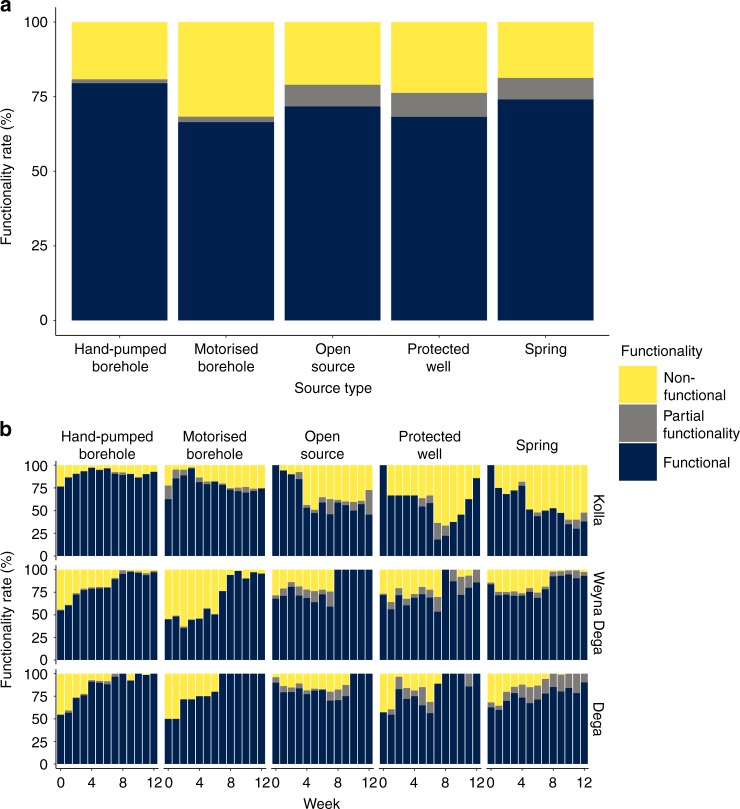
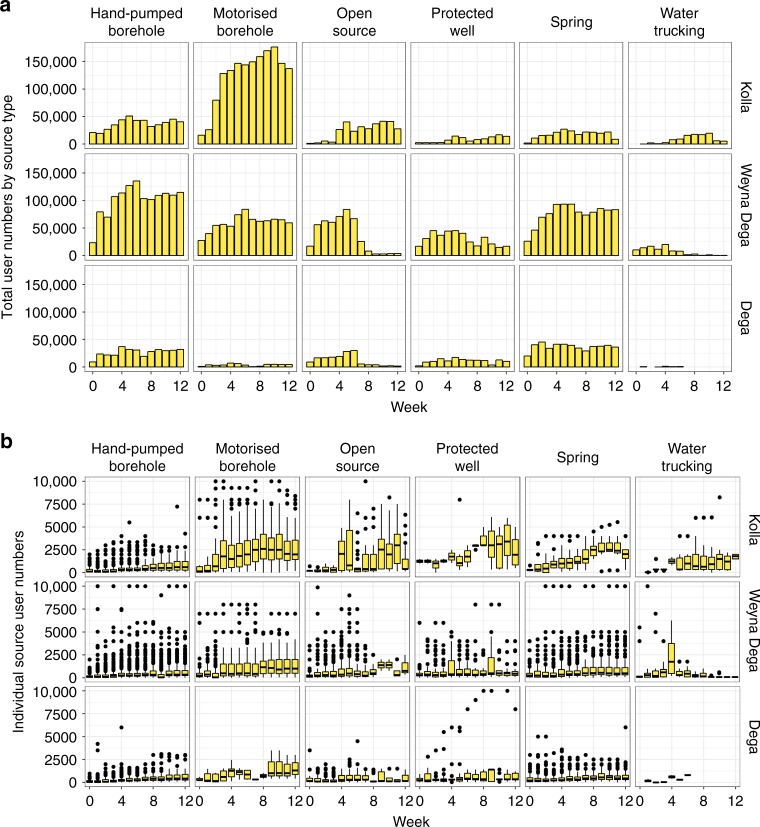
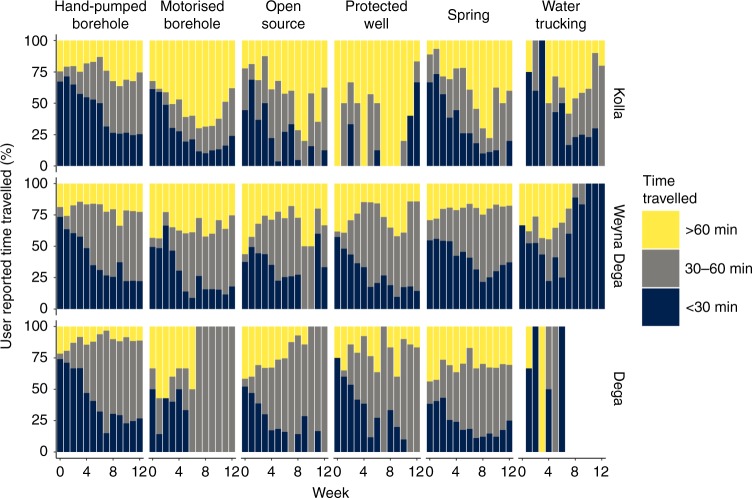
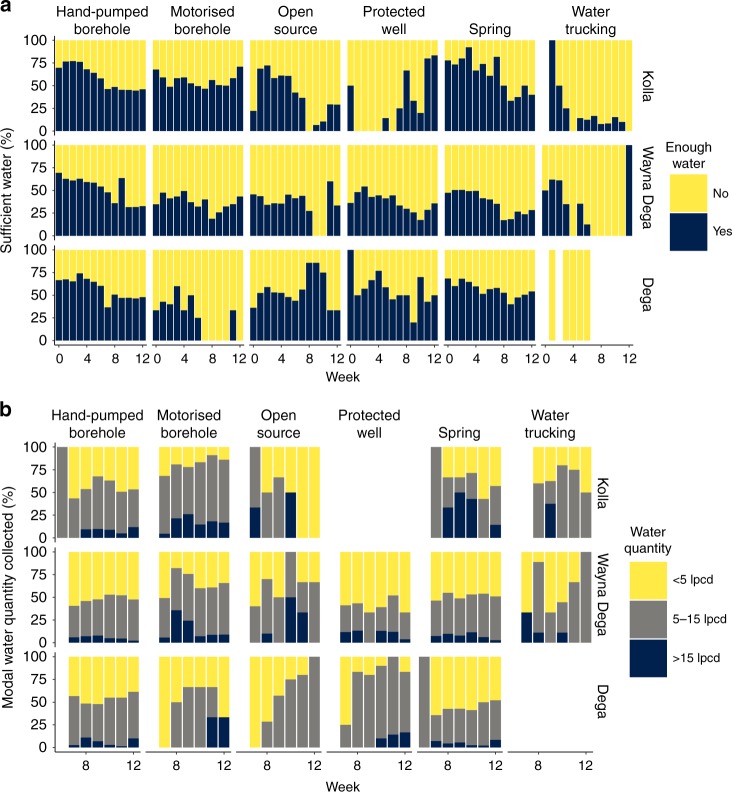
As rural African communities experience more frequent and extreme droughts, it is increasingly important that water supplies are climate resilient. Using a unique temporal dataset we explore rural water supply (n = 5196) performance during the 2015-16 drought in Ethiopia. Mean functionality ranged from 60% for motorised boreholes to 75% for hand-pumped boreholes. Real-time monitoring and responsive operation and maintenance led to rapid increases in functionality of hand-pumped and, to a lesser extent, motorised boreholes. Increased demand was placed on motorised boreholes in lowland areas as springs, hand-dug-wells and open sources failed. Most users travelled >1 h to access motorised boreholes but <30 min, increasing to 30-60 mins, for hand-pumped boreholes. Boreholes accessing deep (>30 m) groundwater performed best during the drought. Prioritising access to groundwater via multiple improved sources and a portfolio of technologies, such as hand-pumped and motorised boreholes, supported by responsive and proactive operation and maintenance, increases rural water supply resilience.
随着农村非裔社区经历越来越频繁和极端的干旱,确保供水具有气候弹性变得越来越重要。我们利用独特的时间数据集,探索了 2015-16 年埃塞俄比亚干旱期间农村供水(n=5196)的性能。平均功能范围从机动井的 60%到手动泵井的 75%。实时监测和响应式操作与维护导致手动泵和在较小程度上的机动泵的功能迅速提高。随着泉水、手挖井和开放水源的枯竭,低地地区对机动井的需求增加。大多数用户需要 >1 小时才能到达机动井,但到达手动泵井的时间<30 分钟,增加到 30-60 分钟。在干旱期间,能够获取深(>30 米)地下水的水井表现最佳。通过多种改良水源和一系列技术(如手动泵和机动泵)优先获取地下水,并通过响应式和主动式操作与维护提供支持,这提高了农村供水的弹性。