Department of Pathobiology, College of Veterinary Medicine, Auburn University, Auburn, AL, United States.
Georgia Cancer Center, Augusta University, Augusta, GA, United States.
Front Immunol. 2020 Feb 17;11:122. doi: 10.3389/fimmu.2020.00122. eCollection 2020.
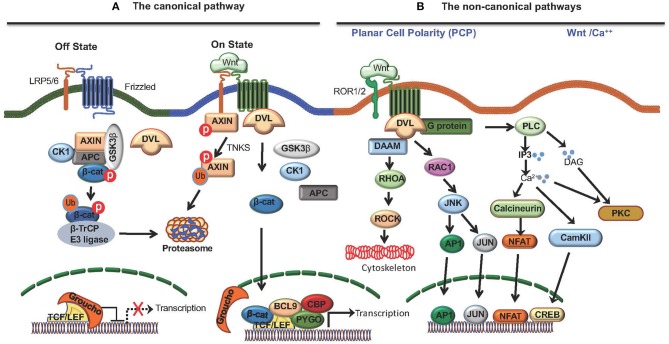
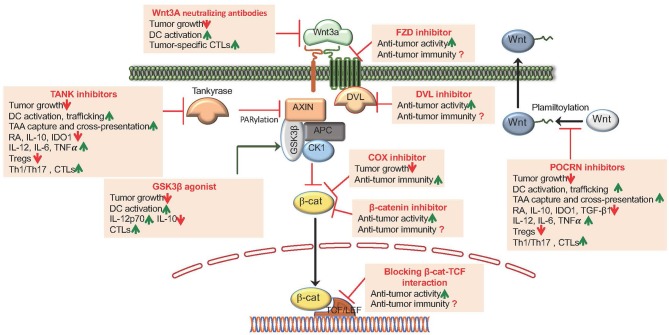
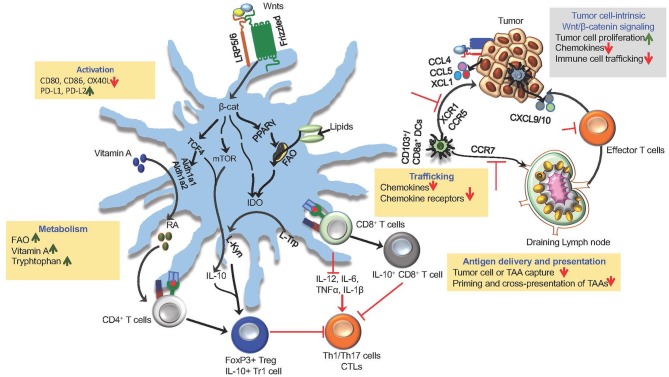
Dendritic cells (DCs) control the strength and quality of antigen-specific adaptive immune responses. This is critical for launching a robust immunity against invading pathogens while maintaining a state of tolerance to self-antigens. However, this also represents a fundamental barrier to anti-tumor immune responses and cancer immunotherapy. DCs in the tumor microenvironment (TME) play a key role in this process. The factors in the TME and signaling networks that program DCs to a regulatory state are not fully understood. Recent advances point to novel mechanisms by which the canonical Wnt signaling cascade in DCs regulates immune suppression, and the same pathway in tumors is associated with the evasion of anti-tumor immunity. Here, we review these recent advances in the context of the pleiotropic effects of the Wnts in shaping anti-tumor immune responses by modulating DC functions. In addition, we will discuss how Wnt/β-catenin pathway in DCs can be targeted for successful cancer immunotherapy.
树突状细胞 (DCs) 控制着抗原特异性适应性免疫反应的强度和质量。这对于发起针对入侵病原体的强大免疫反应至关重要,同时维持对自身抗原的耐受状态。然而,这也代表了抗肿瘤免疫反应和癌症免疫治疗的一个基本障碍。肿瘤微环境 (TME) 中的 DCs 在这个过程中起着关键作用。TME 中的因素和信号网络将 DC 编程为调节状态的机制尚未完全了解。最近的进展指出了 DC 中经典 Wnt 信号级联在调节免疫抑制方面的新机制,而肿瘤中的同一途径与逃避抗肿瘤免疫有关。在这里,我们将在 Wnts 通过调节 DC 功能来塑造抗肿瘤免疫反应的多效性的背景下,综述这些最新进展。此外,我们还将讨论如何针对 DCs 中的 Wnt/β-catenin 途径进行靶向治疗,以实现成功的癌症免疫治疗。