Semnani Behrooz, Flannery Jeremy, Al Maruf Rubayet, Bajcsy Michal
1Institute for Quantum Computing (IQC), University of Waterloo, Waterloo, N2L3G1 ON Canada.
2Department of Electrical & Computer Engineering, University of Waterloo, Waterloo, N2L3G1 ON Canada.
Light Sci Appl. 2020 Feb 20;9:23. doi: 10.1038/s41377-020-0256-5. eCollection 2020.
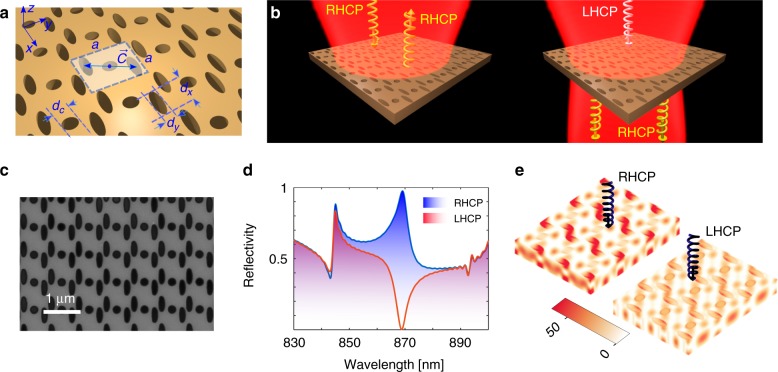
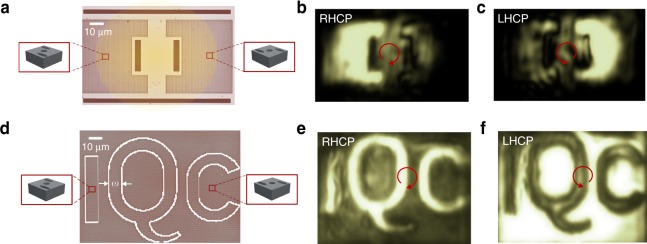
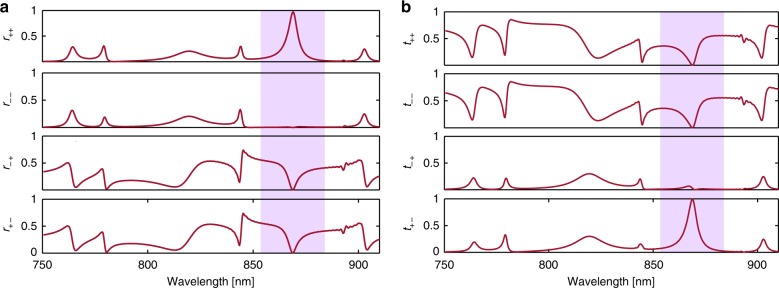
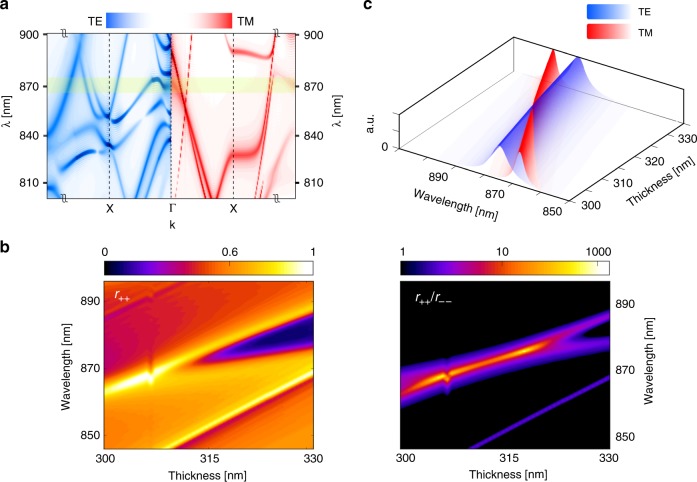
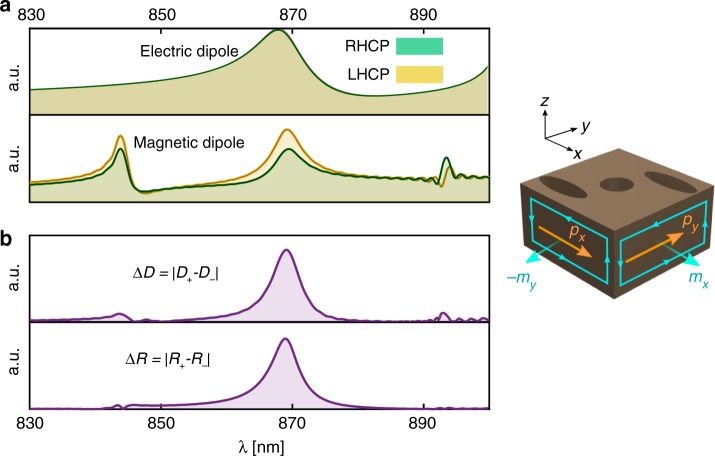
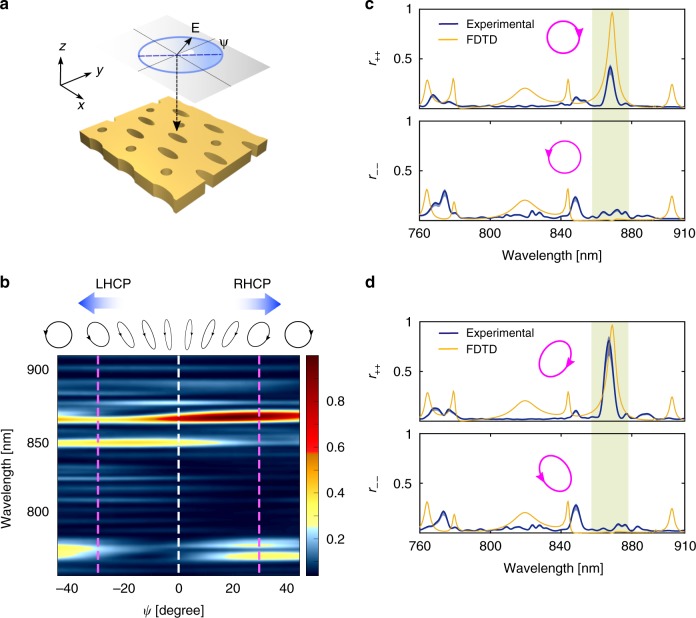
Chirality refers to a geometric phenomenon in which objects are not superimposable on their mirror image. Structures made of nanoscale chiral elements can exhibit chiroptical effects, such as dichroism for left- and right-handed circularly polarized light, which makes these structures highly suitable for applications ranging from quantum information processing and quantum optics to circular dichroism spectroscopy and molecular recognition. At the same time, strong chiroptical effects have been challenging to achieve even in synthetic optical media, and chiroptical effects for light with normal incidence have been speculated to be prohibited in thin, lossless quasi-two-dimensional structures. Here, we report an experimental realization of a giant chiroptical effect in a thin monolithic photonic crystal mirror. Unlike conventional mirrors, our mirror selectively reflects only one spin state of light while preserving its handedness, with a near-unity level of circular dichroism. The operational principle of the photonic crystal mirror relies on guided-mode resonance (GMR) with a simultaneous excitation of leaky transverse electric (TE-like) and transverse magnetic (TM-like) Bloch modes in the photonic crystal slab. Such modes are not reliant on the suppression of radiative losses through long-range destructive interference, and even small areas of the photonic crystal exhibit robust circular dichroism. Despite its simplicity, the mirror strongly outperforms earlier reported structures and, contrary to a prevailing notion, demonstrates that near-unity reflectivity contrast for opposite helicities is achievable in a quasi-two-dimensional structure.
手性是指一种几何现象,即物体无法与其镜像重合。由纳米级手性元素构成的结构能够展现出旋光效应,比如对左旋和右旋圆偏振光的二向色性,这使得这些结构非常适合从量子信息处理、量子光学到圆二色光谱学以及分子识别等一系列应用。与此同时,即便在合成光学介质中,实现强旋光效应也颇具挑战,而且对于垂直入射光的旋光效应,据推测在薄的、无损的准二维结构中是被禁止的。在此,我们报告了在一块薄的单片光子晶体镜中实现巨大旋光效应的实验。与传统镜子不同,我们的镜子仅选择性地反射光的一种自旋状态,同时保持其手性,圆二色性接近单位值。光子晶体镜的工作原理依赖于导模共振(GMR),同时在光子晶体平板中激发泄漏横向电(类TE)和横向磁(类TM)布洛赫模式。此类模式并不依赖于通过长程相消干涉来抑制辐射损耗,即便光子晶体的小面积区域也展现出强大的圆二色性。尽管结构简单,但该镜子的性能远超先前报道的结构,并且与一种普遍观念相反,它证明了在准二维结构中对于相反螺旋度可实现接近单位值的反射率对比度。