Pinto Joel, Almeida Paulo, Ribeiro Fani, Simões Rita
Internal Medicine Department, Centro Hospitalar do Baixo Vouga, Aveiro, Portugal.
Intensive Care Medicine Department, Centro Hospitalar do Baixo Vouga, Aveiro, Portugal.
Eur J Case Rep Intern Med. 2020 Jan 13;7(2):001409. doi: 10.12890/2020_001409. eCollection 2020.
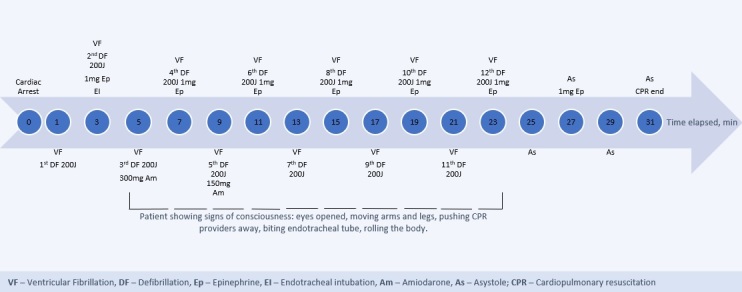
Cardiopulmonary resuscitation-induced consciousness is a rarely described and often misunderstood phenomenon, although it can be encountered. High quality cardiopulmonary resuscitation (CPR) may lead a patient to recover consciousness while in cardiac arrest. The authors present the case of an 89-year-old male patient who received CPR after a cardiac arrest. Spontaneous movements during CPR were noted and prompted several CPR interruptions. These movements immediately stopped during chest compression pauses. Physical restraint was used in order to be able to continue with the CPR algorithm, but sedation may be the best approach. Guidelines on how to identify and manage these cases need to be developed.
Although rare, cardiopulmonary resuscitation-induced consciousness is a phenomenon that physicians should be aware of, given the implications it may have during resuscitation manoeuvres.Cardiopulmonary resuscitation-induced consciousness can readily be recognised by the presence during cardiac arrest of spontaneous and purposeful patient movements that immediately cease after stopping chest compressions.The use of sedative and analgesic drugs such as ketamine may be the best choice to manage cardiopulmonary resuscitation-induced consciousness, as an alternative to physical restraint.
心肺复苏诱导的意识是一种很少被描述且常被误解的现象,尽管它可能会出现。高质量的心肺复苏(CPR)可能会使心脏骤停患者恢复意识。作者报告了一名89岁男性患者在心脏骤停后接受心肺复苏的病例。在心肺复苏过程中观察到自发运动,并导致多次中断心肺复苏。这些运动在胸外按压暂停时立即停止。为了能够继续进行心肺复苏流程,采用了身体约束措施,但镇静可能是最佳方法。需要制定关于如何识别和处理这些病例的指南。
尽管罕见,但考虑到心肺复苏诱导的意识在复苏操作中可能产生的影响,医生应了解这一现象。心肺复苏诱导的意识可通过心脏骤停期间患者出现自发且有目的的运动,而在停止胸外按压后立即停止来轻易识别。使用氯胺酮等镇静和镇痛药物可能是处理心肺复苏诱导的意识的最佳选择,可替代身体约束。