Goodwin Pamela J, Segal Roanne J, Vallis Michael, Ligibel Jennifer A, Pond Gregory R, Robidoux André, Findlay Brian, Gralow Julie R, Mukherjee Som D, Levine Mark, Pritchard Kathleen I
1Department of Medicine, Division of Clinical Epidemiology at the Lunenfeld-Tanenbaum Research Institute, Mount Sinai Hospital, University of Toronto, Toronto, ON Canada.
2Department of Internal Medicine, Division of Medical Oncology, Ottawa Hospital Regional Cancer Center, University of Ottawa, Ottawa, ON Canada.
NPJ Breast Cancer. 2020 Feb 21;6:6. doi: 10.1038/s41523-020-0149-z. eCollection 2020.
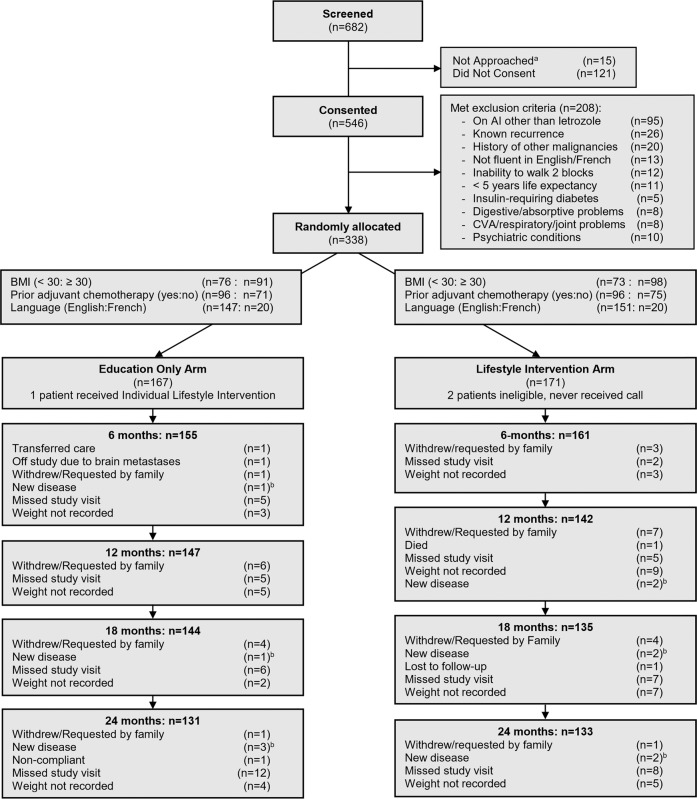
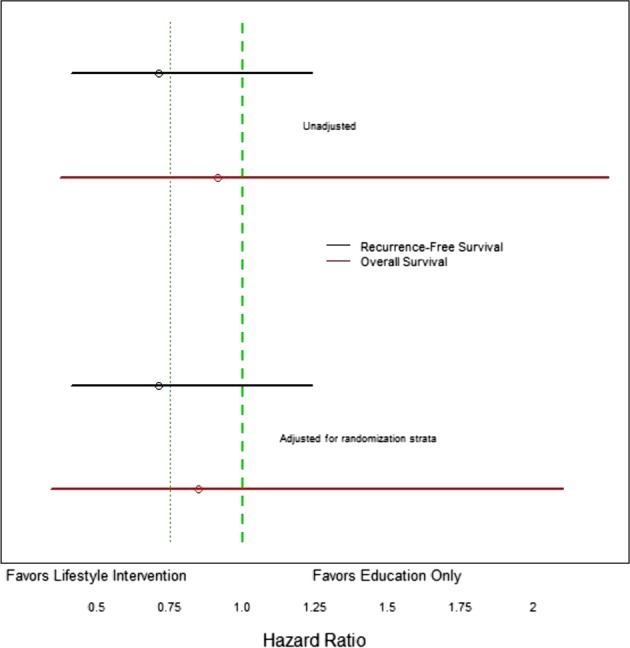
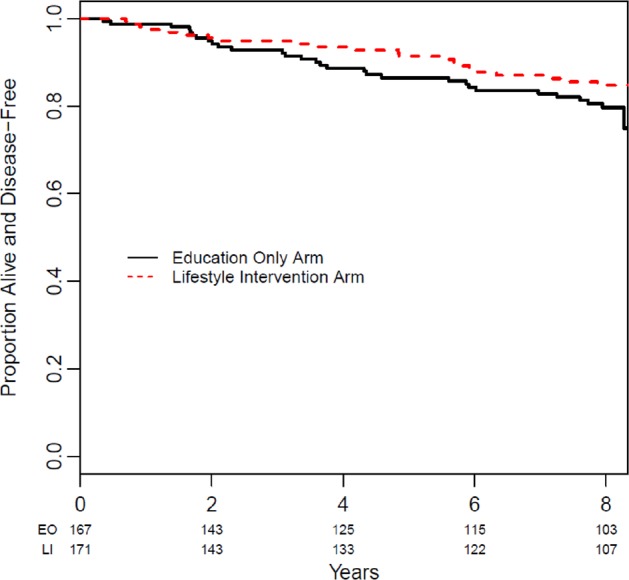
Obesity has been associated with poor breast cancer (BC) outcomes. We investigated whether a standardized, telephone-based weight loss lifestyle intervention in the adjuvant setting would impact BC outcomes. We conducted a multicenter trial randomizing women 1:1 to mail-based educational material alone (control) or combined with a standardized, telephone-based lifestyle intervention that focused on diet, physical activity, and behavior and involved 19 calls over 2 years to achieve up to 10% weight loss. In all, 338 (of 2150 planned) T1-3, N0-3, M0 hormone receptor positive BC patients with body mass index (BMI) ≥24 kg/m receiving adjuvant letrozole were randomized (enrolment ended due to funding loss). The primary outcome was disease-free survival (DFS); secondary outcome was Overall Survival (OS). At 8 years' median follow-up, in a planned analysis, DFS and OS were compared using the Kaplan-Meier method. Baseline BMI and other characteristics were similar between study arms. In all, 22 of 171 (12.9%) in the lifestyle intervention arm versus 30 of 167 (18.0%) in the education had DFS events; the hazard ratio (HR) was 0.71 (95% confidence interval [CI]: 0.41-1.24, = 0.23). Although loss of funding reduced sample size, we view these hypothesis generating results as compatible with our hypothesis of a potential beneficial effect of a lifestyle intervention on DFS. They provide support for completion of ongoing randomized controlled trials of the effect of lifestyle interventions in BC outcomes.
肥胖与乳腺癌(BC)预后不良有关。我们调查了在辅助治疗环境中基于电话的标准化体重减轻生活方式干预是否会影响BC预后。我们进行了一项多中心试验,将女性按1:1随机分为仅接受邮寄教育材料组(对照组)或接受基于电话的标准化生活方式干预组,该干预侧重于饮食、体育活动和行为,在2年内进行19次电话随访以实现最多10%的体重减轻。共有338名(计划的2150名中的)T1-3、N0-3、M0激素受体阳性且体重指数(BMI)≥24 kg/m²接受辅助来曲唑治疗的BC患者被随机分组(由于资金损失,招募结束)。主要结局是无病生存期(DFS);次要结局是总生存期(OS)。在8年的中位随访中,在一项计划分析中,使用Kaplan-Meier方法比较DFS和OS。研究组之间的基线BMI和其他特征相似。生活方式干预组171名中有22名(12.9%)发生DFS事件,而教育组167名中有30名(18.0%)发生DFS事件;风险比(HR)为0.71(95%置信区间[CI]:0.41-1.24,P = 0.23)。尽管资金损失减少了样本量,但我们认为这些产生假设的结果与我们关于生活方式干预对DFS有潜在有益作用的假设相符。它们为正在进行的关于生活方式干预对BC预后影响的随机对照试验的完成提供了支持。