Department of General Surgery, NUTRIM, Maastricht University Medical Center, Maastricht, The Netherlands.
Department of General Surgery, Spaarne Gasthuis, Haarlem / Hoofddorp, Netherlands.
Obes Surg. 2020 May;30(5):1952-1960. doi: 10.1007/s11695-020-04422-6.
To assess safety of the Exilis™ gastric electrical stimulation (GES) system and to investigate whether the settings can be adjusted for comfortable chronic use in subjects with morbid obesity. Gastric emptying and motility and meal intake were evaluated.
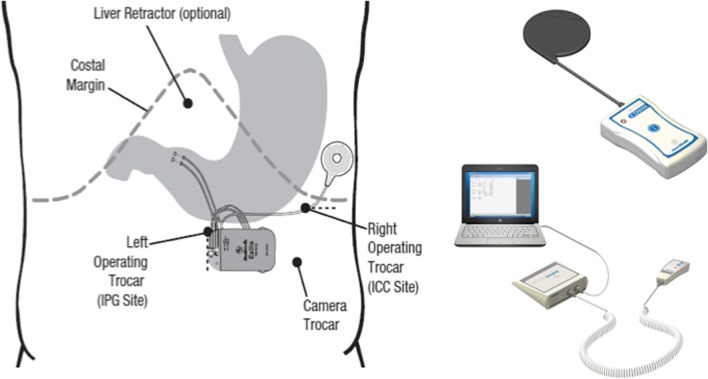
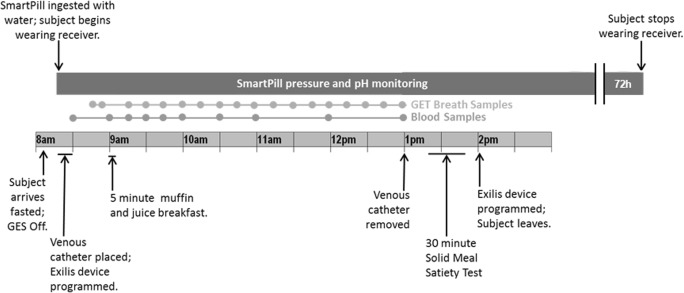
In a multicenter, phase 1, open prospective cohort study, 20 morbidly obese subjects (17 female, mean BMI of 40.8 ± 0.7 kg/m) were implanted with the Exilis™ system. Amplitude of the Exilis™ system was individually set during titration visits. Subjects underwent two blinded baseline test days (GES ON vs. OFF), after which long-term, monthly follow-up continued for up to 52 weeks.
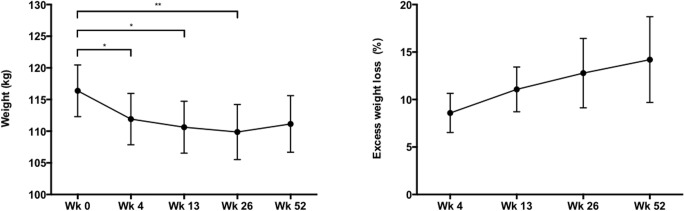
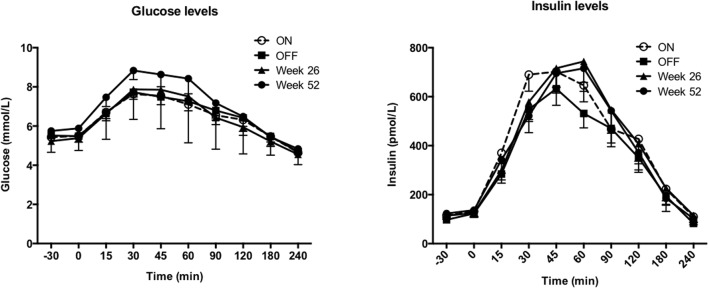
The procedure was safe, and electrical stimulation was well tolerated and comfortable in all subjects. No significant differences in gastric emptying halftime (203 ± 16 vs. 212 ± 14 min, p > 0.05), food intake (713 ± 68 vs. 799 ± 69 kcal, p > 0.05), insulin AUC (2448 ± 347 vs. 2186 ± 204, p > 0.05), and glucose AUC (41 ± 2 vs.41 ± 2, p > 0.05) were found between GES ON and OFF. At week 4, 13, and 26, a significant (p < 0.01) reduction in weight loss was observed but not at week 52. At this time point, the mean excess weight loss (EWL) was 14.2 ± 4.5%.
Gastric electrical stimulation with the Exilis™ system can be considered as safe. No significant effect on food intake, gastric emptying, or gastric motility was observed. The reduction in weight loss with Exilis™ GES was significant but short lasting. Further electrophysiological research is needed to gain more insight in optimal stimulation parameters and lead localization.
评估 Exilis™ 胃电刺激(GES)系统的安全性,并研究是否可以调整设置以方便患有病态肥胖的患者进行慢性使用。评估胃排空、运动和进餐量。
在一项多中心、1 期、开放前瞻性队列研究中,20 名病态肥胖受试者(17 名女性,平均 BMI 为 40.8±0.7kg/m²)植入了 Exilis™系统。在滴定访问期间单独设置 Exilis™系统的幅度。受试者进行了两次盲法基线测试日(GES ON 与 OFF),之后进行长达 52 周的长期每月随访。
该程序是安全的,所有受试者均能很好地耐受和耐受电刺激。胃排空半衰期(203±16 与 212±14min,p>0.05)、食物摄入量(713±68 与 799±69kcal,p>0.05)、胰岛素 AUC(2448±347 与 2186±204,p>0.05)和葡萄糖 AUC(41±2 与 41±2,p>0.05)在 GES ON 和 OFF 之间无显著差异。在第 4、13 和 26 周时,体重减轻明显(p<0.01),但在第 52 周时没有。此时,平均多余体重减轻(EWL)为 14.2±4.5%。
使用 Exilis™系统进行胃电刺激可被认为是安全的。未观察到对食物摄入、胃排空或胃动力的显著影响。Exilis™ GES 减肥效果的降低是显著的,但持续时间短。需要进一步的电生理研究,以更好地了解最佳刺激参数和导联定位。