Department of Biological Sciences and RNA Institute, University at Albany, Albany, NY.
Academic and Research Computing Center, Information Technology Services, University at Albany, Albany, NY.
Mol Biol Evol. 2020 Jul 1;37(7):1942-1948. doi: 10.1093/molbev/msaa055.
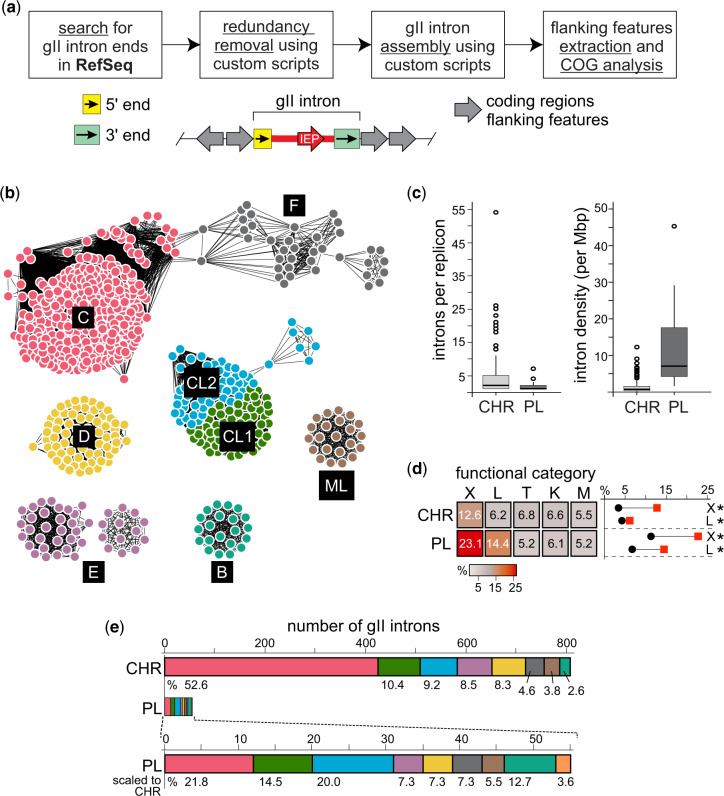
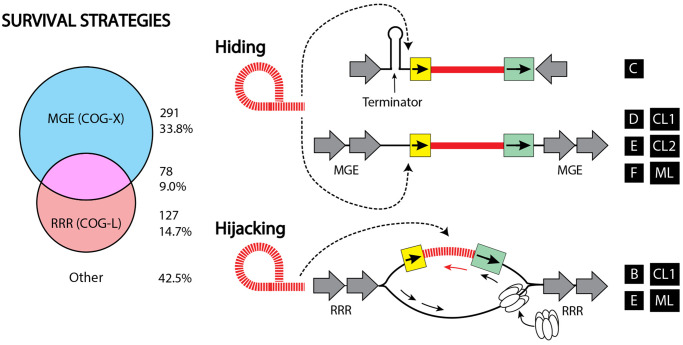
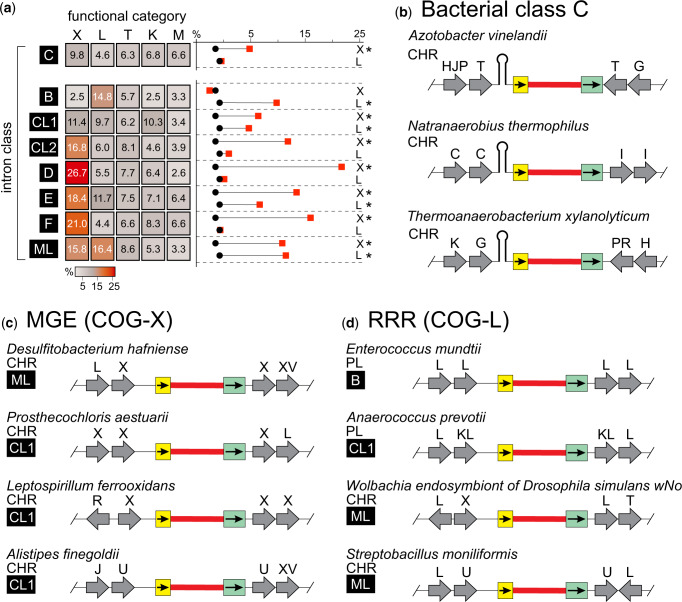
Group II (gII) introns are mobile retroelements that can spread to new DNA sites through retrotransposition, which can be influenced by a variety of host factors. To determine if these host factors bear any relationship to the genomic location of gII introns, we developed a bioinformatic pipeline wherein we focused on the genomic neighborhoods of bacterial gII introns within their native contexts and sought to determine global relationships between introns and their surrounding genes. We found that, although gII introns inhabit diverse regions, these neighborhoods are often functionally enriched for genes that could promote gII intron retention or proliferation. On one hand, we observe that gII introns are frequently found hiding in mobile elements or after transcription terminators. On the other hand, gII introns are enriched in locations in which they could hijack host functions for their movement, potentially timing expression of the intron with genes that produce favorable conditions for retrotransposition. Thus, we propose that gII intron distributions have been shaped by relationships with their surrounding genomic neighbors.
Group II (gII) 内含子是可移动的反转录元件,可通过反转录转座传播到新的 DNA 位点,这一过程可能受到多种宿主因素的影响。为了确定这些宿主因素是否与 gII 内含子的基因组位置有关,我们开发了一种生物信息学管道,其中我们专注于细菌 gII 内含子在其天然环境中的基因组邻域,并试图确定内含子与其周围基因之间的全局关系。我们发现,尽管 gII 内含子栖息在不同的区域,但这些邻近区域通常在功能上富集了可能促进 gII 内含子保留或增殖的基因。一方面,我们观察到 gII 内含子经常隐藏在移动元件或转录终止子之后。另一方面,gII 内含子在它们可以劫持宿主功能以进行移动的位置富集,可能会使内含子的表达与产生有利于反转录转座的条件的基因同步。因此,我们提出 gII 内含子的分布是由其与周围基因组邻居的关系塑造的。