Behnke Judith, Kremer Sarah, Shahzad Tayyab, Chao Cho-Ming, Böttcher-Friebertshäuser Eva, Morty Rory E, Bellusci Saverio, Ehrhardt Harald
Department of General Pediatrics and Neonatology, Justus-Liebig-University, Universities of Giessen and Marburg Lung Center (UGMLC), Member of the German Center for Lung Research (DZL), Feulgenstrasse 12, 35392 Gießen, Germany.
Department of Internal Medicine II, Universities of Giessen and Marburg Lung Center (UGMLC), Cardiopulmonary Institute (CPI), Member of the German Center for Lung Research (DZL), Aulweg 130, 35392 Giessen, Germany.
J Clin Med. 2020 Mar 3;9(3):682. doi: 10.3390/jcm9030682.
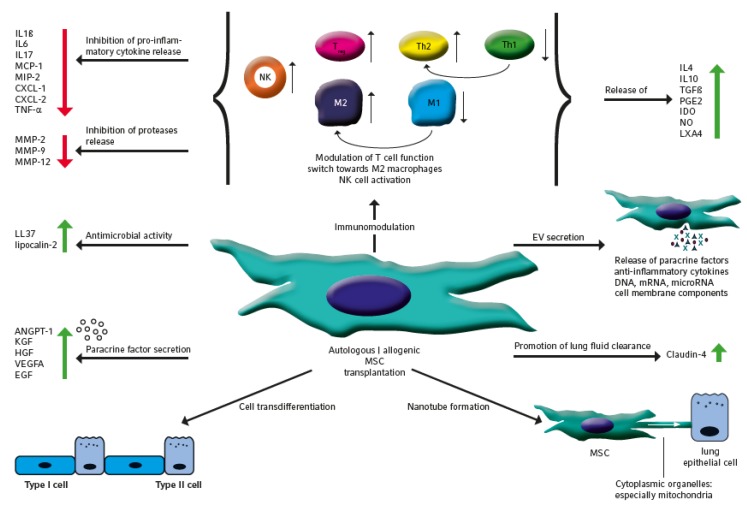
Chronic lung diseases pose a tremendous global burden. At least one in four people suffer from severe pulmonary sequelae over the course of a lifetime. Despite substantial improvements in therapeutic interventions, persistent alleviation of clinical symptoms cannot be offered to most patients affected to date. Despite broad discrepancies in origins and pathomechanisms, the important disease entities all have in common the pulmonary inflammatory response which is central to lung injury and structural abnormalities. Mesenchymal stem cells (MSC) attract particular attention due to their broadly acting anti-inflammatory and regenerative properties. Plenty of preclinical studies provided congruent and convincing evidence that MSC have the therapeutic potential to alleviate lung injuries across ages. These include the disease entities bronchopulmonary dysplasia, asthma and the different forms of acute lung injury and chronic pulmonary diseases in adulthood. While clinical trials are so far restricted to pioneering trials on safety and feasibility, preclinical results point out possibilities to boost the therapeutic efficacy of MSC application and to take advantage of the MSC secretome. The presented review summarizes the most recent advances and highlights joint mechanisms of MSC action across disease entities which provide the basis to timely tackle this global disease burden.
慢性肺部疾病给全球带来了巨大负担。至少四分之一的人在一生中会遭受严重的肺部后遗症。尽管治疗干预有了显著改善,但迄今为止,大多数受影响的患者仍无法持续缓解临床症状。尽管病因和发病机制存在广泛差异,但重要的疾病实体都有一个共同特点,即肺部炎症反应,这是肺损伤和结构异常的核心。间充质干细胞(MSC)因其广泛的抗炎和再生特性而备受关注。大量临床前研究提供了一致且令人信服的证据,表明MSC具有缓解各年龄段肺损伤的治疗潜力。这些疾病包括支气管肺发育不良、哮喘以及成年期不同形式的急性肺损伤和慢性肺部疾病。虽然迄今为止临床试验仅限于安全性和可行性的开创性试验,但临床前结果指出了提高MSC应用治疗效果以及利用MSC分泌组的可能性。本综述总结了最新进展,并强调了MSC在不同疾病实体中的联合作用机制,这些机制为及时应对这一全球疾病负担提供了基础。