Cavalcante Luyara de Almeida, Ribeiro Laís Sibaldo, Takeno Mitsuo Lopes, Aum Pedro Tupã Pandava, Aum Yanne Katiussy Pereira Gurgel, Andrade Jean Carlos Silva
Department of Chemistry, Environment and Food; Federal Institute of Education, Science and Technology of Amazonas, Manaus 69080900, Brazil.
Department of Chemical Engineering, Federal University of Rio Grande do Norte, Natal 59078-970, Brazil.
Materials (Basel). 2020 Mar 3;13(5):1129. doi: 10.3390/ma13051129.
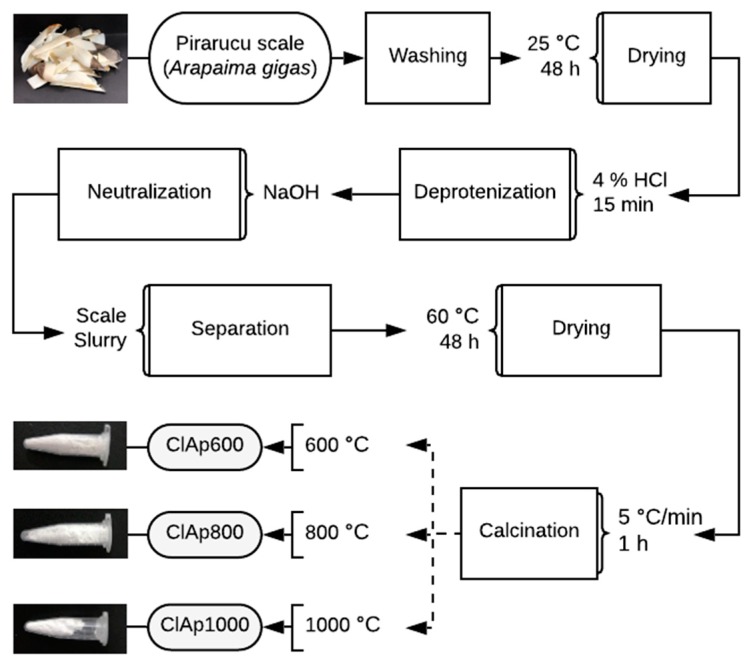
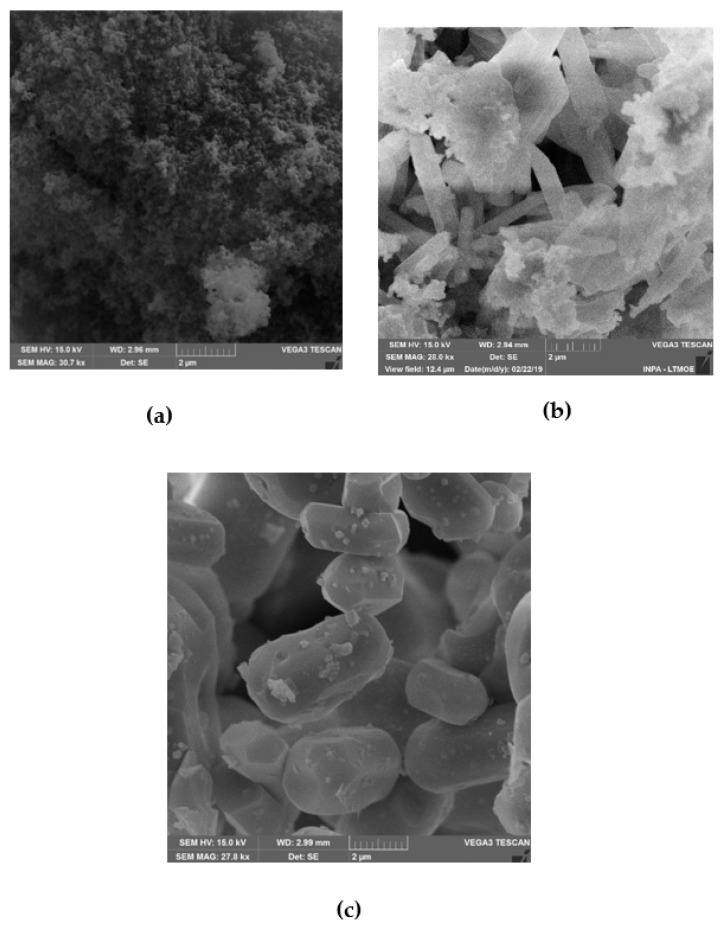
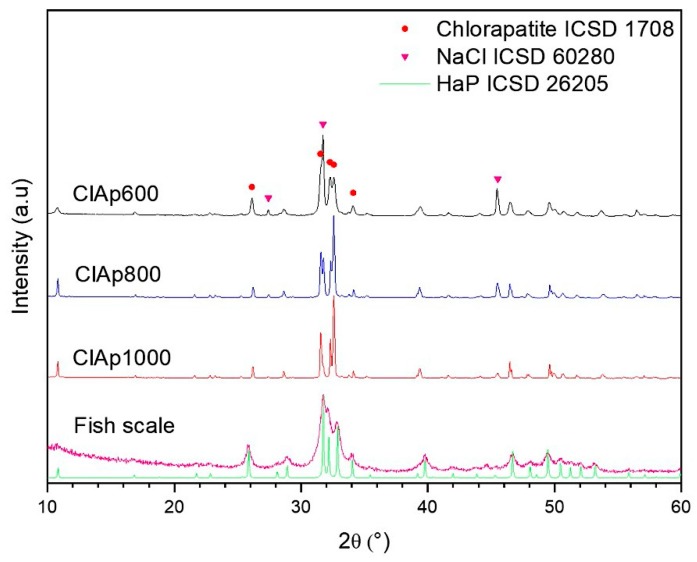
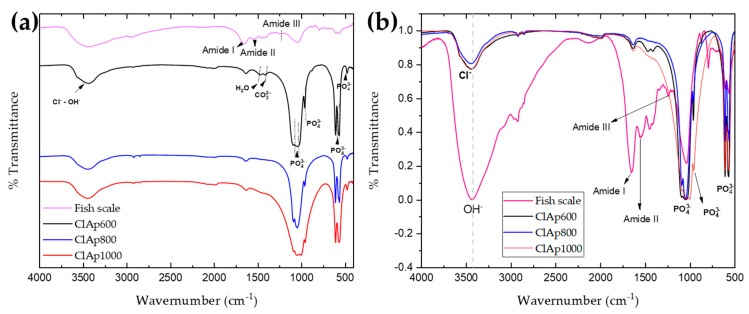
The present work demonstrates the production of chlorapatite (ClAp) through thermal decomposition of chemically treated fish scales, originating from an Amazon fish species (). The scales were treated with hydrochloric acid (HCl) solution for deproteinization. Afterwards, the solution was neutralized by sodium hydroxide (NaOH) treatment to obtain an apatite-rich slurry. The heat treatment was carried out at different temperatures including 600 °C, 800 °C, and 1000 °C. The powders obtained were characterized through X-ray diffraction (XRD), Fourier transform infrared spectroscopy (FTIR), energy-dispersive X-ray spectroscopy (EDS), and scanning electron microscopy (SEM). The XRD analysis and FTIR spectra confirmed the incorporation of chlorine into the apatite structure. The FTIR results showed absorption bands relative to the OH, PO functional groups which are a characteristic of chlorapatite; moreover, the intensity of the OH-Cl elongation could be observed. Chlorapatite Ca(PO)Cl, NaCl, and NaCaPO phases were identified, achieving up to 87.4 wt% for ClAp. From the SEM observations, the ClAp obtained consisted of slightly larger grains and more crystalline with increasing temperature with observed grains ranging in sizes between 1 and 5 μm and 84.27% crystallinity for the ClAp1000 sample. The ClAp and NaCaPO can be used in electronics as a phosphor material due to the fact of its luminescence and biomedical applications.
本研究展示了通过对源自一种亚马逊鱼类的鱼鳞进行化学处理后热分解来制备氯磷灰石(ClAp)。鱼鳞用盐酸(HCl)溶液处理以进行脱蛋白。之后,通过氢氧化钠(NaOH)处理使溶液中和以获得富含磷灰石的浆料。热处理在不同温度下进行,包括600℃、800℃和1000℃。通过X射线衍射(XRD)、傅里叶变换红外光谱(FTIR)、能量色散X射线光谱(EDS)和扫描电子显微镜(SEM)对所得粉末进行表征。XRD分析和FTIR光谱证实了氯掺入磷灰石结构中。FTIR结果显示了与OH、PO官能团相关的吸收带,这是氯磷灰石的特征;此外,还能观察到OH - Cl伸缩振动的强度。鉴定出了氯磷灰石Ca(PO)Cl、NaCl和NaCaPO相,其中ClAp的含量高达87.4 wt%。从SEM观察结果来看,随着温度升高,所获得的ClAp由稍大的晶粒组成且结晶度更高,观察到的ClAp1000样品的晶粒尺寸在1至5μm之间,结晶度为84.27%。由于其发光特性,ClAp和NaCaPO可作为磷光材料用于电子领域以及生物医学应用。