Czaja Tomasz, Sobota Aldona, Szostak Roman
Department of Chemistry, University of Wrocław, 14F. Joliot-Curie, 50-383 Wrocław, Poland.
Department of Food Science, University of Copenhagen, Rolighedsvej 26, 1958 Frederiksberg, Denmark.
Foods. 2020 Mar 3;9(3):280. doi: 10.3390/foods9030280.
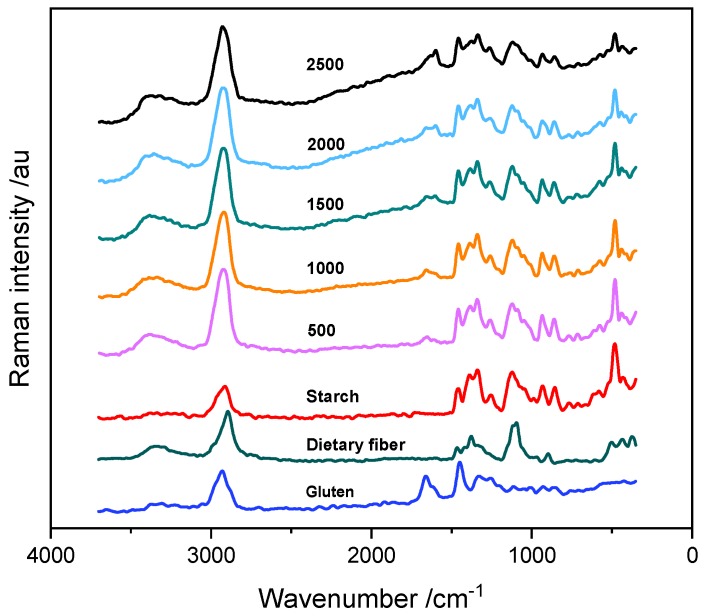
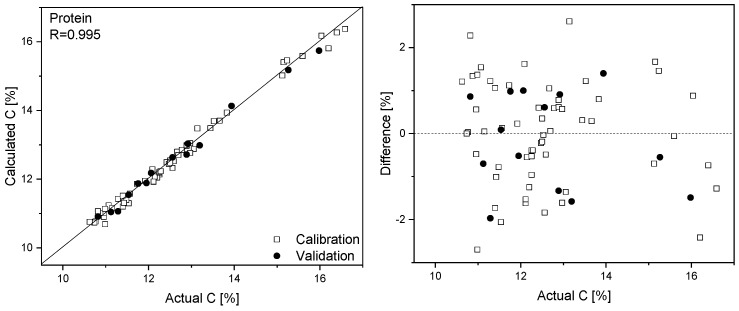
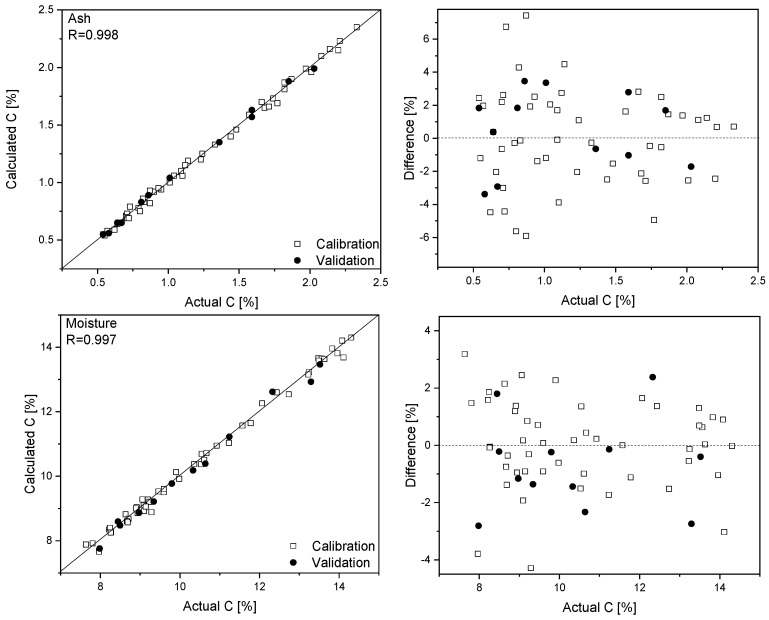
Wheat flour is widely used on an industrial scale in baked goods, pasta, food concentrates, and confectionaries. Ash content and moisture can serve as important indicators of the wheat flour's quality and use, but the routinely applied assessment methods are laborious. Partial least squares regression models, obtained using Raman spectra of flour samples and the results of reference gravimetric analysis, allow for fast and reliable determination of ash and moisture in wheat flour, with relative standard errors of prediction of the order of 2%. Analogous calibration models that enable quantification of carbon, oxygen, sulfur, and nitrogen, and hence protein, in the analyzed flours, with relative standard errors of prediction equal to 0.1, 0.3, 3.3, and 1.4%, respectively, were built combining the results of elemental analysis and Raman spectra.
小麦粉在烘焙食品、面食、食品浓缩物和糖果等工业规模生产中被广泛使用。灰分和水分可作为小麦粉质量和用途的重要指标,但常规应用的评估方法较为繁琐。利用面粉样品的拉曼光谱和参考重量分析结果获得的偏最小二乘回归模型,能够快速可靠地测定小麦粉中的灰分和水分,预测相对标准误差约为2%。结合元素分析结果和拉曼光谱,建立了类似的校准模型,可对分析面粉中的碳、氧、硫和氮(进而对蛋白质)进行定量分析,预测相对标准误差分别为0.1%、0.3%、3.3%和1.4%。