Jaffré Jérémy, Aubry Alexandra, Maitre Thomas, Morel Florence, Brossier Florence, Robert Jérôme, Sougakoff Wladimir, Veziris Nicolas
AP-HP (Assistance Publique Hôpitaux de Paris), Centre National de Référence des Mycobactéries et de la Résistance des Mycobactéries aux Antituberculeux, Groupe Hospitalier Universitaire Sorbonne Université, Hôpital Pitié Salpêtrière, Paris, France.
INSERM, U1135, Centre d'Immunologie et des Maladies Infectieuses, Sorbonne Université, Cimi-Paris, Paris, France.
Front Microbiol. 2020 Feb 19;11:81. doi: 10.3389/fmicb.2020.00081. eCollection 2020.
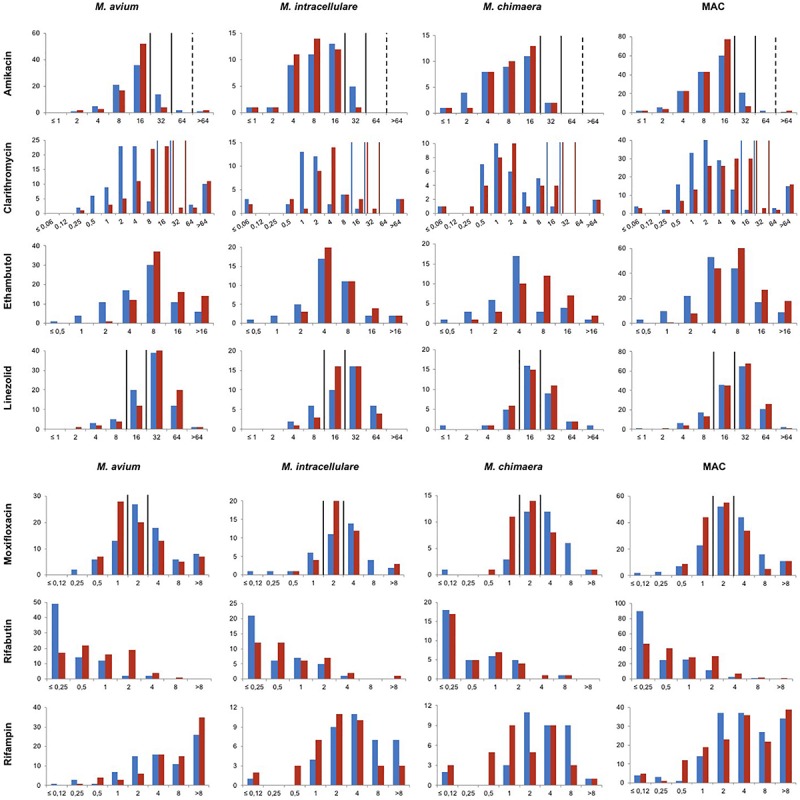
The Clinical and Laboratory Standards Institute recommends the use of Mueller Hinton (MH) medium to perform drug susceptibility testing (DST) of complex (MAC) using the microdilution method. For MAC, there has been no study on the impact of media on the determination of minimum inhibitory concentrations (MICs) of antibiotics other than clarithromycin. This study aimed at determining the impact of two media used for DST of MAC and at augmenting the number of pertinent MICs for MAC species encountered in clinical practice. MICs of antibiotics used for the treatment of MAC infections were determined for 158 clinical MAC isolates (80 , 40 , 35 , two and one ) in MH and 7H9 broths using the SLOMYCO Sensititre system (TREK Diagnostic Systems, East Grinstead, United Kingdom). The modal MICs determined in both media were the same for linezolid, moxifloxacin, rifabutin and amikacin but not for clarithromycin, rifampin and ethambutol. The kappa test for MICs converted to susceptibility categories showed an excellent agreement for clarithromycin, a moderate agreement for linezolid and a weak agreement for moxifloxacin and amikacin. For amikacin, 7H9 allowed a better distinction (fewer intermediate strains) of wild-type populations than MH. Existing breakpoints for linezolid and moxifloxacin are spread through the distribution of MICs for wild-type populations. The only breakpoints that can be used rationally are those for amikacin and clarithromycin. For amikacin, 7H9 performs better than MH, whereas both media perform equally for clarithromycin. Given that testing in 7H9, as opposed to MH, allows easier MIC measurements and yields greater reproducibility, we propose the use of 7H9 medium for DST of MAC.
临床和实验室标准协会建议使用 Mueller Hinton(MH)培养基,采用微量稀释法对鸟分枝杆菌复合体(MAC)进行药敏试验(DST)。对于 MAC,除克拉霉素外,尚无关于培养基对其他抗生素最低抑菌浓度(MIC)测定影响的研究。本研究旨在确定用于 MAC DST 的两种培养基的影响,并增加临床实践中遇到的 MAC 菌种相关 MIC 的数量。使用 SLOMYCO Sensititre 系统(英国东格林斯特德的 TREK 诊断系统公司),在 MH 肉汤和 7H9 肉汤中测定了 158 株临床 MAC 分离株(80 株、40 株、35 株、2 株和 1 株)对用于治疗 MAC 感染的抗生素的 MIC。在两种培养基中测定的利奈唑胺、莫西沙星、利福布汀和阿米卡星的模态 MIC 相同,但克拉霉素、利福平及乙胺丁醇的不同。将 MIC 转换为药敏类别后的卡帕检验显示,克拉霉素的一致性极佳,利奈唑胺的一致性中等,莫西沙星和阿米卡星的一致性较弱。对于阿米卡星,7H9 比 MH 能更好地区分野生型群体(中间菌株较少)。利奈唑胺和莫西沙星的现有断点分布在野生型群体的 MIC 分布范围内。唯一可合理使用的断点是阿米卡星和克拉霉素的断点。对于阿米卡星,7H9 的性能优于 MH,而两种培养基对克拉霉素的性能相当。鉴于与 MH 相比,在 7H9 中进行检测能更轻松地测量 MIC 且重现性更高,我们建议使用 7H9 培养基进行 MAC 的 DST。