Bell Caryn N, Sacks Tina K, Thomas Tobin Courtney S, Thorpe Roland J
Department of African American Studies, University of Maryland, College Park, United States.
School of Social Welfare, University of California-Berkeley, United States.
SSM Popul Health. 2020 Feb 21;10:100561. doi: 10.1016/j.ssmph.2020.100561. eCollection 2020 Apr.
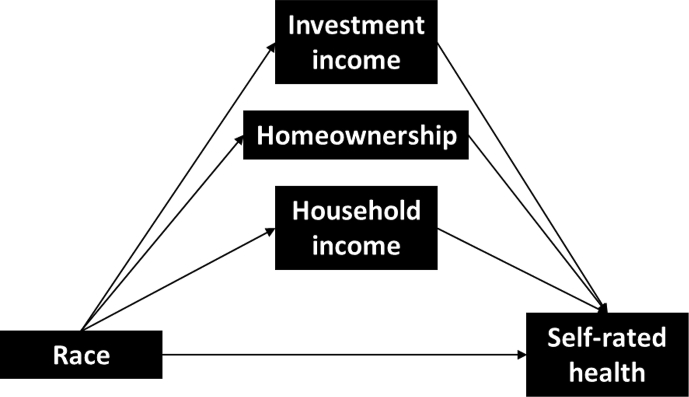
Racial health inequities are not fully explained by socioeconomic status (SES) measures like education, income and wealth. The largest inequities are observed among African American and white college graduates suggesting that African Americans do not receive the same health benefits of education. African Americans do not receive the same income and wealth returns of college education as their white counterparts indicating a racial non-equivalence of SES that may affect health inequities. The aim of this study is to determine whether racial non-equivalence of SES mediates race inequities in self-rated health by education and sex. Using data from the 2007-2016 National Health and Nutrition Examination Survey in the United States, the mediation of the associations between race and self-rated health through household income ≥400% federal poverty line, homeownership, and investment income were assessed among college graduates and non-college graduates by sex. Indirect associations were observed among college graduate women (odds = 0.08, standard error (s.e.) = 0.03), and non-college graduate men (odds = 0.14, s.e. = 0.02) and women (odds = 0.06, s.e. = 0.02). Direct associations between race and self-rated health remained after accounting for household income and wealth indicators suggesting that race differences in income and wealth partially mediate racial inequities in self-rated health. This study demonstrates that the racial non-equivalence of SES has implications for health inequities, but the magnitude of indirect associations varied by sex. Other factors like discrimination, health pessimism and segregation should be considered in light of the racial non-equivalence of SES and racial inequities in self-rated health.
种族健康不平等并不能完全由教育、收入和财富等社会经济地位(SES)指标来解释。在非裔美国人和白人大学毕业生中观察到最大的不平等现象,这表明非裔美国人并未从教育中获得同等的健康益处。非裔美国人从大学教育中获得的收入和财富回报与白人同龄人不同,这表明社会经济地位存在种族不平等,可能会影响健康不平等。本研究的目的是确定社会经济地位的种族不平等是否通过教育和性别介导自评健康方面的种族不平等。利用美国2007 - 2016年国家健康与营养检查调查的数据,按性别在大学毕业生和非大学毕业生中评估了种族与自评健康之间通过家庭收入≥400%联邦贫困线、自有住房和投资收入的关联的中介作用。在大学毕业女性(比值 = 0.08,标准误(s.e.)= 0.03)、非大学毕业男性(比值 = 0.14,s.e. = 0.02)和女性(比值 = 0.06,s.e. = 0.02)中观察到间接关联。在考虑家庭收入和财富指标后,种族与自评健康之间的直接关联仍然存在,这表明收入和财富方面的种族差异部分介导了自评健康方面的种族不平等。本研究表明,社会经济地位的种族不平等对健康不平等有影响,但间接关联的程度因性别而异。鉴于社会经济地位的种族不平等和自评健康方面的种族不平等,应考虑歧视、健康悲观主义和隔离等其他因素。