Department of Human Services Psychology, University of Maryland, Baltimore, Maryland, United States of America.
Division of Gerontology and Geriatric Medicine, Department of Medicine, University of Maryland School of Medicine, Baltimore, Maryland, United States of America.
PLoS One. 2021 May 19;16(5):e0251174. doi: 10.1371/journal.pone.0251174. eCollection 2021.
To examine whether intersections of race with other key sociodemographic categories contribute to variations in multiple dimensions of race- and non-race-related, interpersonal-level discrimination and burden in urban-dwelling African Americans and Whites.
Data from 2,958 participants aged 30-64 in the population-based Healthy Aging in Neighborhoods of Diversity across the Life Span (HANDLS) study were used to estimate up to four-way interactions of race, age, gender, and poverty status with reports of racial and everyday discrimination, discrimination across multiple social statuses, and related lifetime discrimination burden in multiple regression models.
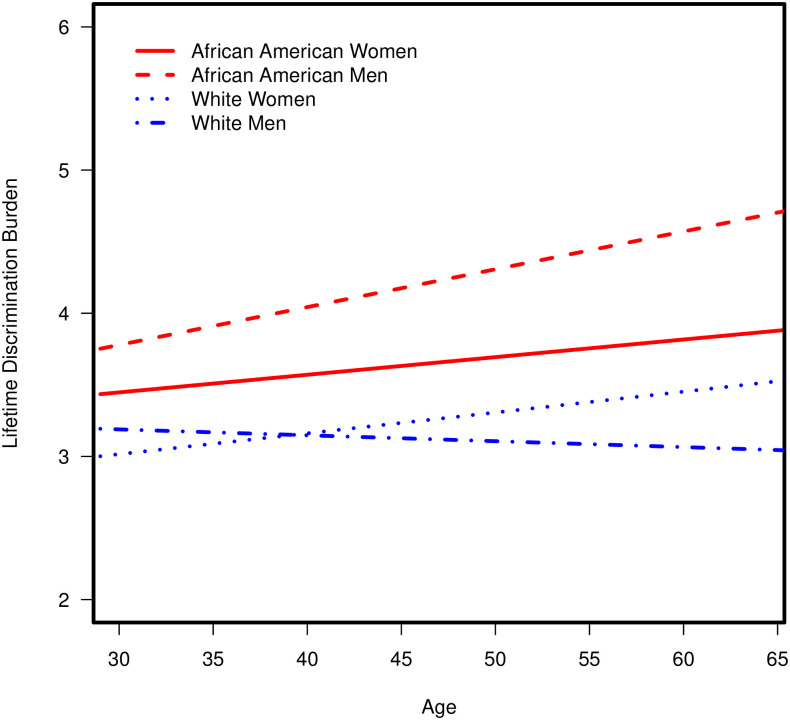
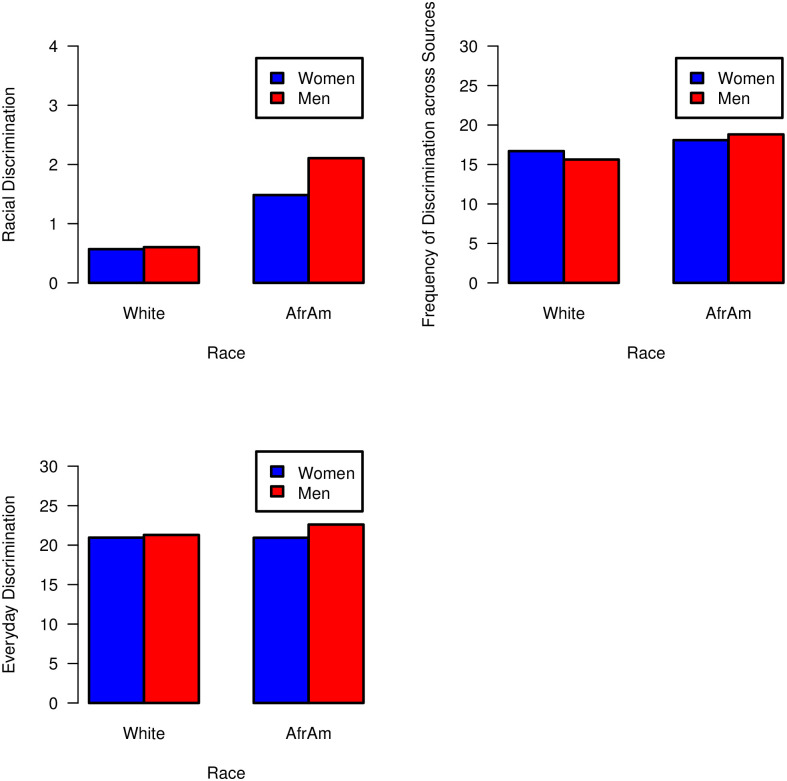
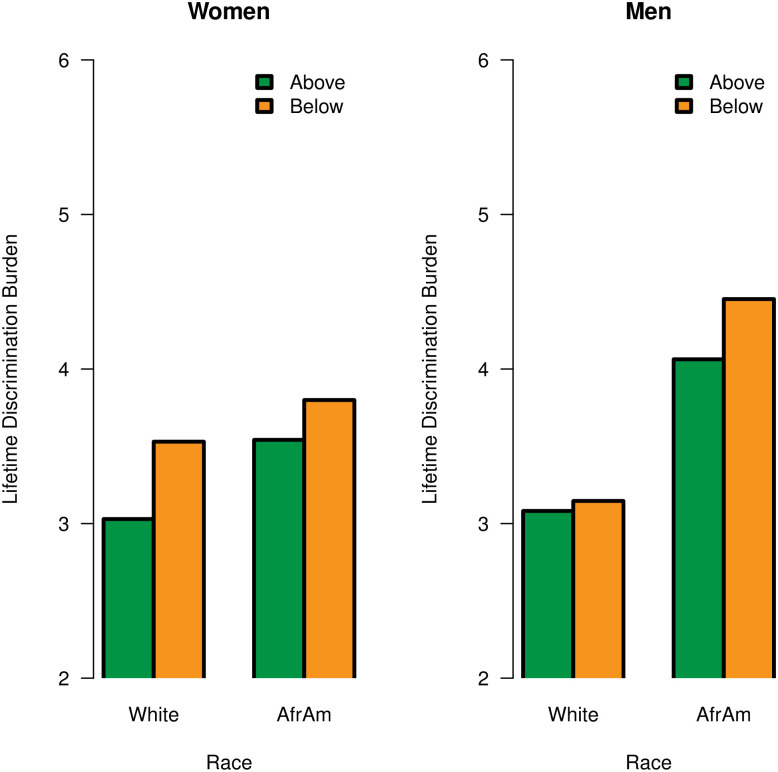
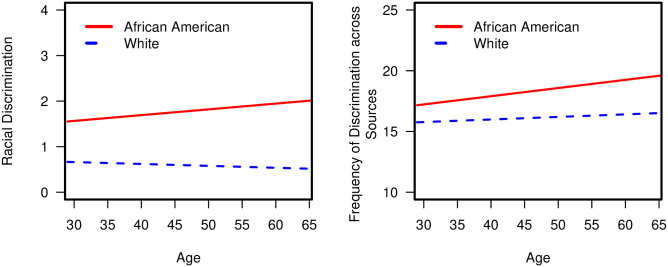
We observed that: 1) African Americans experienced all forms of discrimination more frequently than Whites, but this finding was qualified by interactions of race with age, gender, and/or poverty status; 2) older African Americans, particularly African American men, and African American men living in poverty reported the greatest lifetime discrimination burden; 3) older African Americans reported greater racial discrimination and greater frequency of multiple social status-based discrimination than younger African Americans; 4) African American men reported greater racial and everyday discrimination and a greater frequency of social status discrimination than African American women; and, 5) White women reported greater frequency of discrimination than White men. All p's < .05.
Within African Americans, older, male individuals with lower SES experienced greater racial, lifetime, and multiple social status-based discrimination, but this pattern was not observed in Whites. Among Whites, women reported greater frequency of discrimination across multiple social statuses and other factors (i.e., gender, income, appearance, and health status) than men. Efforts to reduce discrimination-related health disparities should concurrently assess dimensions of interpersonal-level discrimination across multiple sociodemographic categories, while simultaneously considering the broader socioecological context shaping these factors.
探讨种族与其他关键社会人口学类别之间的交叉是否会导致城市居住的非裔美国人和白人在种族和非种族相关的、人际层面的歧视和负担的多个维度上存在差异。
使用来自基于人群的多样性跨越生命历程的邻里健康老龄化(HANDLS)研究中 2958 名年龄在 30-64 岁的参与者的数据,在多元回归模型中估计种族、年龄、性别和贫困状况与报告的种族和日常歧视、多种社会地位的歧视以及相关的终身歧视负担之间的最多四向交互作用。
我们观察到:1)非裔美国人比白人更频繁地经历所有形式的歧视,但这一发现受到种族与年龄、性别和/或贫困状况的相互作用的限制;2)年龄较大的非裔美国人,特别是非裔美国男性和生活贫困的非裔美国男性,报告了最大的终身歧视负担;3)年龄较大的非裔美国人报告的种族歧视和多种社会地位歧视的频率高于年轻的非裔美国人;4)非裔美国男性报告的种族和日常歧视以及社会地位歧视的频率高于非裔美国女性;5)白人女性报告的歧视频率高于白人男性。所有 p 值均小于 0.05。
在非裔美国人中,年龄较大、社会经济地位较低的男性个体经历了更大的种族、终身和多种社会地位歧视,但这种模式在白人中没有观察到。在白人中,女性报告的多种社会地位歧视和其他因素(即性别、收入、外貌和健康状况)的歧视频率高于男性。减少与歧视相关的健康差距的努力应同时评估多个社会人口学类别中的人际层面歧视的维度,同时考虑塑造这些因素的更广泛的社会生态环境。