Chu Haichen, Dong He, Wang Yongjie, Niu Zejun
Department of Anesthesiology, The Affiliated Hospital of Qingdao University, No.16 Jiangsu Road, Shinan District, Qingdao, China.
Department of Thoracic Surgery, The Affiliated Hospital of Qingdao University, Qingdao, China.
BMC Anesthesiol. 2020 Mar 6;20(1):59. doi: 10.1186/s12871-020-00976-1.
Local anesthesia can reduce the response to surgical stress and decrease the consumption of opioids, which may reduce immunosuppression and potentially delay postoperative tumor recurrence. We compared paravertebral block (PVB) combined with general anesthesia (GA) and general anesthesia regarding their effects on postoperative pain and matrix metalloproteinase-9 (MMP-9) after video-assisted thoracoscopic surgery (VATS) lobectomy.
54 patients undergoing elective VATS lobectomy at a single tertiary care, teaching hospital located in Qingdao between May 2, 2018 and Sep 28, 2018 were randomised by computer to either paravertebral block combined with general anesthesia or general anesthesia. The primary outcomes were pain scores at rest and on cough at 1, 4, 24, and 48 h after surgery. The secondary outcome were plasma concentrations of MMP-9, complications, and length of postoperative hospital stay.
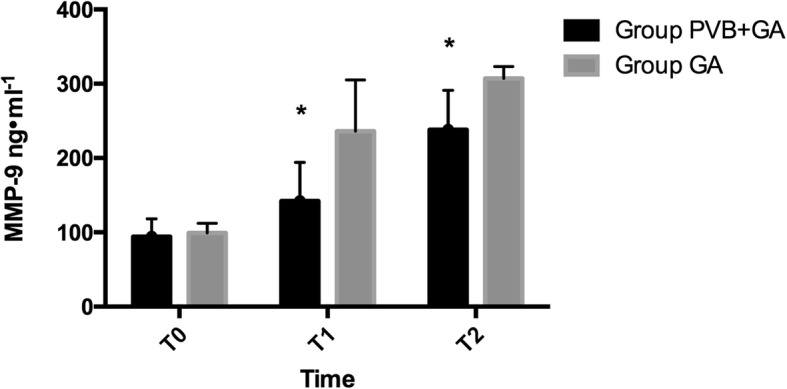
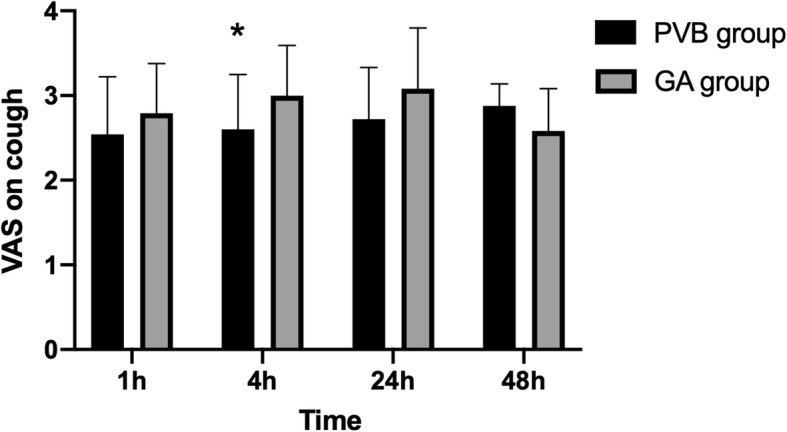
75 were enrolled to the study, of whom 21 were excluded before surgery. We analyzed lobectomy patients undergoing paravertebral block combined with general anesthesia (n = 25) or general anesthesia (n = 24). Both groups were similar regarding baseline characteristics. Pain scores at rest at 4 h and 24 h, on cough at 4 h were lower in PVB/GA group, compared with GA group (P < 0.05). There were no difference in pain scores at rest at 1 h, 48 h and on cough at 1 h, 24 h, and 48 h between groups. Patients in the PVB/GA group showed a greater decrease in plasma MMP-9 level at T1 and T2 after VATS lobectomy (P < 0.05). Postoperative complications and length of stay did not differ by anesthetic technique.
The paravertebral block/general anesthesia can provide statistically better pain relief and attenuate MMP-9 response to surgery and after VATS lobectomy. This technique may be beneficial for patients to recover rapidly after lung surgery and reduce postoperative tumor recurrence.
Chinese Clinical Trial registration number ChiCTR1800016379. Registered 28 May 2018.
局部麻醉可减轻手术应激反应并减少阿片类药物的使用,这可能减轻免疫抑制并潜在延缓术后肿瘤复发。我们比较了椎旁阻滞(PVB)联合全身麻醉(GA)与单纯全身麻醉对电视辅助胸腔镜手术(VATS)肺叶切除术后疼痛及基质金属蛋白酶-9(MMP-9)的影响。
2018年5月2日至2018年9月28日期间,在青岛一家三级甲等教学医院接受择期VATS肺叶切除术的54例患者通过计算机随机分为椎旁阻滞联合全身麻醉组或单纯全身麻醉组。主要结局指标为术后1、4、24和48小时静息及咳嗽时的疼痛评分。次要结局指标为血浆MMP-9浓度、并发症及术后住院时间。
75例患者纳入研究,其中21例在手术前被排除。我们分析了接受椎旁阻滞联合全身麻醉(n = 25)或单纯全身麻醉(n = 24)的肺叶切除术患者。两组患者的基线特征相似。与全身麻醉组相比,椎旁阻滞联合全身麻醉组在术后4小时和24小时静息时以及4小时咳嗽时的疼痛评分更低(P < 0.05)。两组在术后1小时、48小时静息时以及1小时、24小时和48小时咳嗽时的疼痛评分无差异。椎旁阻滞联合全身麻醉组患者在VATS肺叶切除术后T1和T2时血浆MMP-9水平下降幅度更大(P < 0.05)。术后并发症和住院时间在不同麻醉技术之间无差异。
椎旁阻滞/全身麻醉在统计学上能提供更好的疼痛缓解,并减轻VATS肺叶切除术后MMP-9对手术的反应。该技术可能有利于患者肺手术后快速恢复并减少术后肿瘤复发。
中国临床试验注册号ChiCTR1800016379。于2018年5月28日注册。