Department of Chest Diseases, Faculty of Medicine, Assuit University, Assiut University Hospital, Assuit, 71515, Egypt.
Respir Res. 2020 Mar 6;21(1):64. doi: 10.1186/s12931-020-1320-7.
The long-term effect of average volume-assured pressure support (AVAPS) on health-related quality of life (HRQOL) in chronic obstructive pulmonary disease (COPD) patients with chronic hypercapnic respiratory failure (CHRF) remains unclear. The objective of this study is to identify the long-term effect of AVAPS in COPD patients with CHRF through assessment of HRQOL, exercise tolerance after six months duration.
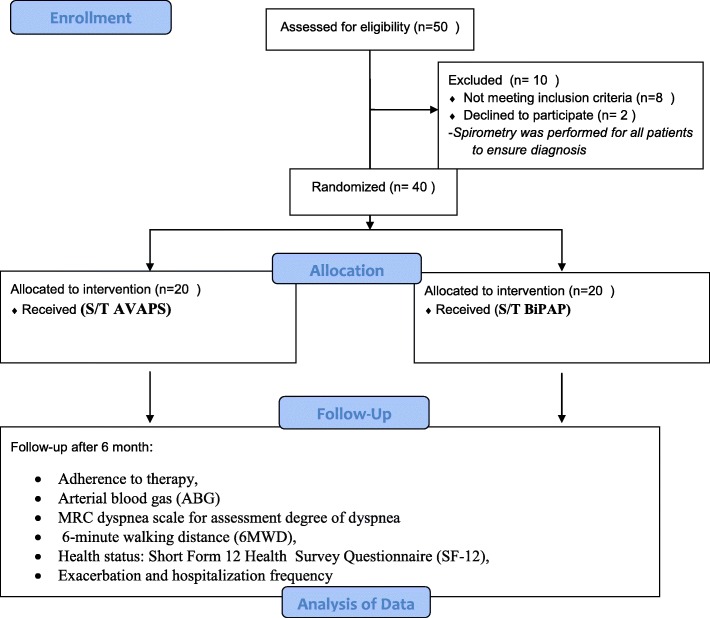
In this randomized, controlled, parallel-group study, 40 stable hypercapnic COPD patients were randomized in a 1:1 ratio to receive either spontaneous timed AVAPS (ST/AVAPS) (intervention) or Bilevel positive airway pressure (ST/BiPAP) (control). HRQL was measured with the Short Form 12 Health Survey Questionnaire (SF-12). Exercise tolerance assessed by 6 min walking distance. Analyses were done between groups from baseline to the average of six months measurements.
AVAPS led to significant 6 months improvements in several domains of (SF-12) compared to the control group, with the greatest improvement seen in general health [treatment effect of 8.2 points (95% confidence interval [95% CI 3.2 to 11.7; p = 0.001)], vitality (treatment effect 5.4 points [95% CI 1.4 to 9.3]; p = 0.001), physical functioning 5.5 points [95% CI 1.1 to 9.8]; p = 0.001) and bodily pain 5.1 points [95% CI 3.4 to 8.8]; p = 0.002). The physical health summary score improved by 3.7 points (95% CI 1.2 to 5.8; p = 0.001), but no significant improvement in the emotional or social role functioning, mental health subscale was noted. AVAPS also resulted in improvement 6 min walking distance 9.2 points (95% CI - 1 to - 15];p = 0.001). A significant reduction in the daytime (PaCO2) was observed after 6 months in those treated with AVAPS.
In COPD patients with hypercapnic respiratory failure, AVAPS improved exercise tolerance and multiple domains of HRQOL over six months of follow-up, with the significant improvement observed in general health.
本研究旨在通过评估 6 个月后患者的健康相关生活质量(HRQOL)和运动耐量,确定平均容量保证压力支持(AVAPS)对慢性阻塞性肺疾病(COPD)合并慢性高碳酸血症呼吸衰竭(CHRF)患者的长期影响。
在这项随机、对照、平行组研究中,40 例稳定的高碳酸血症 COPD 患者按照 1:1 的比例随机分为两组,分别接受自主定时 AVAPS(ST/AVAPS)(干预组)或双水平气道正压通气(ST/BiPAP)(对照组)。采用简短 12 项健康调查量表(SF-12)评估 HRQL。6 分钟步行距离评估运动耐量。对两组从基线到平均 6 个月的测量结果进行分析。
与对照组相比,AVAPS 组在 SF-12 的多个领域在 6 个月时均有显著改善,其中一般健康状况的改善最大[治疗效果为 8.2 分(95%置信区间[95%CI]为 3.2 至 11.7;p=0.001)]、活力(治疗效果为 5.4 分[95%CI 为 1.4 至 9.3;p=0.001])、身体机能 5.5 分[95%CI 为 1.1 至 9.8;p=0.001)和身体疼痛 5.1 分[95%CI 为 3.4 至 8.8;p=0.002)]。生理健康综合评分提高了 3.7 分(95%CI 为 1.2 至 5.8;p=0.001),但情绪或社会角色功能、心理健康亚量表无显著改善。AVAPS 还使 6 分钟步行距离增加了 9.2 分(95%CI -1 至 -15;p=0.001)。AVAPS 治疗后 6 个月,白天(PaCO2)显著降低。
在合并高碳酸血症呼吸衰竭的 COPD 患者中,AVAPS 可改善运动耐量和 HRQOL 的多个领域,在 6 个月的随访中,一般健康状况的改善最为显著。