Social Neuroscience Lab at the Translational Psychiatry Unit (TPU), Department of Psychiatry and Psychotherapy, University of Lübeck, Ratzeburger Allee 160, D-23538, Lübeck, Germany.
Nat Commun. 2020 Mar 6;11(1):1230. doi: 10.1038/s41467-020-14800-4.
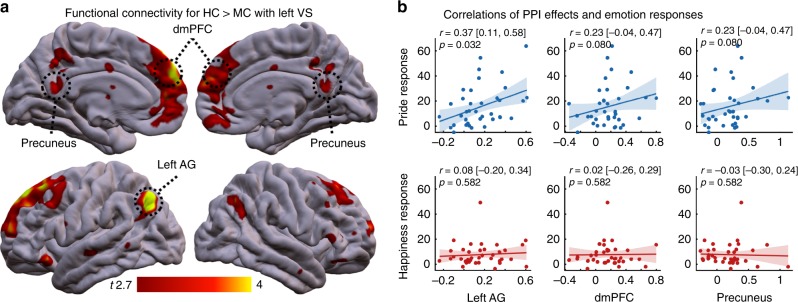
Experiencing events as controllable is essential for human well-being. Based on classic psychological theory, we test how internal control beliefs impact the affective valuation of task outcomes, neural dynamics and ensuing behavioral preferences. In three consecutive studies we show that dynamics in positive affect increase, with a qualitative shift towards self-evaluative pride, when agents believe they caused a given outcome. We demonstrate that these outcomes engage brain networks processing self-referential information in the cortical midline. Here, activity in the ventromedial prefrontal cortex tracks outcome valence regarding both success as well as internal control, and covaries with positive affect in response to outcomes. These affective dynamics also relate to increased functional coupling between the ventral striatum and cortical midline structures. Finally, we show that pride predicts preferences for control, even at monetary costs. Our investigations extend recent models of positive affect and well-being, and emphasize that control beliefs drive intrinsic motivation.
体验事件可控性对人类福祉至关重要。基于经典心理学理论,我们测试了内部控制信念如何影响任务结果的情感评估、神经动力学和随后的行为偏好。在三项连续的研究中,我们表明,当代理人相信他们导致了给定的结果时,积极情感的动态会增加,并朝着自我评估的自豪感发生定性转变。我们证明,这些结果涉及到处理自我参照信息的大脑网络在皮质中线。在这里,腹内侧前额叶皮层的活动在成功和内部控制方面都与结果的效价有关,并与对结果的积极情感相关。这些情感动态也与腹侧纹状体和皮质中线结构之间的功能耦合增加有关。最后,我们表明,自豪感甚至可以预测对控制的偏好,即使需要付出金钱代价。我们的研究扩展了积极情感和幸福感的最新模型,并强调控制信念驱动内在动机。