Kavli Institute for Fundamental Neuroscience and Department of Physiology, University of California, San Francisco, CA, 94158, USA.
Department of Psychiatry, University of California, San Francisco, CA, 94143, USA.
Mol Psychiatry. 2021 Jun;26(6):1909-1927. doi: 10.1038/s41380-020-0703-y. Epub 2020 Mar 6.
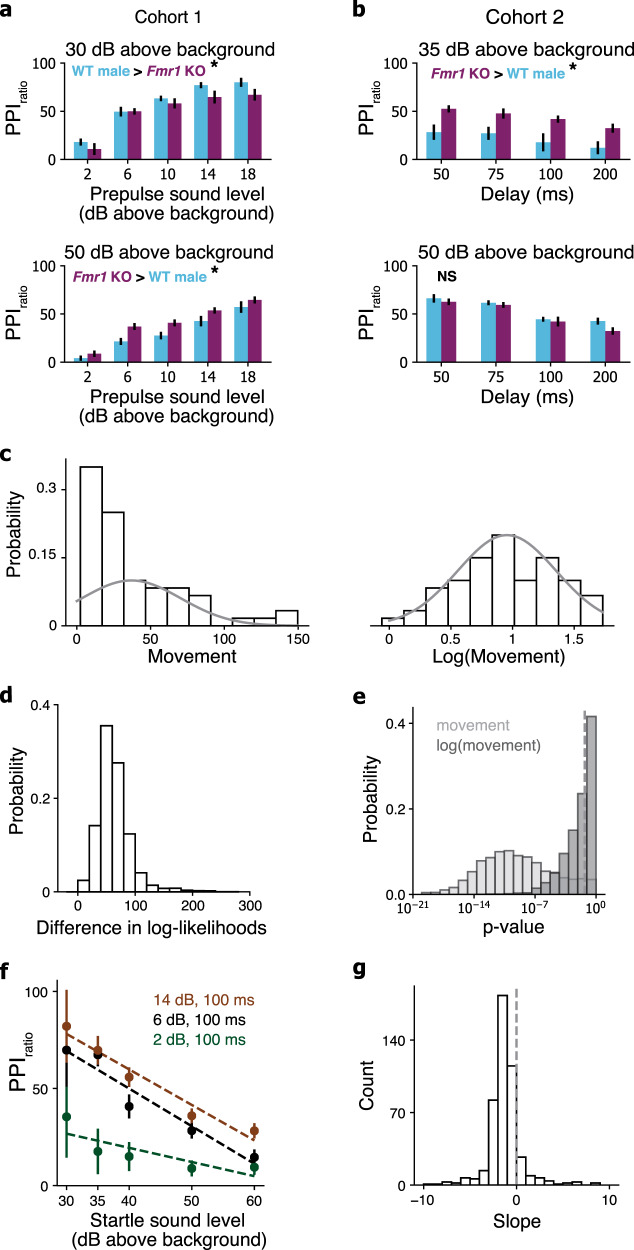
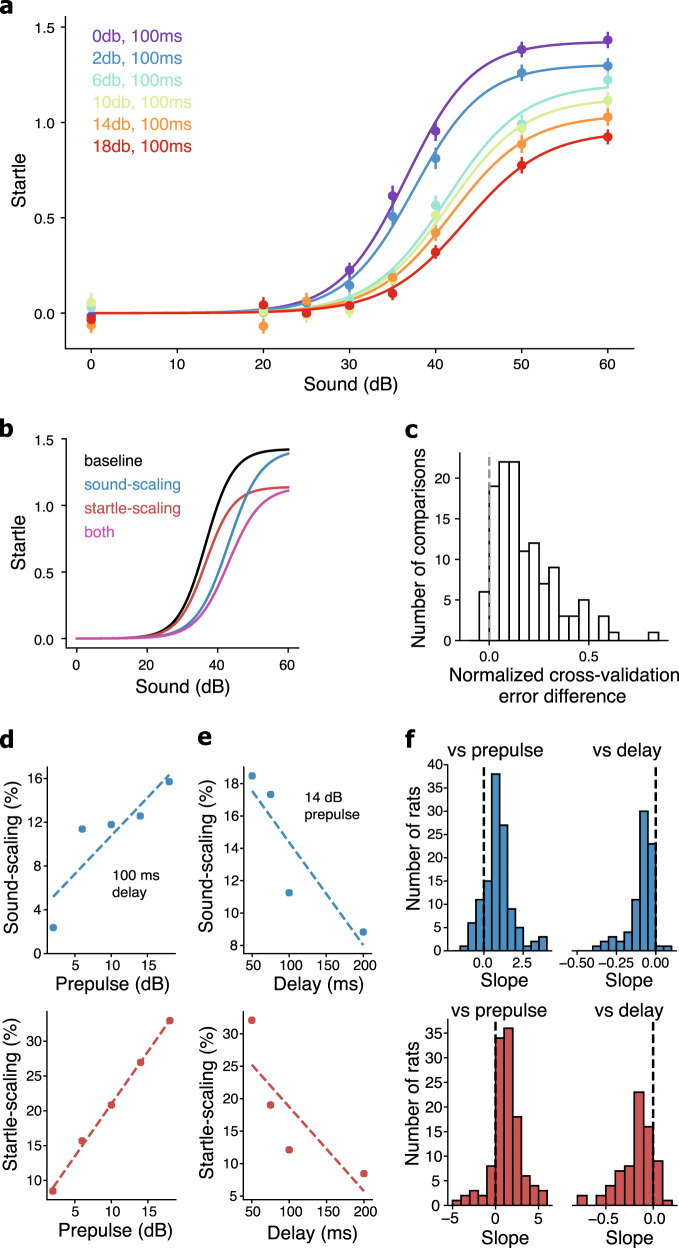
Measuring animal behavior in the context of experimental manipulation is critical for modeling, and understanding neuropsychiatric disease. Prepulse inhibition of the acoustic startle response (PPI) is a behavioral phenomenon studied extensively for this purpose, but the results of PPI studies are often inconsistent. As a result, the utility of this phenomenon remains uncertain. Here, we deconstruct the phenomenon of PPI and confirm several limitations of the methodology traditionally utilized to describe PPI, including that the underlying startle response has a non-Gaussian distribution, and that the traditional PPI metric changes with different stimuli. We then develop a novel model that reveals PPI to be a combination of the previously appreciated scaling of the startle response, as well as a scaling of sound processing. Using our model, we find no evidence for differences in PPI in a rat model of Fragile-X Syndrome (FXS) compared with wild-type controls. These results in the rat provide a reliable methodology that could be used to clarify inconsistent PPI results in mice and humans. In contrast, we find robust differences between wild-type male and female rats. Our model allows us to understand the nature of these differences, and we find that both the startle-scaling and sound-scaling components of PPI are a function of the baseline startle response. Males and females differ specifically in the startle-scaling, but not the sound-scaling, component of PPI. These findings establish a robust experimental and analytical approach that has the potential to provide a consistent biomarker of brain function.
在实验操作的背景下测量动物行为对于建模和理解神经精神疾病至关重要。听觉惊跳反应的预备脉冲抑制(PPI)是为此目的广泛研究的一种行为现象,但 PPI 研究的结果往往不一致。因此,这种现象的实用性仍然不确定。在这里,我们对 PPI 现象进行了剖析,并证实了传统上用于描述 PPI 的方法学存在一些局限性,包括基础惊跳反应具有非高斯分布,以及传统的 PPI 度量随着不同刺激而变化。然后,我们开发了一种新模型,该模型揭示了 PPI 是惊跳反应的缩放以及声音处理的缩放的组合。使用我们的模型,我们没有发现脆性 X 综合征(FXS)大鼠模型与野生型对照之间的 PPI 存在差异的证据。这些在大鼠中的结果提供了一种可靠的方法,可以用来澄清在小鼠和人类中不一致的 PPI 结果。相比之下,我们发现野生型雄性和雌性大鼠之间存在明显差异。我们的模型使我们能够理解这些差异的本质,并且我们发现 PPI 的惊跳反应缩放和声音缩放两个组成部分都是基础惊跳反应的函数。雄性和雌性在 PPI 的惊跳反应缩放部分存在差异,但在声音缩放部分没有差异。这些发现建立了一种强大的实验和分析方法,有可能提供一致的大脑功能生物标志物。