Institute for Cell and Molecular Biosciences, Newcastle University Institute for Ageing, Newcastle University, Campus for Ageing and Vitality, Newcastle upon Tyne, NE4 5PL, United Kingdom; Institute of Molecular, Cell and Systems Biology, College of Medical, Veterinary and Life Sciences, University of Glasgow, G12 8QQ, Glasgow, United Kingdom.
Institute for Cell and Molecular Biosciences, Newcastle University Institute for Ageing, Newcastle University, Campus for Ageing and Vitality, Newcastle upon Tyne, NE4 5PL, United Kingdom.
Redox Biol. 2020 May;32:101450. doi: 10.1016/j.redox.2020.101450. Epub 2020 Feb 7.
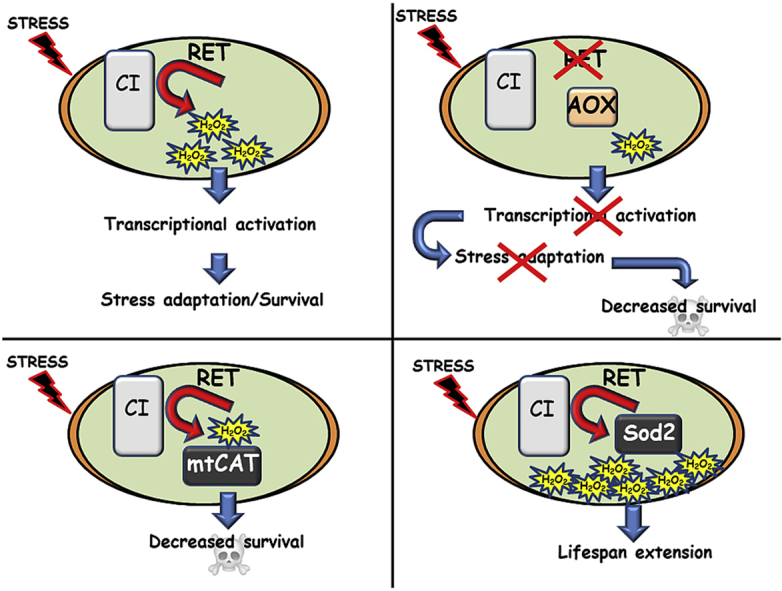
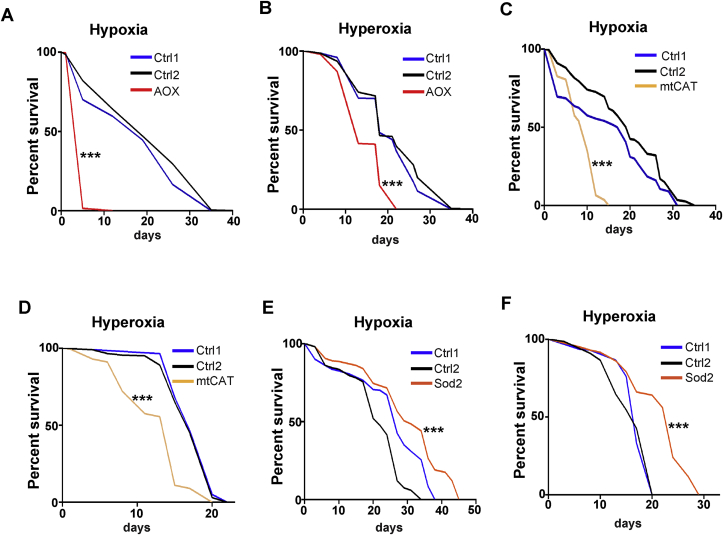
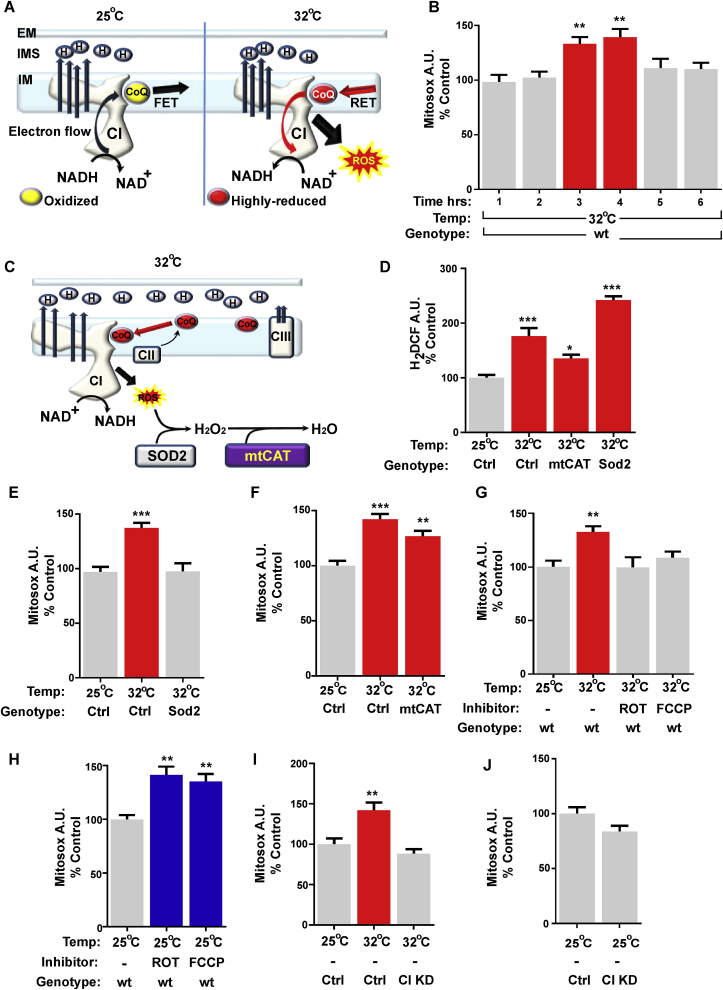
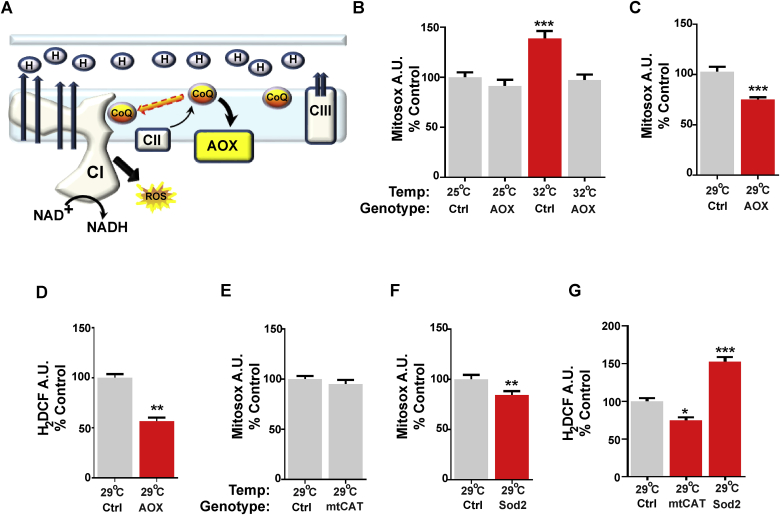
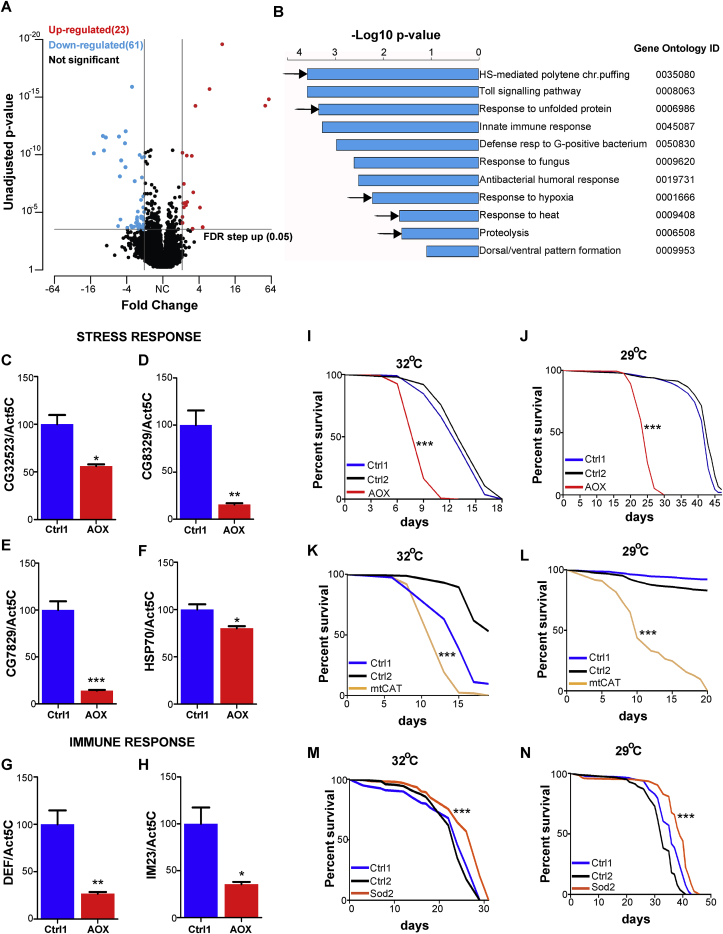
Reactive Oxygen Species (ROS) are essential cellular messengers required for cellular homeostasis and regulate the lifespan of several animal species. The main site of ROS production is the mitochondrion, and within it, respiratory complex I (CI) is the main ROS generator. ROS produced by CI trigger several physiological responses that are essential for the survival of neurons, cardiomyocytes and macrophages. Here, we show that CI produces ROS when electrons flow in either the forward (Forward Electron Transport, FET) or reverse direction (Reverse Electron Transport, RET). We demonstrate that ROS production via RET (ROS-RET) is activated under thermal stress conditions and that interruption of ROS-RET production, through ectopic expression of the alternative oxidase AOX, attenuates the activation of pro-survival pathways in response to stress. Accordingly, we find that both suppressing ROS-RET signalling or decreasing levels of mitochondrial HO by overexpressing mitochondrial catalase (mtCAT), reduces survival dramatically in flies under stress. Our results uncover a specific ROS signalling pathway where hydrogen peroxide (HO) generated by CI via RET is required to activate adaptive mechanisms, maximising survival under stress conditions.
活性氧 (ROS) 是细胞内稳态所必需的细胞信使,调节着几种动物物种的寿命。ROS 的主要产生部位是线粒体,而在线粒体中,呼吸复合物 I (CI) 是主要的 ROS 产生器。CI 产生的 ROS 引发了几种对神经元、心肌细胞和巨噬细胞的生存至关重要的生理反应。在这里,我们表明当电子在正向 (Forward Electron Transport, FET) 或反向 (Reverse Electron Transport, RET) 方向流动时,CI 会产生 ROS。我们证明,在热应激条件下,通过 RET 产生的 ROS (ROS-RET) 被激活,并且通过异位表达替代氧化酶 AOX 中断 ROS-RET 的产生,可减弱应激反应中促生存途径的激活。因此,我们发现,无论是通过抑制 ROS-RET 信号转导还是通过过表达线粒体过氧化氢酶 (mtCAT) 降低线粒体 HO 的水平,都会导致果蝇在应激下的存活率显著降低。我们的结果揭示了一种特定的 ROS 信号通路,其中 CI 通过 RET 产生的过氧化氢 (HO) 被用来激活适应机制,从而在应激条件下最大限度地提高存活率。