Scialò Filippo, Fernández-Ayala Daniel J, Sanz Alberto
Institute for Cell and Molecular Biosciences, Newcastle University Institute for Ageing, Newcastle UniversityNewcastle upon Tyne, United Kingdom.
Centro Andaluz de Biología del Desarrollo, Universidad Pablo de Olavide-CSIC and CIBERER-ISCIIISeville, Spain.
Front Physiol. 2017 Jun 27;8:428. doi: 10.3389/fphys.2017.00428. eCollection 2017.
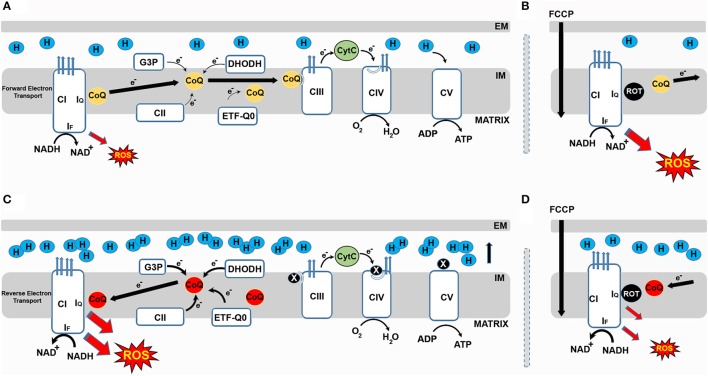
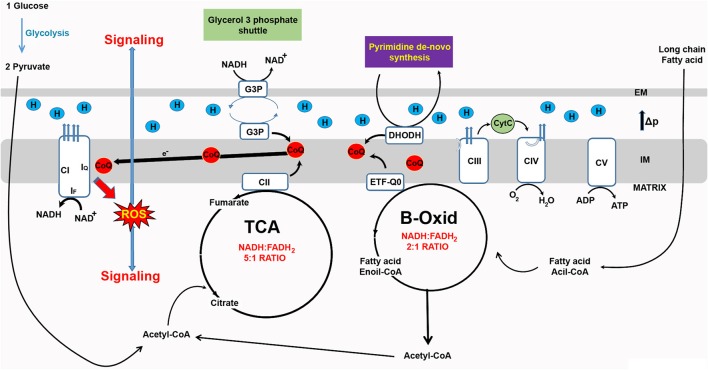
Reactive Oxygen Species (ROS) can cause oxidative damage and have been proposed to be the main cause of aging and age-related diseases including cancer, diabetes and Parkinson's disease. Accordingly, mitochondria from old individuals have higher levels of ROS. However, ROS also participate in cellular signaling, are instrumental for several physiological processes and boosting ROS levels in model organisms extends lifespan. The current consensus is that low levels of ROS are beneficial, facilitating adaptation to stress via signaling, whereas high levels of ROS are deleterious because they trigger oxidative stress. Based on this model the amount of ROS should determine the physiological effect. However, recent data suggests that the site at which ROS are generated is also instrumental in determining effects on cellular homeostasis. The best example of site-specific ROS signaling is reverse electron transport (RET). RET is produced when electrons from ubiquinol are transferred back to respiratory complex I, reducing NAD+ to NADH. This process generates a significant amount of ROS. RET has been shown to be instrumental for the activation of macrophages in response to bacterial infection, re-organization of the electron transport chain in response to changes in energy supply and adaptation of the carotid body to changes in oxygen levels. In , stimulating RET extends lifespan. Here, we review what is known about RET, as an example of site-specific ROS signaling, and its implications for the field of redox biology.
活性氧(ROS)可导致氧化损伤,并且被认为是衰老以及包括癌症、糖尿病和帕金森病在内的与年龄相关疾病的主要成因。因此,老年个体的线粒体具有更高水平的ROS。然而,ROS也参与细胞信号传导,对多个生理过程至关重要,并且提高模式生物中的ROS水平可延长寿命。目前的共识是,低水平的ROS有益,可通过信号传导促进对压力的适应,而高水平的ROS有害,因为它们会引发氧化应激。基于此模型,ROS的量应决定生理效应。然而,最近的数据表明,ROS产生的部位在决定对细胞稳态的影响方面也很重要。位点特异性ROS信号传导的最佳例子是逆向电子传递(RET)。当泛醇中的电子被转移回呼吸复合体I,将NAD⁺还原为NADH时,就会产生RET。这个过程会产生大量的ROS。RET已被证明在响应细菌感染时对巨噬细胞的激活、响应能量供应变化时电子传递链的重组以及颈动脉体对氧水平变化的适应中发挥作用。在……中,刺激RET可延长寿命。在这里,我们回顾关于RET的已知信息,作为位点特异性ROS信号传导的一个例子,以及它对氧化还原生物学领域的影响。