Key Laboratory of Cardiovascular Epidemiology, Chinese Academy of Medical Sciences; Department of Epidemiology, Fuwai Hospital, National Center for Cardiovascular Diseases, Chinese Academy of Medical Sciences and Peking Union Medical College, Beijing 100037, China; Tianjin Key Laboratory of Environment, Nutrition and Public Health; Department of Occupational and Environmental Health, School of Public Health, Tianjin Medical University, Tianjin 300070, China.
Key Laboratory of Cardiovascular Epidemiology, Chinese Academy of Medical Sciences; Department of Epidemiology, Fuwai Hospital, National Center for Cardiovascular Diseases, Chinese Academy of Medical Sciences and Peking Union Medical College, Beijing 100037, China.
Environ Int. 2020 May;138:105589. doi: 10.1016/j.envint.2020.105589. Epub 2020 Mar 5.
The concentration-response relationship between mortality and long-term exposure to fine particulate matter (PM) has not been fully elucidated, especially at high levels of PM concentrations.
We aimed to evaluate chronic effects of ambient PM exposure on deaths among Chinese adults in high-exposure settings.
Participants of the Prediction for Atherosclerotic cardiovascular disease Risk in China (China-PAR) project were included from four prospective cohorts among Chinese adults aged ≥18 years old. The overall follow-up rate of the four cohorts was 93.4% until the recent follow-up survey that ended in 2015. The average of satellite-based PM concentrations during 2000-2015 at 1-km spatial resolution was assigned to each participant according to individual residence addresses. Based on the pooled analysis of individual data from the four cohorts, a Cox proportional hazards model was used to estimate the hazard ratio (HR) and corresponding 95% confidence intervals (95% CIs) for the association of PM exposure with mortality after multivariate adjustment.
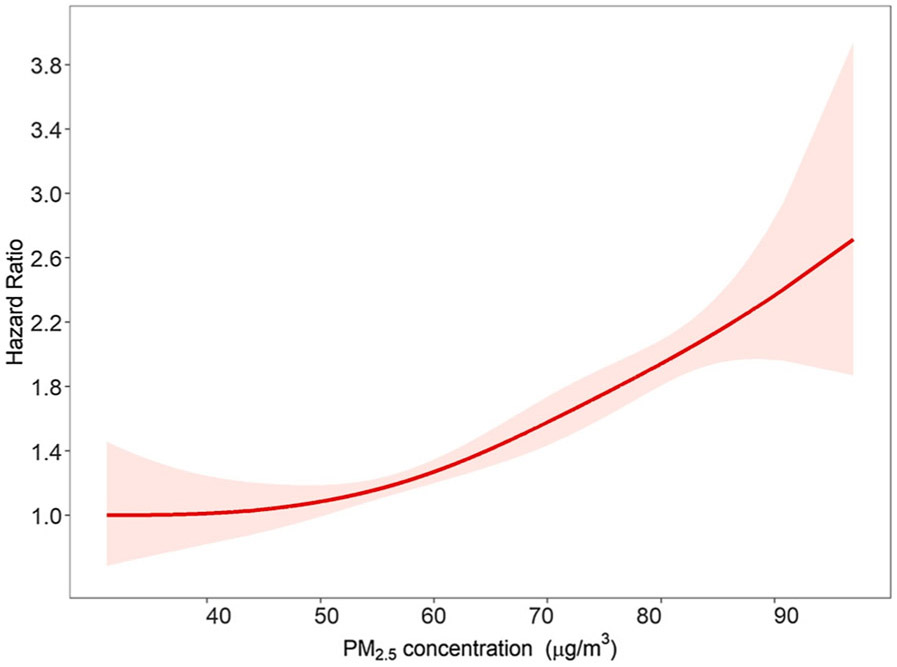
A total of 116,821 participants were eligible in the final analysis. During a mean of 7.7 years of follow-up, 6,395 non-accidental deaths and 2,507 cardio-metabolic deaths occurred. The mean of PM concentration was 64.9 μg/m ranging from 31.2 μg/m to 97.0 μg/m. For each 10 μg/m increment in PM, the HR was 1.11 (95% CI: 1.08-1.14) for non-accidental mortality and 1.22 (95% CI: 1.16-1.27) for cardio-metabolic mortality. In addition, a weak exponential curve for the concentration-response association between mortality and PM was observed among Chinese adults.
Our study provided important evidence of the long-term effects of PM exposure on deaths among Chinese adults. The findings expand our knowledge on concentration-response relationship in high-exposure environments, which is essential to address the urgent challenge of reducing the disease burden attributable to PM exposure in rapidly industrializing countries such as China.
长期暴露于细颗粒物(PM)与死亡率之间的浓度-反应关系尚未完全阐明,尤其是在 PM 浓度较高的情况下。
评估环境 PM 暴露对中国高暴露地区成年人死亡的慢性影响。
研究对象来自于年龄≥18 岁的中国成年人的四个前瞻性队列组成的预测动脉粥样硬化性心血管疾病风险在中国(China-PAR)项目。四个队列的总体随访率在最近一次随访调查中达到 93.4%,随访调查结束于 2015 年。根据个体居住地址,将 2000-2015 年期间 1 公里空间分辨率的卫星基 PM 浓度平均值分配给每个参与者。基于四个队列的个体数据的汇总分析,使用 Cox 比例风险模型估计 PM 暴露与多变量调整后死亡率之间的关联的风险比(HR)和相应的 95%置信区间(95%CI)。
最终分析共纳入 116821 名符合条件的参与者。在平均 7.7 年的随访期间,发生了 6395 例非意外死亡和 2507 例心脑血管代谢死亡。PM 浓度的平均值为 64.9μg/m,范围为 31.2μg/m 至 97.0μg/m。每增加 10μg/m 的 PM,非意外死亡率的 HR 为 1.11(95%CI:1.08-1.14),心脑血管代谢死亡率的 HR 为 1.22(95%CI:1.16-1.27)。此外,在中国成年人中,死亡率与 PM 之间的浓度-反应关系呈弱指数曲线。
本研究提供了重要证据表明 PM 暴露对中国成年人死亡的长期影响。研究结果扩展了我们对高暴露环境中浓度-反应关系的认识,这对于解决中国等快速工业化国家因 PM 暴露导致的疾病负担问题至关重要。