Perspectum Ltd, Oxford, UK.
Department of Oncology, Medical Sciences Division, University of Oxford, Oxford, UK.
J Magn Reson Imaging. 2020 Sep;52(3):807-820. doi: 10.1002/jmri.27113. Epub 2020 Mar 8.
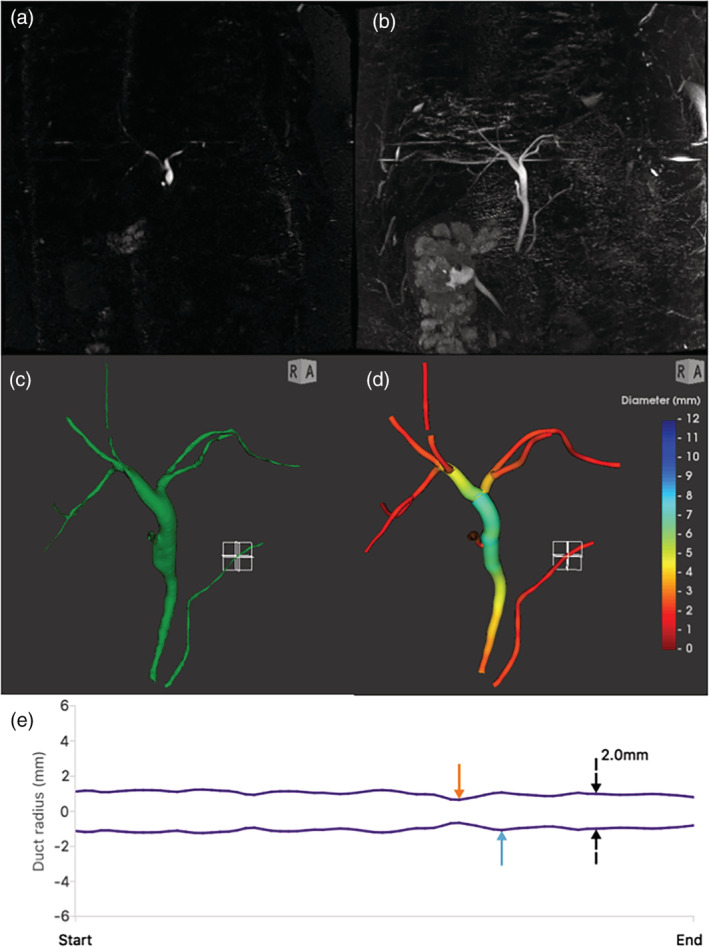
Magnetic resonance cholangiopancreatography (MRCP) is an important tool for noninvasive imaging of biliary disease, however, its assessment is currently subjective, resulting in the need for objective biomarkers.
To investigate the accuracy, scan/rescan repeatability, and cross-scanner reproducibility of a novel quantitative MRCP tool on phantoms and in vivo. Additionally, to report normative ranges derived from the healthy cohort for duct measurements and tree-level summary metrics.
Prospective.
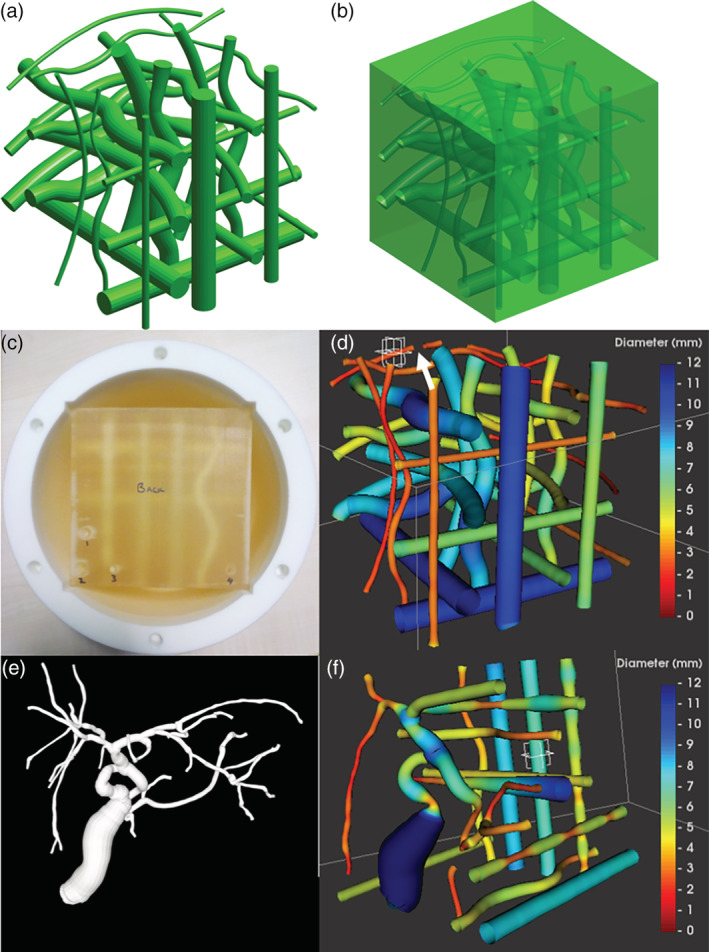
PHANTOMS/SUBJECTS: Phantoms: two bespoke designs, one with varying tube-width, curvature, and orientation, and one exhibiting a complex structure based on a real biliary tree. Subjects Twenty healthy volunteers, 10 patients with biliary disease, and 10 with nonbiliary liver disease.
SEQUENCE/FIELD STRENGTH: MRCP data were acquired using heavily T -weighted 3D multishot fast/turbo spin echo acquisitions at 1.5T and 3T.
Digital instances of the phantoms were synthesized with varying resolution and signal-to-noise ratio. Physical 3D-printed phantoms were scanned across six scanners (two field strengths for each of three manufacturers). Human subjects were imaged on four scanners (two fieldstrengths for each of two manufacturers).
Bland-Altman analysis and repeatability coefficient (RC).
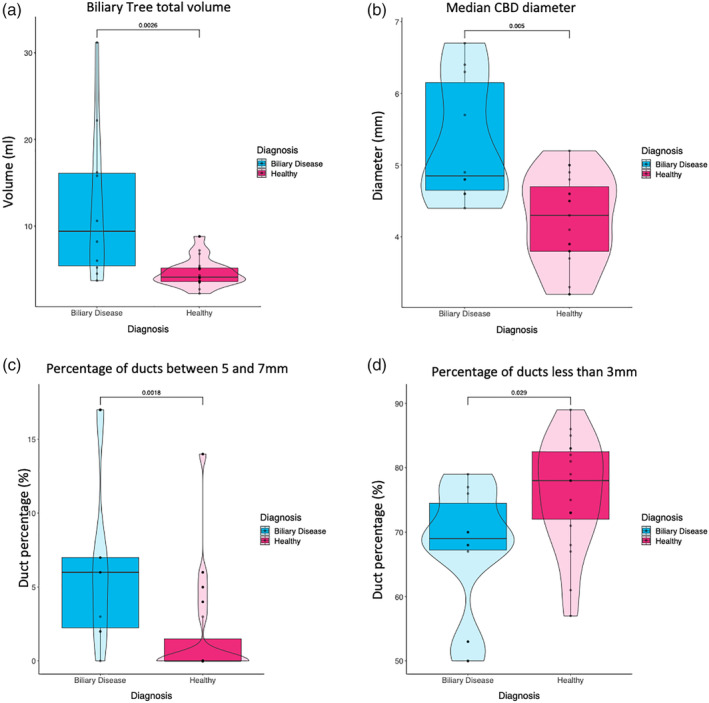
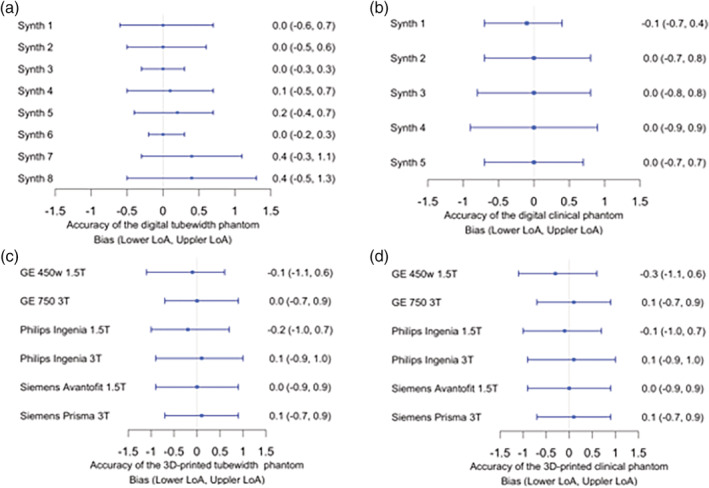
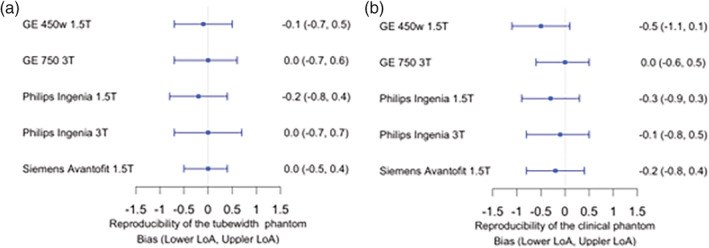
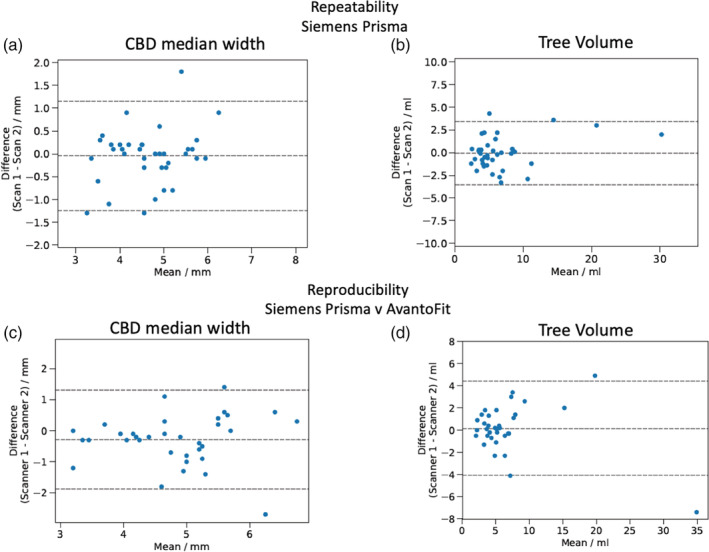
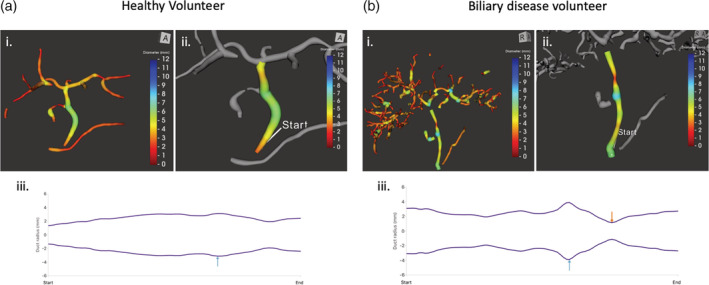
Accuracy of the diameter measurement approximated the scanning resolution, with 95% limits of agreement (LoA) from -1.1 to 1.0 mm. Excellent phantom repeatability was observed, with LoA from -0.4 to 0.4 mm. Good reproducibility was observed across the six scanners for both phantoms, with a range of LoA from -1.1 to 0.5 mm. Inter- and intraobserver agreement was high. Quantitative MRCP detected strictures and dilatations in the phantom with 76.6% and 85.9% sensitivity and 100% specificity in both. Patients and healthy volunteers exhibited significant differences in metrics including common bile duct (CBD) maximum diameter (7.6 mm vs. 5.2 mm P = 0.002), and overall biliary tree volume 12.36 mL vs. 4.61 mL, P = 0.0026).
The results indicate that quantitative MRCP provides accurate, repeatable, and reproducible measurements capable of objectively assessing cholangiopathic change. Evidence Level: 1 Technical Efficacy: Stage 2 J. Magn. Reson. Imaging 2020;52:807-820.
磁共振胰胆管成像(MRCP)是一种用于胆道疾病无创成像的重要工具,然而,其评估目前是主观的,因此需要客观的生物标志物。
在体模和体内研究一种新型定量 MRCP 工具的准确性、扫描/重扫可重复性和跨扫描仪可重复性,并报告来自健康队列的管腔测量和树状汇总指标的正常值范围。
前瞻性。
体模/受试者:体模:两个定制设计,一个具有不同的管腔宽度、曲率和方向,另一个基于真实的胆道树展示了复杂的结构。受试者:20 名健康志愿者、10 名胆道疾病患者和 10 名非胆道肝病患者。
序列/场强:在 1.5T 和 3T 下使用重度 T1 加权 3D 多shot 快速/涡轮自旋回波采集获得 MRCP 数据。
使用不同的分辨率和信噪比对体模的数字实例进行了合成。物理 3D 打印的体模在六个扫描仪上进行了扫描(每个制造商有两种场强)。对四名志愿者在四个扫描仪上进行了成像(每个制造商有两种场强)。
Bland-Altman 分析和重复性系数(RC)。
直径测量的准确性接近扫描分辨率,95%的一致性界限(LoA)为-1.1 至 1.0mm。观察到极好的体模重复性,LoA 为-0.4 至 0.4mm。两种制造商的两个场强的四个扫描仪均观察到良好的跨扫描仪可重复性,LoA 范围为-1.1 至 0.5mm。观察者间和观察者内的一致性很高。定量 MRCP 在体模中检测到狭窄和扩张,敏感性分别为 76.6%和 85.9%,特异性均为 100%。患者和健康志愿者在包括胆总管(CBD)最大直径(7.6mm 与 5.2mm,P=0.002)和整体胆道树容积(12.36mL 与 4.61mL,P=0.0026)在内的多个指标上存在显著差异。
结果表明,定量 MRCP 可提供准确、可重复和可重现的测量结果,能够客观评估胆管病变变化。
1 技术功效:2 阶段 J. Magn. Reson. Imaging 2020;52:807-820.