Yao Yuanyuan, Wang Xiaoqi, Chen Baocheng, Zhang Min, Ma Jinzhao
National Engineering Laboratory for Efficient Utilization of Soil and Fertilizer Resources, College of Recourses and Environment, Shandong Agricultural University, Taian 271018, China.
State Key Laboratory of Nutrition Resources Integrated Utilization, Kingenta Ecological Engineering Group Co., Ltd., Linshu 276700, China.
ACS Omega. 2020 Feb 21;5(8):4242-4249. doi: 10.1021/acsomega.9b04155. eCollection 2020 Mar 3.
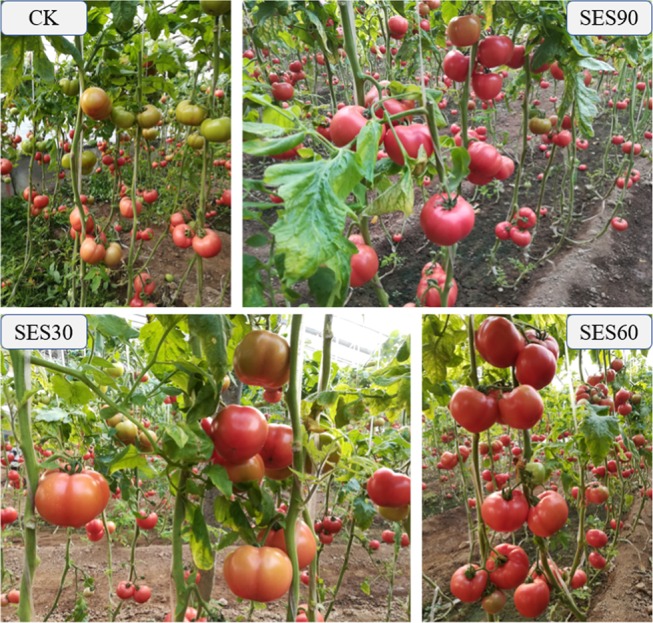
Overuse of chemical fertilizers in the intensive greenhouse tomato cultivation system has limited the increase of plant production. Nowadays, seaweed extract has been gradually applied in agriculture as an effective way to achieve a higher yield of crops, but its effects on tomato cultivation have not been fully explored. In this study, a greenhouse experiment was conducted in Shandong province of China with a novel seaweed extract (SES) originated from , to investigate the effects of different doses of SES (0, 30, 60, and 90 kg hm) on yields, quality, ripening time, and net returns of tomato. The results indicated that the application of SES significantly increased tomato yield by 4.6-6.9% compared to the control, which is attributed to the improved photosynthetic capacity of tomato leaves. The yields of tomato increased first and then decreased with increasing dosage of SES, and SES applied at the dose of 60 kg hm achieved the highest tomato yield. Compared to the control, SES at 60 and 90 kg hm significantly increased the hardness of tomato by 10.2 and 19.8%, respectively, and this can help to reduce losses during transportation and storage. Moreover, SES shortened the ripening time of tomato, and the coincidence between tomato harvest and sale price peak achieved a high net return.
在集约化温室番茄种植系统中,化肥的过度使用限制了作物产量的提高。如今,海藻提取物已逐渐应用于农业,作为实现作物高产的有效途径,但其对番茄种植的影响尚未得到充分探索。在本研究中,在中国山东省进行了一项温室试验,使用源自[具体来源未给出]的新型海藻提取物(SES),以研究不同剂量的SES(0、30、60和90千克/公顷)对番茄产量、品质、成熟时间和净收益的影响。结果表明,与对照相比,施用SES显著提高了番茄产量4.6% - 6.9%,这归因于番茄叶片光合能力的提高。番茄产量随着SES施用量的增加先增加后降低,施用60千克/公顷剂量的SES时番茄产量最高。与对照相比,60和90千克/公顷剂量的SES分别显著提高了番茄硬度10.2%和19.8%,这有助于减少运输和储存过程中的损失。此外,SES缩短了番茄的成熟时间,番茄收获与销售价格峰值的重合实现了较高的净收益。