Department of Molecular & Integrative Physiology, University of Kansas Medical Center, Kansas City, KS 66160, USA.
University of Kansas Alzheimer's Disease Center, Fairway, KS 66103, USA.
Nutrients. 2020 Mar 5;12(3):697. doi: 10.3390/nu12030697.
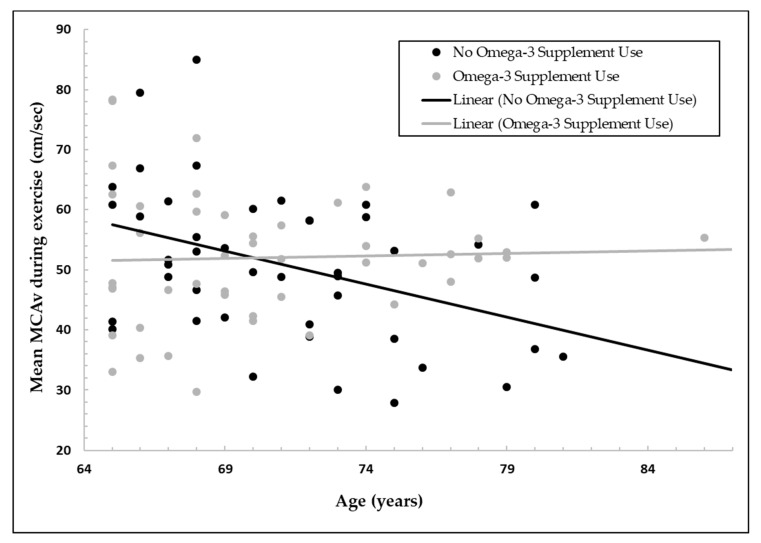
Cerebral blood flow (CBF) decreases across the lifespan, and chronic conditions such as dementia and stroke accelerate this decline. Impaired CBF results in reduced delivery of oxygen and nutrients, which can damage the brain over time. Thus, there is a need to identify lifestyle interventions, including diet and exercise, to maintain CBF with aging and in the presence of chronic disease. In the present study, we used transcranial Doppler ultrasound to record middle cerebral artery velocity (MCAv), a surrogate measure of CBF, during moderate-intensity exercise in sedentary, cognitively normal older adults ( = 90). A multiple linear regression model ((4, 85) = 3.21, = 0.02) showed that self-reported omega-3 supplement use significantly moderated the association between age and mean exercising MCAv in these individuals ( = 0.01). Older age was associated with lower exercising MCAv in the group not taking omega-3 supplements, while exercising MCAv showed no decline with increasing age in the group who reported omega-3 supplement use. These findings suggest omega-3 supplementation may have an important role in the preservation of CBF with aging.
大脑血流 (CBF) 会随着寿命的增长而减少,痴呆症和中风等慢性疾病会加速这种减少。CBF 受损会导致氧气和营养物质的输送减少,随着时间的推移会对大脑造成损害。因此,需要确定生活方式干预措施,包括饮食和运动,以维持 CBF 随着年龄的增长和在慢性疾病存在的情况下。在本研究中,我们使用经颅多普勒超声记录了久坐、认知正常的老年人(n = 90)在中等强度运动期间大脑中动脉速度(MCAv),这是 CBF 的替代测量指标。多元线性回归模型((4, 85) = 3.21, p = 0.02)表明,自我报告的ω-3 补充剂使用显著调节了年龄与这些个体运动时 MCAv 平均值之间的关联(β = 0.01)。在不服用 ω-3 补充剂的组中,年龄越大,运动时 MCAv 越低,而在报告服用 ω-3 补充剂的组中,MCAv 随着年龄的增长没有下降。这些发现表明,ω-3 补充剂可能在随着年龄增长而保持 CBF 方面发挥重要作用。