Department of Biomedical Engineering, Tel-Aviv University, Tel-Aviv, Israel.
Sagol School of Neuroscience, Tel-Aviv University, Tel-Aviv, Israel.
Genome Biol. 2020 Mar 9;21(1):63. doi: 10.1186/s13059-020-01971-y.
mRNA can form local secondary structure within the protein-coding sequence, and the strength of this structure is thought to influence gene expression regulation. Previous studies suggest that secondary structure strength may be maintained under selection, but the details of this phenomenon are not well understood.
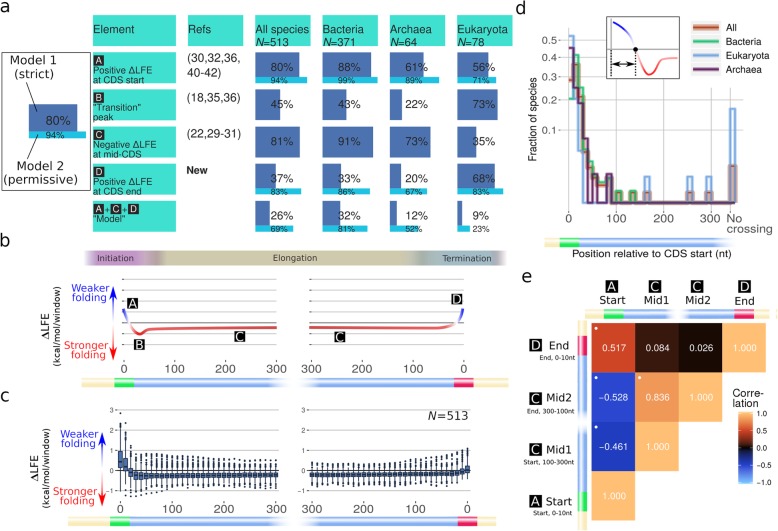
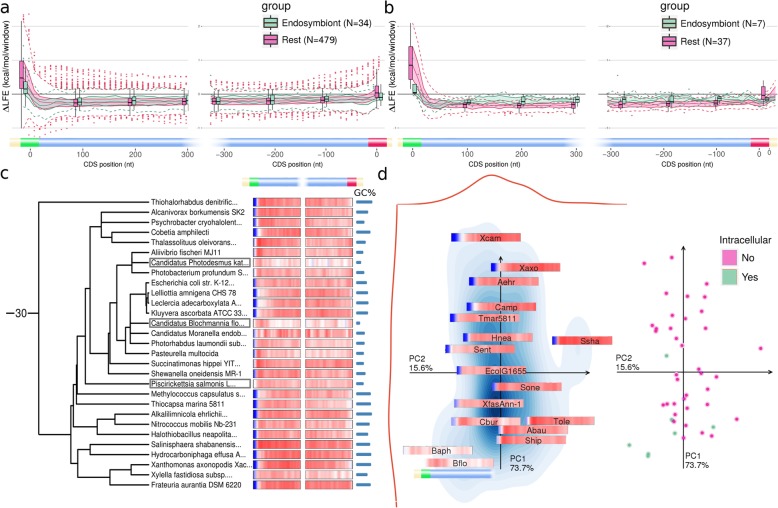
We perform a comprehensive study of the selection on local mRNA folding strengths considering variation between species across the tree of life. We show for the first time that local folding strength selection tends to follow a conserved characteristic profile in most phyla, with selection for weak folding at the two ends of the coding region and for strong folding elsewhere in the coding sequence, with an additional peak of selection for strong folding located downstream of the start codon. The strength of this pattern varies between species and organism groups, and we highlight contradicting cases. To better understand the underlying evolutionary process, we show that selection strengths in the different regions are strongly correlated, and report four factors which have a clear predictive effect on local mRNA folding selection within the coding sequence in different species.
The correlations observed between selection for local secondary structure strength in the different regions and with the four genomic and environmental factors suggest that they are shaped by the same evolutionary process throughout the coding sequence, and might be maintained under direct selection related to optimization of gene expression and specifically translation regulation.
mRNA 在编码序列内可以形成局部二级结构,并且这种结构的强度被认为会影响基因表达调控。先前的研究表明,二级结构强度可能在选择压力下得以维持,但这种现象的细节尚不清楚。
我们全面研究了跨越生命之树的物种间变异的局部 mRNA 折叠强度的选择。我们首次表明,在大多数门中,局部折叠强度选择往往遵循一个保守的特征模式,在编码区的两端选择弱折叠,在编码序列的其他地方选择强折叠,在起始密码子下游还有一个强折叠选择的峰。这种模式在物种和生物群体之间存在差异,我们强调了一些矛盾的情况。为了更好地理解潜在的进化过程,我们表明不同区域的选择强度具有很强的相关性,并报告了四个因素,它们在不同物种的编码序列中对局部 mRNA 折叠选择具有明显的预测作用。
不同区域之间以及与四个基因组和环境因素之间的局部二级结构强度选择的相关性表明,它们在整个编码序列中受到相同的进化过程的影响,并且可能受到与基因表达优化特别是翻译调控相关的直接选择的维持。