Goldsmith David R, Rapaport Mark Hyman
Department of Psychiatry and Behavioral Sciences, Emory University School of Medicine, Atlanta, GA, United States.
Front Psychiatry. 2020 Feb 20;11:46. doi: 10.3389/fpsyt.2020.00046. eCollection 2020.
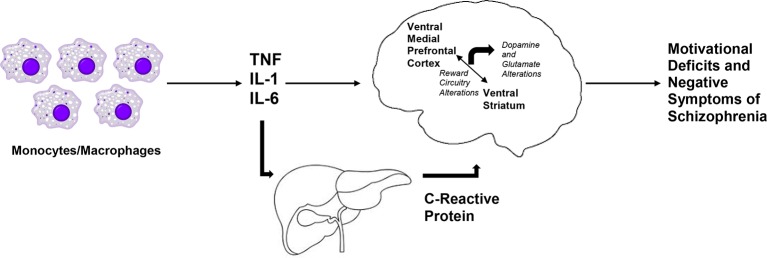
Negative symptoms of schizophrenia are debilitating and chronic in nature, are difficult to treat, and contribute to poor functional outcomes. Motivational deficits are a core negative symptom and may involve alterations in reward processing, which involve subcortical regions such as the basal ganglia. More specifically, dopamine-rich regions like the ventral striatum, have been implicated in these reward-processing deficits. Inflammation is one mechanism that may underlie negative symptoms, and specifically motivational deficits, via the effects of inflammatory cytokines on the basal ganglia. Previous work has demonstrated that inflammatory stimuli decrease neural activity in the ventral striatum and decrease connectivity in reward-relevant neural circuitry. The immune system has been shown to be involved in the pathophysiology of schizophrenia, and inflammatory cytokines have been shown to be altered in patients with the disorder. This paper reviews the literature on associations between inflammatory markers and negative symptoms of schizophrenia as well as the role of anti-inflammatory drugs to target negative symptoms. We also review the literature on the role of inflammation and reward processing deficits in both healthy controls and individuals with depression. We use the literature on inflammation and depression as a basis for a model that explores potential mechanisms responsible for inflammation modulating certain aspects of negative symptoms in patients with schizophrenia. This approach may offer novel targets to treat these symptoms of the disorder that are significant barriers to functional recovery and do not respond well to available antipsychotic medications.
精神分裂症的阴性症状本质上具有致残性且病程慢性,难以治疗,并导致功能预后不良。动机缺陷是核心阴性症状,可能涉及奖赏处理的改变,这涉及诸如基底神经节等皮质下区域。更具体地说,富含多巴胺的区域如腹侧纹状体,已被认为与这些奖赏处理缺陷有关。炎症是一种可能通过炎性细胞因子对基底神经节的作用而成为阴性症状尤其是动机缺陷基础的机制。先前的研究表明,炎性刺激会降低腹侧纹状体的神经活动,并减少与奖赏相关的神经回路的连通性。免疫系统已被证明参与精神分裂症的病理生理学,并且炎性细胞因子在该疾病患者中已被证明发生了改变。本文综述了关于炎性标志物与精神分裂症阴性症状之间关联的文献,以及抗炎药物针对阴性症状的作用。我们还综述了关于炎症和奖赏处理缺陷在健康对照者和抑郁症患者中的作用的文献。我们以关于炎症和抑郁症的文献为基础,构建一个模型,探讨炎症调节精神分裂症患者阴性症状某些方面的潜在机制。这种方法可能为治疗该疾病的这些症状提供新的靶点,这些症状是功能恢复的重大障碍,且对现有的抗精神病药物反应不佳。