Department of Psychiatry, Psychotherapy and Psychosomatics, Psychiatric Hospital, University of Zurich, Zurich, Switzerland.
Laboratory for Social and Neural Systems Research, Department of Economics, University of Zurich, Zurich, Switzerland.
PLoS One. 2018 Jun 18;13(6):e0198215. doi: 10.1371/journal.pone.0198215. eCollection 2018.
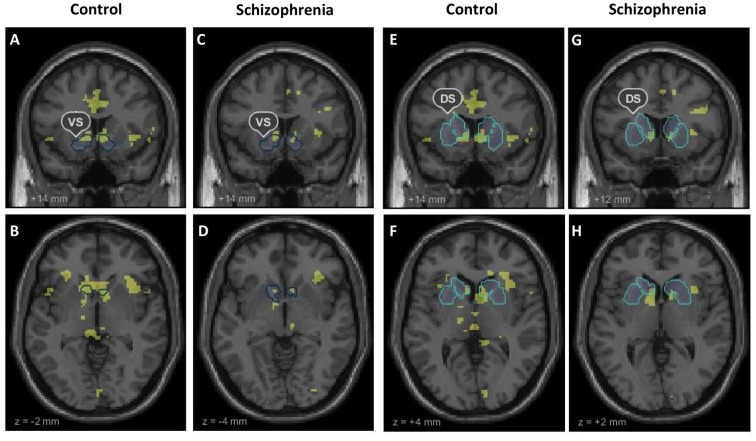
Negative symptoms are a core feature of schizophrenia and also found in healthy individuals in subclinical forms. According to the current literature the two negative symptom domains, apathy and diminished expression may have different underlying neural mechanisms. Previous observations suggest that striatal dysfunction is associated with apathy in schizophrenia. However, it is unclear whether apathy is specifically related to ventral or dorsal striatal alterations. Here, we investigated striatal dysfunction during reward anticipation in patients with schizophrenia and a non-clinical population, to determine whether it is associated with apathy.
Chronic schizophrenia patients (n = 16) and healthy controls (n = 23) underwent an event- related functional MRI, while performing a variant of the Monetary Incentive Delay Task. The two negative symptom domains were assessed in both groups using the Brief Negative Symptoms Scale.
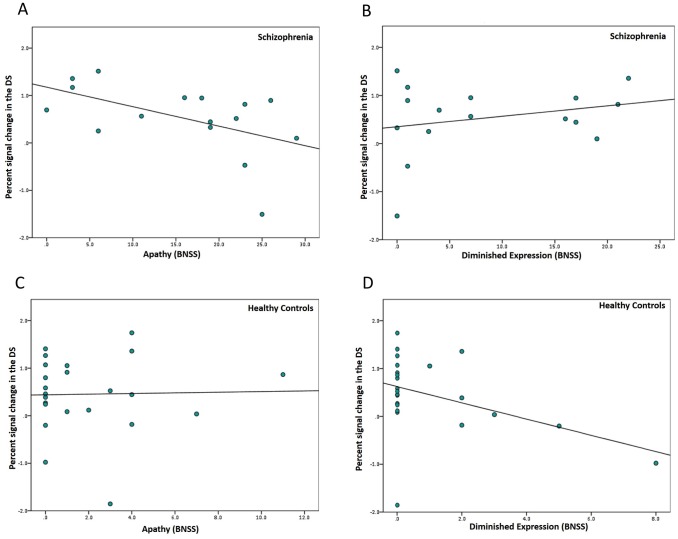
In schizophrenia patients, we saw a strong negative correlation between apathy and ventral and dorsal striatal activation during reward anticipation. In contrast, there was no correlation with diminished expression. In healthy controls, apathy was not correlated with ventral or dorsal striatal activation during reward anticipation.
This study replicates our previous findings of a correlation between ventral striatal activity and apathy but not diminished expression in chronic schizophrenia patients. The association between apathy and reduced dorsal striatal activity during reward anticipation suggests that impaired action-outcome selection is involved in the pathophysiology of motivational deficits in schizophrenia.
阴性症状是精神分裂症的核心特征,在亚临床形式中也存在于健康个体中。根据目前的文献,阴性症状的两个领域,即冷漠和表情减退可能具有不同的潜在神经机制。先前的观察表明,纹状体功能障碍与精神分裂症中的冷漠有关。然而,尚不清楚冷漠是否与腹侧或背侧纹状体的改变有特定关系。在这里,我们研究了精神分裂症患者和非临床人群在奖励预期期间的纹状体功能障碍,以确定它是否与冷漠有关。
慢性精神分裂症患者(n = 16)和健康对照组(n = 23)接受了事件相关功能磁共振成像,同时进行了货币奖励延迟任务的变体。使用简短的阴性症状量表评估两组的两个阴性症状领域。
在精神分裂症患者中,我们在奖励预期期间看到了冷漠与腹侧和背侧纹状体激活之间的强烈负相关。相比之下,与表情减退没有相关性。在健康对照组中,冷漠与奖励预期期间的腹侧或背侧纹状体激活没有相关性。
这项研究复制了我们之前的发现,即慢性精神分裂症患者中,腹侧纹状体活动与冷漠而不是表情减退之间存在相关性。在奖励预期期间,冷漠与背侧纹状体活动减少之间的关联表明,在精神分裂症的动机缺陷的病理生理学中,受损的动作-结果选择参与其中。