Erdman Alon, Abend Rany, Jalon Itamar, Artzi Moran, Gazit Tomer, Avirame Keren, Ais Ezequiel Diego, Levokovitz Hilik, Gilboa-Schechtman Eva, Hendler Talma, Harel Eiran Vadim
Sagol Brain Institute Tel Aviv, Tel Aviv Sourasky Medical Center, Tel Aviv, Israel.
Psychology Department, Bar-Ilan University, Ramat Gan, Israel.
Front Psychiatry. 2020 Feb 20;11:67. doi: 10.3389/fpsyt.2020.00067. eCollection 2020.
Ruminative responding involves repetitive and passive thinking about one's negative affect. This tendency interferes with initiation of goal-directed rewarding strategies, which could alleviate depressive states. Such reward-directed response selection has been shown to be mediated by ventral striatum/nucleus accumbens (VS/NAcc) function. However, to date, no study has examined whether trait rumination relates to VS/NAcc functionality. Here, we tested whether rumination moderates VS/NAcc function both in response to reward and during a ruminative state.
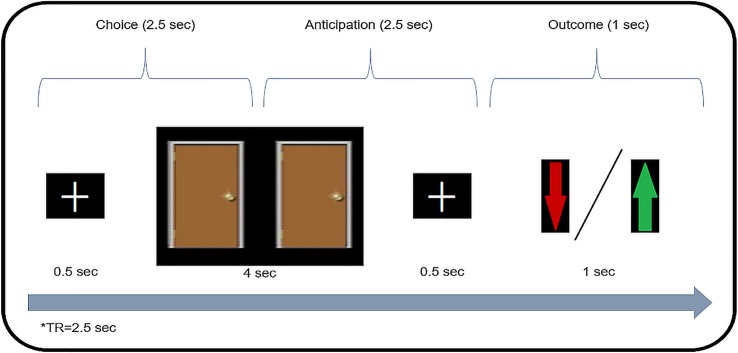
Trait rumination was considered dimensionally using Rumination Response Scale (RRS) scores. Our sample (N = 80) consisted of individuals from a community sample and from patients diagnosed with major depressive disorder, providing a broad range of RRS scores. Participants underwent fMRI to assess two modes of VS/NAcc functionality: 1) in response to reward, and 2) during resting-state, as a proxy for ruminative state. We then tested for associations between RRS scores and VS/NAcc functional profiles, statistically controlling for overall depressive symptom severity.
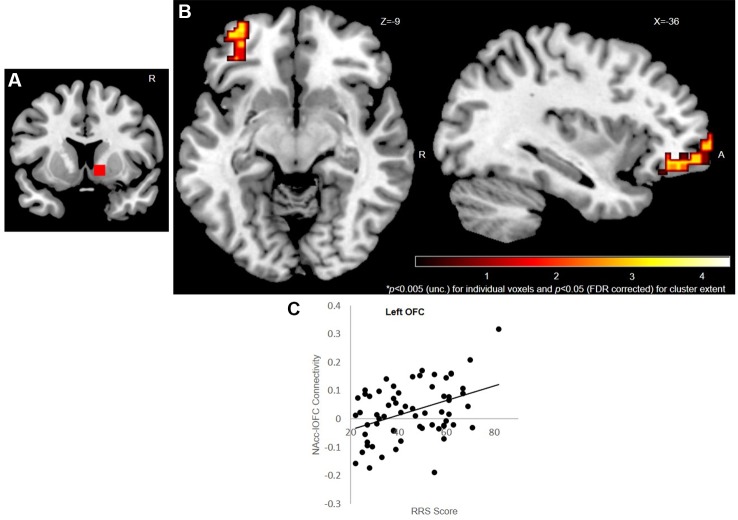
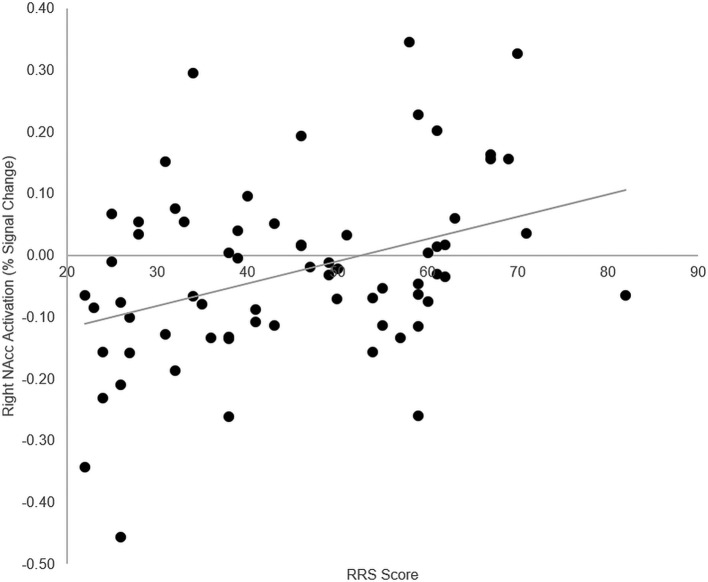
RRS scores correlated positively with VS/NAcc response to reward. Furthermore, we noted that higher RRS scores were associated with increased ruminative-dependent resting-state functional connectivity of the VS/NAcc with the left orbitofrontal cortex.
These findings suggest that ruminative tendencies manifest in VS/NAcc reward- and rumination-related functions, providing support for a theoretical-clinical perspective of rumination as a habitual impairment in selection of rewarding, adaptive coping strategies.
沉思反应涉及对自身消极情绪的反复被动思考。这种倾向会干扰目标导向性奖励策略的启动,而这些策略本可缓解抑郁状态。已有研究表明,这种奖励导向性反应选择是由腹侧纹状体/伏隔核(VS/NAcc)功能介导的。然而,迄今为止,尚无研究考察特质性沉思是否与VS/NAcc功能相关。在此,我们测试了沉思是否会在对奖励的反应以及沉思状态下调节VS/NAcc功能。
使用沉思反应量表(RRS)得分从维度上考量特质性沉思。我们的样本(N = 80)包括来自社区样本的个体以及被诊断为重度抑郁症的患者,提供了广泛的RRS得分范围。参与者接受功能磁共振成像(fMRI)以评估VS/NAcc功能的两种模式:一是对奖励的反应,二是静息状态下(作为沉思状态的替代指标)。然后,我们测试了RRS得分与VS/NAcc功能特征之间的关联,并对总体抑郁症状严重程度进行了统计控制。
RRS得分与VS/NAcc对奖励的反应呈正相关。此外,我们注意到较高的RRS得分与VS/NAcc与左侧眶额皮质之间与沉思相关的静息状态功能连接增加有关。
这些发现表明,沉思倾向体现在VS/NAcc与奖励及沉思相关的功能中,为将沉思视为选择奖励性、适应性应对策略的习惯性损害这一理论 - 临床观点提供了支持。