• 文献检索
  • 文档翻译
  • 深度研究
  • 学术资讯
  • Suppr Zotero 插件Zotero 插件
  • 邀请有礼
  • 套餐&价格
  • 历史记录
应用&插件
Suppr Zotero 插件Zotero 插件浏览器插件Mac 客户端Windows 客户端微信小程序
定价
高级版会员购买积分包购买API积分包
服务
文献检索文档翻译深度研究API 文档MCP 服务
关于我们
关于 Suppr公司介绍联系我们用户协议隐私条款
关注我们

Suppr 超能文献

核心技术专利:CN118964589B侵权必究
粤ICP备2023148730 号-1Suppr @ 2026

文献检索

告别复杂PubMed语法,用中文像聊天一样搜索,搜遍4000万医学文献。AI智能推荐,让科研检索更轻松。

立即免费搜索

文件翻译

保留排版,准确专业,支持PDF/Word/PPT等文件格式,支持 12+语言互译。

免费翻译文档

深度研究

AI帮你快速写综述,25分钟生成高质量综述,智能提取关键信息,辅助科研写作。

立即免费体验

尼泊尔发育迟缓的趋势与不平等现象:对2001年至2016年四次尼泊尔人口与健康调查的二次数据分析

Trends and inequalities in stunting in Nepal: a secondary data analysis of four Nepal demographic health surveys from 2001 to 2016.

作者信息

Nepali Sajama, Simkhada Padam, Davies Ian

机构信息

1Central Department of Home Science, Tribhuvan University, Kathmandu, Nepal.

2Faculty of Education, Health and Community, Public Health Institute, Liverpool John Moores University, Liverpool, UK.

出版信息

BMC Nutr. 2019 Mar 4;5:19. doi: 10.1186/s40795-019-0283-x. eCollection 2019.

DOI:10.1186/s40795-019-0283-x
PMID:32153932
原文链接:https://pmc.ncbi.nlm.nih.gov/articles/PMC7050877/
Abstract

BACKGROUND

The rate of stunting in Nepal is among the highest in the world, which is a major public health problem. The objective of this study was to present data on stunting prevalence according to socio-demographic and geographical circumstances and to determine the impact of those circumstances on the risk of stunting.

METHODS

Data from Nepal Demographic and Health Surveys were used with the study population of children under 5 years old. The prevalence of stunting was determined by descriptive analysis and logistic regression analysis was used to determine risk factors for stunting.

RESULTS

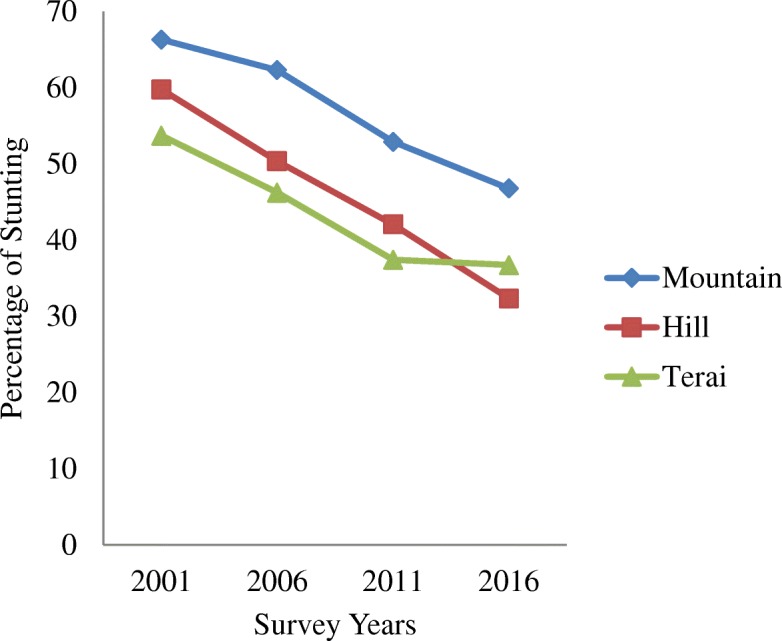
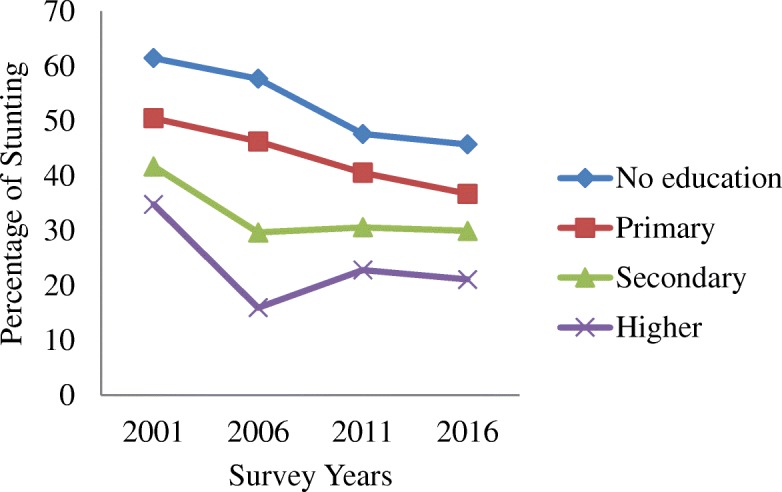
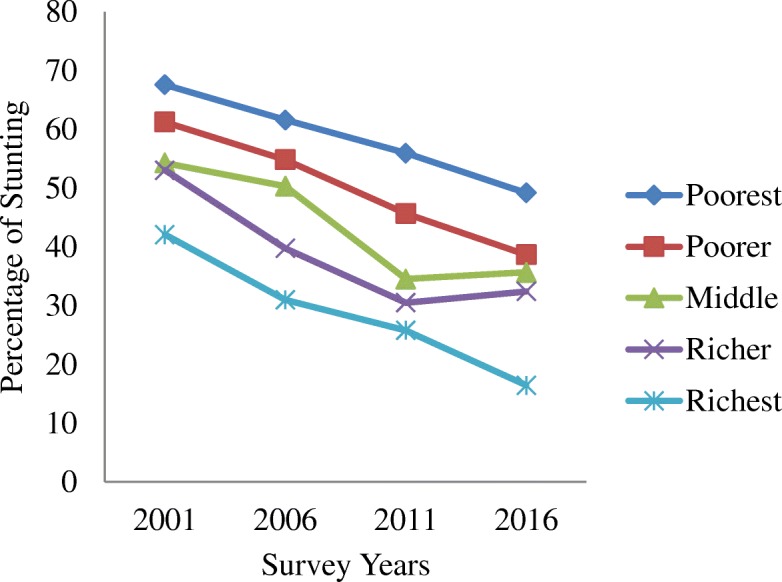
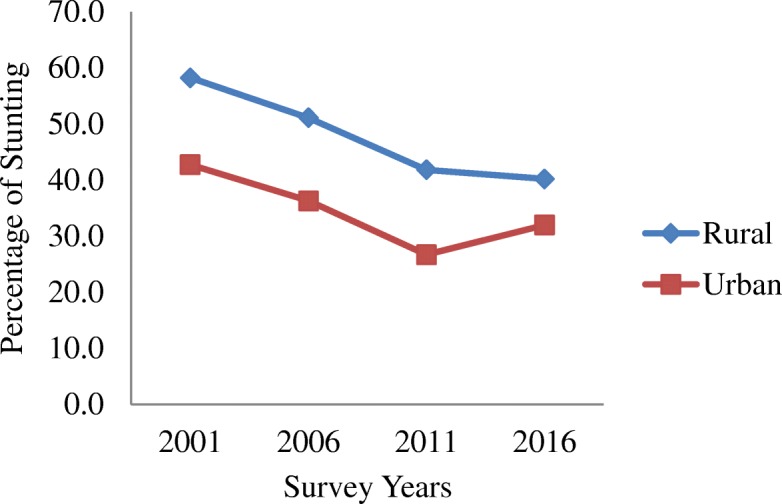
The prevalence of stunting has declined in overall as well as in all groups and subgroups analysed. The percentage of stunted children from 2001 to 2016 decreased by 18 and 10.7% in the rural and urban areas respectively. The unadjusted analysis depicted association between stunting and children living in rural areas since children living in rural areas had higher odds of being stunted compared to their urban counterparts. However, the association was no longer observed when adjusted for other variables included in this study. Children born to mothers without any education had 2.27 (95% CI 1.70-3.05), 5.222 (95% CI 2.54-10.74), 1.81 (95% CI 0.92-3.55) and 1.92 (95% CI 1.28-2.89) odds of being stunted than those born to mothers with higher education for the year 2001, 2006, 2011 and 2016 respectively in the adjusted analysis. Similarly, children belonging to the poorest wealth quintile had 1.90 (95% CI 1.55-2.33), 1.87 (95% CI 1.36-2.58), 2.47 (95% CI 1.51-4.02) and 4.18 (95% CI 2.60-6.71) odds of being stunted than those belonging to the richest quintile in 2001, 2006, 2011 and 2016 respectively. The association between stunting and wealth quintile depicting children belonging to the poorest and poorer wealth quintile having higher odds of being stunted remain the same in both unadjusted and adjusted analysis.

CONCLUSION

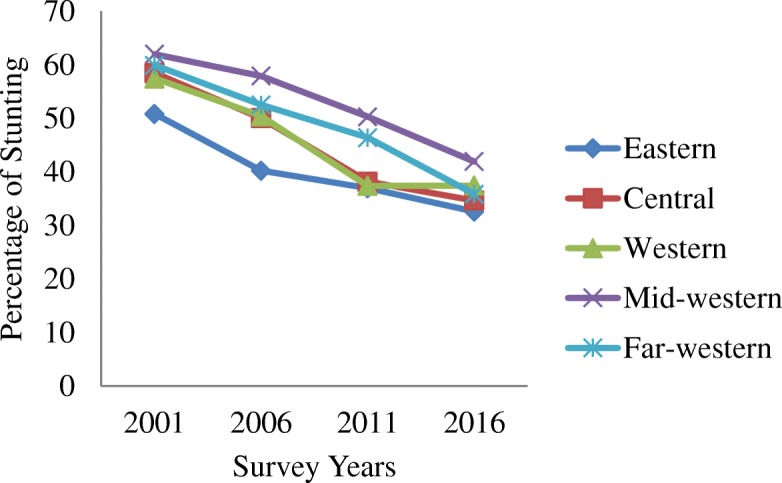
At national level, stunting is decreasing in Nepal; however, the prevalence of stunting is different between groups and subgroups analysed. The substantial inequalities in stunting have been preserved. Therefore, special emphasis should be given to vulnerable groups such as children belonging to the poorest and poorer wealth quintile instead of using blanket approach for delivering nutrition interventions. A balanced approach to nutritional inequalities prevalent across different regions and subgroups is required.

摘要

背景

尼泊尔的发育迟缓率位居世界前列,这是一个重大的公共卫生问题。本研究的目的是根据社会人口统计学和地理环境呈现发育迟缓患病率的数据,并确定这些环境因素对发育迟缓风险的影响。

方法

使用尼泊尔人口与健康调查的数据,研究对象为5岁以下儿童。通过描述性分析确定发育迟缓的患病率,并使用逻辑回归分析确定发育迟缓的风险因素。

结果

总体以及所有分析的组和亚组中,发育迟缓的患病率均有所下降。2001年至2016年,农村和城市地区发育迟缓儿童的比例分别下降了18%和10.7%。未经调整的分析表明发育迟缓与农村地区儿童之间存在关联,因为农村地区的儿童比城市儿童发育迟缓的几率更高。然而,在对本研究中纳入的其他变量进行调整后,这种关联不再存在。在调整后的分析中,2001年、2006年、2011年和2016年,母亲未接受任何教育的儿童发育迟缓的几率分别是母亲受过高等教育的儿童的2.27倍(95%置信区间1.70 - 3.05)、5.222倍(95%置信区间2.54 - 10.74)、1.81倍(95%置信区间0.92 - 3.55)和1.92倍(95%置信区间1.28 - 2.89)。同样,2001年、2006年、2011年和2016年,最贫困财富五分位数组的儿童发育迟缓的几率分别是最富有五分位数组儿童的1.90倍(95%置信区间1.55 - 2.33)、1.87倍(95%置信区间1.36 - 2.58)、2.47倍(95%置信区间1.51 - 4.02)和4.18倍(95%置信区间2.60 - 6.71)。在未经调整和调整后的分析中,发育迟缓与财富五分位数之间的关联表明,最贫困和较贫困财富五分位数组的儿童发育迟缓的几率更高,这种关联保持不变。

结论

在国家层面,尼泊尔的发育迟缓现象正在减少;然而,在分析的组和亚组中,发育迟缓的患病率存在差异。发育迟缓方面的巨大不平等现象依然存在。因此,应特别关注弱势群体,如最贫困和较贫困财富五分位数组的儿童,而不是采用一刀切的方式提供营养干预措施。需要采取一种平衡的方法来应对不同地区和亚组中普遍存在的营养不平等问题。
https://cdn.ncbi.nlm.nih.gov/pmc/blobs/4dce/7050877/4b48825de0d6/40795_2019_283_Fig5_HTML.jpg
https://cdn.ncbi.nlm.nih.gov/pmc/blobs/4dce/7050877/092b9cf836d1/40795_2019_283_Fig1_HTML.jpg
https://cdn.ncbi.nlm.nih.gov/pmc/blobs/4dce/7050877/03a978d56f60/40795_2019_283_Fig2_HTML.jpg
https://cdn.ncbi.nlm.nih.gov/pmc/blobs/4dce/7050877/1ae467b3ff05/40795_2019_283_Fig3_HTML.jpg
https://cdn.ncbi.nlm.nih.gov/pmc/blobs/4dce/7050877/1a6f4614b8ad/40795_2019_283_Fig4_HTML.jpg
https://cdn.ncbi.nlm.nih.gov/pmc/blobs/4dce/7050877/4b48825de0d6/40795_2019_283_Fig5_HTML.jpg
https://cdn.ncbi.nlm.nih.gov/pmc/blobs/4dce/7050877/092b9cf836d1/40795_2019_283_Fig1_HTML.jpg
https://cdn.ncbi.nlm.nih.gov/pmc/blobs/4dce/7050877/03a978d56f60/40795_2019_283_Fig2_HTML.jpg
https://cdn.ncbi.nlm.nih.gov/pmc/blobs/4dce/7050877/1ae467b3ff05/40795_2019_283_Fig3_HTML.jpg
https://cdn.ncbi.nlm.nih.gov/pmc/blobs/4dce/7050877/1a6f4614b8ad/40795_2019_283_Fig4_HTML.jpg
https://cdn.ncbi.nlm.nih.gov/pmc/blobs/4dce/7050877/4b48825de0d6/40795_2019_283_Fig5_HTML.jpg

相似文献

1
Trends and inequalities in stunting in Nepal: a secondary data analysis of four Nepal demographic health surveys from 2001 to 2016.尼泊尔发育迟缓的趋势与不平等现象:对2001年至2016年四次尼泊尔人口与健康调查的二次数据分析
BMC Nutr. 2019 Mar 4;5:19. doi: 10.1186/s40795-019-0283-x. eCollection 2019.
2
Trends and predictors of inequality in childhood stunting in Nepal from 1996 to 2016.1996 年至 2016 年尼泊尔儿童发育迟缓不平等的趋势和预测因素。
Int J Equity Health. 2019 Mar 5;18(1):42. doi: 10.1186/s12939-019-0944-z.
3
Determinants of stunting and severe stunting among under-fives: evidence from the 2011 Nepal Demographic and Health Survey.五岁以下儿童发育迟缓及严重发育迟缓的决定因素:来自2011年尼泊尔人口与健康调查的证据
BMC Pediatr. 2014 Sep 27;14:239. doi: 10.1186/1471-2431-14-239.
4
The trend of full vaccination coverage in infants and inequalities by wealth quintile and maternal education: analysis from four recent demographic and health surveys in Nepal.婴儿完全疫苗接种覆盖率的趋势以及按财富五分位数和母亲受教育程度划分的不平等:来自尼泊尔最近四次人口与健康调查的分析。
BMC Public Health. 2019 Dec 12;19(1):1673. doi: 10.1186/s12889-019-7995-3.
5
Ethnic inequalities and trends in stunting prevalence among Guatemalan children: an analysis using national health surveys 1995-2014.危地马拉儿童发育迟缓流行率的民族不平等和趋势:使用 1995-2014 年国家健康调查的分析。
Int J Equity Health. 2019 Jul 18;18(1):110. doi: 10.1186/s12939-019-1016-0.
6
Mothers' education but not fathers' education, household assets or land ownership is the best predictor of child health inequalities in rural Uganda.在乌干达农村地区,母亲的教育程度而非父亲的教育程度、家庭资产或土地所有权,是儿童健康不平等现象的最佳预测指标。
Int J Equity Health. 2004 Oct 13;3(1):9. doi: 10.1186/1475-9276-3-9.
7
Prevalence and socio-demographic correlates of stunting and thinness among Pakistani primary school children.巴基斯坦小学生发育迟缓与消瘦的流行情况及其社会人口学相关因素。
BMC Public Health. 2011 Oct 11;11:790. doi: 10.1186/1471-2458-11-790.
8
Impact of disasters on child stunting in Nepal.灾害对尼泊尔儿童发育迟缓的影响。
Risk Manag Healthc Policy. 2016 Jun 8;9:113-27. doi: 10.2147/RMHP.S101124. eCollection 2016.
9
Prevalence and Determinants of Stunting Among Adolescent Girls in Ethiopia.埃塞俄比亚青春期少女发育迟缓的流行状况及其决定因素。
J Pediatr Nurs. 2020 May-Jun;52:e1-e6. doi: 10.1016/j.pedn.2020.01.013. Epub 2020 Feb 3.
10
Factors associated with undernutrition among 20 to 49 year old women in Uganda: a secondary analysis of the Uganda demographic health survey 2016.乌干达 20 至 49 岁女性营养不良相关因素分析:基于 2016 年乌干达人口健康调查的二次分析。
BMC Public Health. 2020 Nov 3;20(1):1644. doi: 10.1186/s12889-020-09775-2.

引用本文的文献

1
Spatial analysis of provincial and district trends in stunting among children under five years in Nepal from 2001 to 2016.2001年至2016年尼泊尔五岁以下儿童发育迟缓的省级和地区趋势的空间分析。
BMC Nutr. 2022 Nov 14;8(1):131. doi: 10.1186/s40795-022-00629-1.
2
Determinants affecting utilisation of health services and treatment for children under-5 in rural Nepali health centres: a cross-sectional study.影响农村尼泊尔卫生中心 5 岁以下儿童卫生服务利用和治疗的决定因素:一项横断面研究。
BMC Public Health. 2022 Oct 20;22(1):1948. doi: 10.1186/s12889-022-14318-y.
3
Poor and non-poor gap in under-five child nutrition: a case from Nepal using Blinder-Oaxaca decomposition approach.

本文引用的文献

1
Trends and determinants of inequities in childhood stunting in Bangladesh from 1996/7 to 2014.1996/7至2014年孟加拉国儿童发育迟缓不平等现象的趋势及决定因素
Int J Equity Health. 2016 Nov 16;15(1):186. doi: 10.1186/s12939-016-0477-7.
2
Stunting in Nepal: looking back, looking ahead.尼泊尔的发育迟缓:回顾与展望。
Matern Child Nutr. 2016 May;12 Suppl 1(Suppl 1):257-9. doi: 10.1111/mcn.12286.
3
Childhood stunting: a global perspective.儿童发育迟缓:全球视角
五岁以下儿童营养的贫富差距:尼泊尔案例研究,采用 Blinder-Oaxaca 分解方法。
BMC Health Serv Res. 2022 Oct 12;22(1):1245. doi: 10.1186/s12913-022-08643-6.
4
Double burden of malnutrition in Nepal: A trend analysis of protein-energy malnutrition and High Body Mass Index using the data from Global Burden of Disease 2010-2019.尼泊尔的营养不良双重负担:使用全球疾病负担 2010-2019 年的数据对蛋白质-能量营养不良和高身体质量指数的趋势分析。
PLoS One. 2022 Sep 29;17(9):e0273485. doi: 10.1371/journal.pone.0273485. eCollection 2022.
5
Does birth season correlate with childhood stunting? An input for astrological nutrition.出生季节与儿童发育迟缓有关吗?占星营养的一个输入。
BMC Pediatr. 2022 May 24;22(1):306. doi: 10.1186/s12887-022-03343-w.
6
Socioeconomic and demographic correlates of child nutritional status in Nepal: an investigation of heterogeneous effects using quantile regression.尼泊尔儿童营养状况的社会经济和人口统计学相关因素:使用分位数回归研究异质效应。
Global Health. 2022 Apr 20;18(1):42. doi: 10.1186/s12992-022-00834-4.
7
Unravelling adolescent girls' aspirations in Nepal: Status and associations with individual-, household-, and community-level characteristics.揭开尼泊尔少女的志向之谜:个人、家庭和社区层面特征的现状及其关联。
PLoS One. 2021 Nov 12;16(11):e0258416. doi: 10.1371/journal.pone.0258416. eCollection 2021.
8
Effective nutrition governance is correlated with better nutrition outcomes in Nepal.有效的营养治理与尼泊尔更好的营养结果相关。
BMC Pediatr. 2021 Oct 6;21(1):434. doi: 10.1186/s12887-021-02898-4.
9
Trends in child growth failure among children under five years of age in Ethiopia: Evidence from the 2000 to 2016 Demographic and Health Surveys.趋势:埃塞俄比亚五岁以下儿童生长发育迟缓:来自 2000 年至 2016 年人口与健康调查的证据。
PLoS One. 2021 Aug 5;16(8):e0254768. doi: 10.1371/journal.pone.0254768. eCollection 2021.
10
Aflatoxin exposure and child nutrition: measuring anthropometric and long-bone growth over time in Nepal.黄曲霉毒素暴露与儿童营养:在尼泊尔测量随时间变化的人体测量学和长骨生长。
Am J Clin Nutr. 2021 Apr 6;113(4):874-883. doi: 10.1093/ajcn/nqaa397.
Matern Child Nutr. 2016 May;12 Suppl 1(Suppl 1):12-26. doi: 10.1111/mcn.12231.
4
Understanding the Rapid Reduction of Undernutrition in Nepal, 2001-2011.了解2001 - 2011年尼泊尔营养不良状况的迅速改善
PLoS One. 2015 Dec 23;10(12):e0145738. doi: 10.1371/journal.pone.0145738. eCollection 2015.
5
Children's height and weight in rural and urban populations in low-income and middle-income countries: a systematic analysis of population-representative data.低收入和中等收入国家城乡人口的儿童身高和体重:基于代表性人群数据的系统分析。
Lancet Glob Health. 2013 Nov;1(5):e300-9. doi: 10.1016/S2214-109X(13)70109-8. Epub 2013 Oct 24.
6
Factors associated with small size at birth in Nepal: further analysis of Nepal Demographic and Health Survey 2011.尼泊尔出生时低体重相关因素:2011年尼泊尔人口与健康调查的进一步分析
BMC Pregnancy Childbirth. 2014 Jan 18;14:32. doi: 10.1186/1471-2393-14-32.
7
An analysis of socio-demographic patterns in child malnutrition trends using Ghana demographic and health survey data in the period 1993-2008.利用1993 - 2008年加纳人口与健康调查数据对儿童营养不良趋势中的社会人口模式进行分析。
BMC Public Health. 2013 Oct 16;13:960. doi: 10.1186/1471-2458-13-960.
8
Determinants of reduced child stunting in Cambodia: analysis of pooled data from three demographic and health surveys.柬埔寨儿童发育迟缓减少的决定因素:三项人口与健康调查汇总数据的分析。
Bull World Health Organ. 2013 May 1;91(5):341-9. doi: 10.2471/BLT.12.113381. Epub 2013 Feb 19.
9
Household food insecurity associated with stunting and underweight among preschool children in Antioquia, Colombia.哥伦比亚安蒂奥基亚地区家庭粮食不安全与学龄前儿童发育迟缓及体重不足的关联
Rev Panam Salud Publica. 2009 Jun;25(6):506-10. doi: 10.1590/s1020-49892009000600006.