Friedman School of Nutrition Science and Policy, Tufts University, Boston, MA, USA.
Department of Agricultural Economics, Purdue University, West Lafayette, IN, USA.
Am J Clin Nutr. 2021 Apr 6;113(4):874-883. doi: 10.1093/ajcn/nqaa397.
Naturally occurring aflatoxins may contribute to poor growth and nutritional statuses in children.
We analyzed the relationship between contemporary and lagged aflatoxin exposure and 1) length-for-age z-score (LAZ); and 2) length, knee-heel length, stunting, weight-for-age z-score (WAZ), and weight-for-length z-score (WLZ).
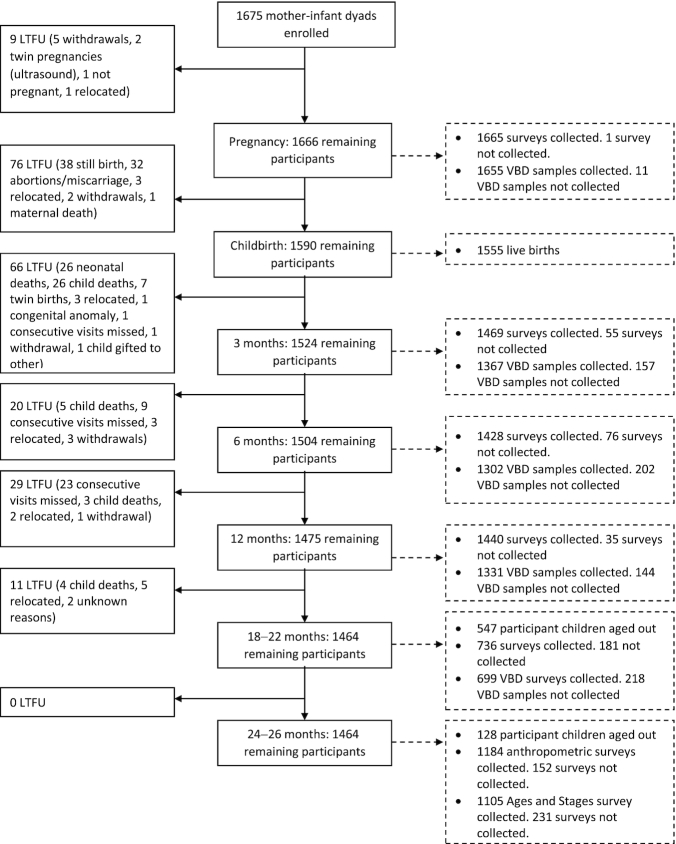
We conducted a longitudinal birth cohort study involving 1675 mother-infant dyads in rural Nepal. Participants were repeatedly visited from pregnancy to 2 years of age (2015-2019). One blood sample was collected during pregnancy and 4 samples were collected from the children at 3, 6, 12, and 18-22 months of age to measure concentrations of aflatoxin B1 (AFB1)-lysine adduct. Multivariate linear fixed-effects and logistic models with generalized estimating equations were used to identify associations between child growth and aflatoxin exposure.
AFB1-lysine adducts were detected in the majority of children (at 3 months, 80.5%; at 6 months, 75.3%; at 12 months, 81.1%; and at 18-22 months, 85.1%) and in 94.3% of pregnant women. Changes in contemporary ln child AFB1-lysine adduct concentrations were significantly associated with changes in LAZ (β, -0.05; 95% CI, -0.09 to -0.02; P = 0.003), length (β, -0.19; 95% CI, -0.29 to -0.10; P < 0.001), knee-heel length (β, -0.09; 95% CI, -0.13 to -0.05; P < 0.001), and WAZ (β, -0.04; 95% CI, -0.07 to -0.005; P = 0.022). Serum aflatoxin concentrations were associated with stunting (OR, 1.18; 95% CI, 1.05-1.32; P = 0.005). Similar results were found in the models using changes in contemporary ln AFB1 adjusted for changes in child weight, with significant associations with changes in WLZ (β, -0.07; 95% CI, -0.10 to -0.03; P < 0.001). Changes in time-lagged ln AFB1 (unadjusted and adjusted for changes in child weight) were associated with changes in length and knee-heel length.
Our results add to the growing body of evidence confirming chronic aflatoxin exposure and suggest that exposure is significantly correlated with various negative growth outcomes, which may vary by child weight status. This trial was registered at clinicaltrials.gov as NCT03312049.
天然存在的黄曲霉毒素可能导致儿童生长和营养状况不良。
我们分析了当代和滞后黄曲霉毒素暴露与 1)年龄别身长 Z 评分(LAZ);和 2)身长、膝-跟长、发育迟缓、年龄别体重 Z 评分(WAZ)和体重别身长 Z 评分(WLZ)之间的关系。
我们进行了一项纵向出生队列研究,涉及尼泊尔农村地区的 1675 对母婴对。参与者从怀孕到 2 岁(2015-2019 年)期间被反复访问。在怀孕期间采集了一份血样,在儿童 3、6、12 和 18-22 个月时采集了 4 份样本,以测量黄曲霉毒素 B1(AFB1)-赖氨酸加合物的浓度。使用具有广义估计方程的多变量线性固定效应和逻辑模型来确定儿童生长与黄曲霉毒素暴露之间的关联。
大多数儿童(3 个月时为 80.5%;6 个月时为 75.3%;12 个月时为 81.1%;18-22 个月时为 85.1%)和 94.3%的孕妇检测到 AFB1-赖氨酸加合物。当代儿童 ln AFB1-赖氨酸加合物浓度的变化与 LAZ(β,-0.05;95%CI,-0.09 至-0.02;P=0.003)、身长(β,-0.19;95%CI,-0.29 至-0.10;P<0.001)、膝-跟长(β,-0.09;95%CI,-0.13 至-0.05;P<0.001)和 WAZ(β,-0.04;95%CI,-0.07 至-0.005;P=0.022)的变化显著相关。血清黄曲霉毒素浓度与发育迟缓(OR,1.18;95%CI,1.05-1.32;P=0.005)相关。在使用调整儿童体重变化后的当代 ln AFB1 进行的模型中也得到了类似的结果,与 WLZ(β,-0.07;95%CI,-0.10 至-0.03;P<0.001)的变化显著相关。时间滞后 ln AFB1(未经调整和调整儿童体重变化)的变化与身长和膝-跟长的变化相关。
我们的结果增加了越来越多的确认慢性黄曲霉毒素暴露与各种负面生长结果相关的证据,并表明暴露与体重状态不同的各种负面生长结果显著相关。本试验在 clinicaltrials.gov 上注册为 NCT03312049。