Gregg L Parker, Carmody Thomas, Le Dustin, Martins Gerard, Trivedi Madhukar, Hedayati S Susan
Division of Nephrology, Department of Medicine, University of Texas Southwestern Medical Center, Dallas, Texas, USA.
Division of Nephrology, Medical Service, Veterans Affairs North Texas Health Care System, Dallas, Texas, USA.
Kidney Int Rep. 2019 Dec 21;5(3):318-330. doi: 10.1016/j.ekir.2019.12.009. eCollection 2020 Mar.
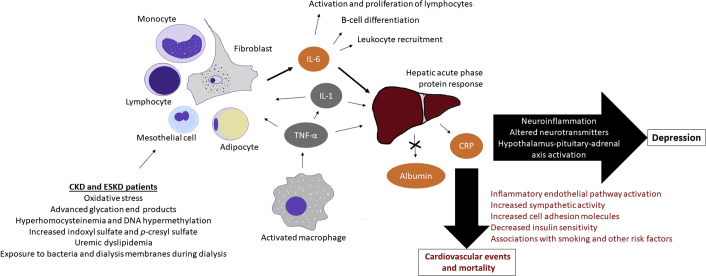
Depression comorbid with chronic disease may be mediated by inflammation. We sought to characterize relationships between inflammatory biomarkers and depressive symptoms in patients with chronic kidney disease and end-stage kidney disease.
A systematic literature search was conducted by 2 authors up to March 19, 2019, for studies of patients with chronic kidney disease or end-stage kidney disease evaluating circulating inflammatory biomarkers associated with depression of chronic disease: albumin, C-reactive protein (CRP), high-sensitivity CRP, interleukin-6 (IL-6), tumor necrosis factor-α, and interleukin-1. Standardized mean differences in biomarkers between individuals with and without depression were computed and analyzed using mixed effects models. Correlations between biomarkers and the severity of depressive symptoms were computed.
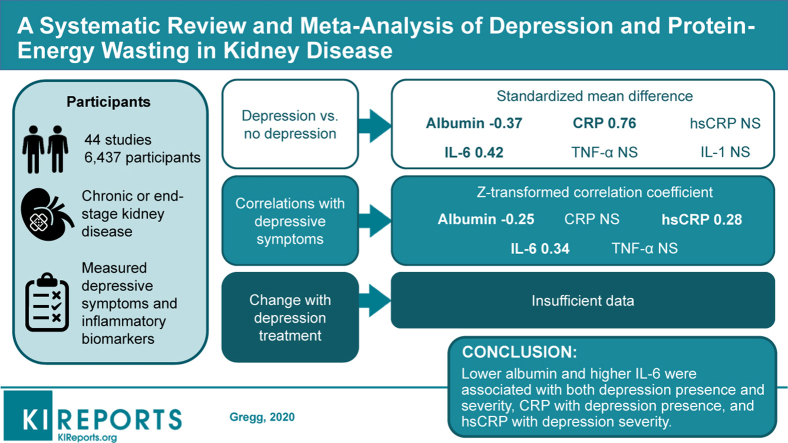
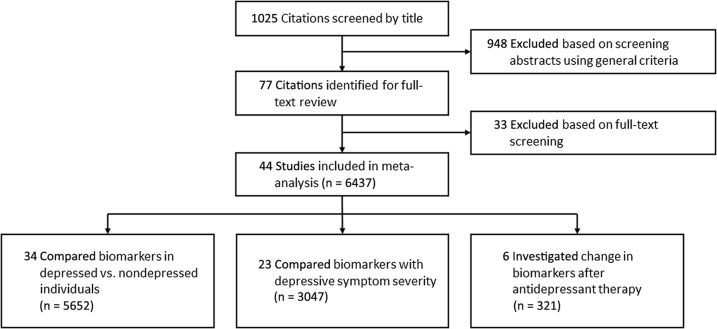
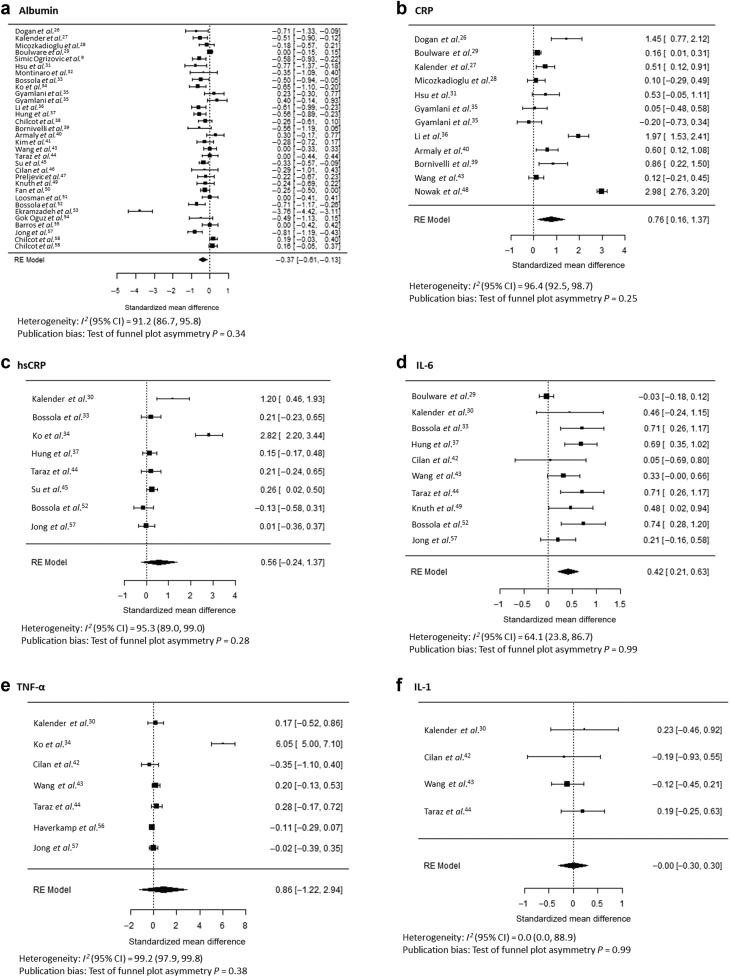
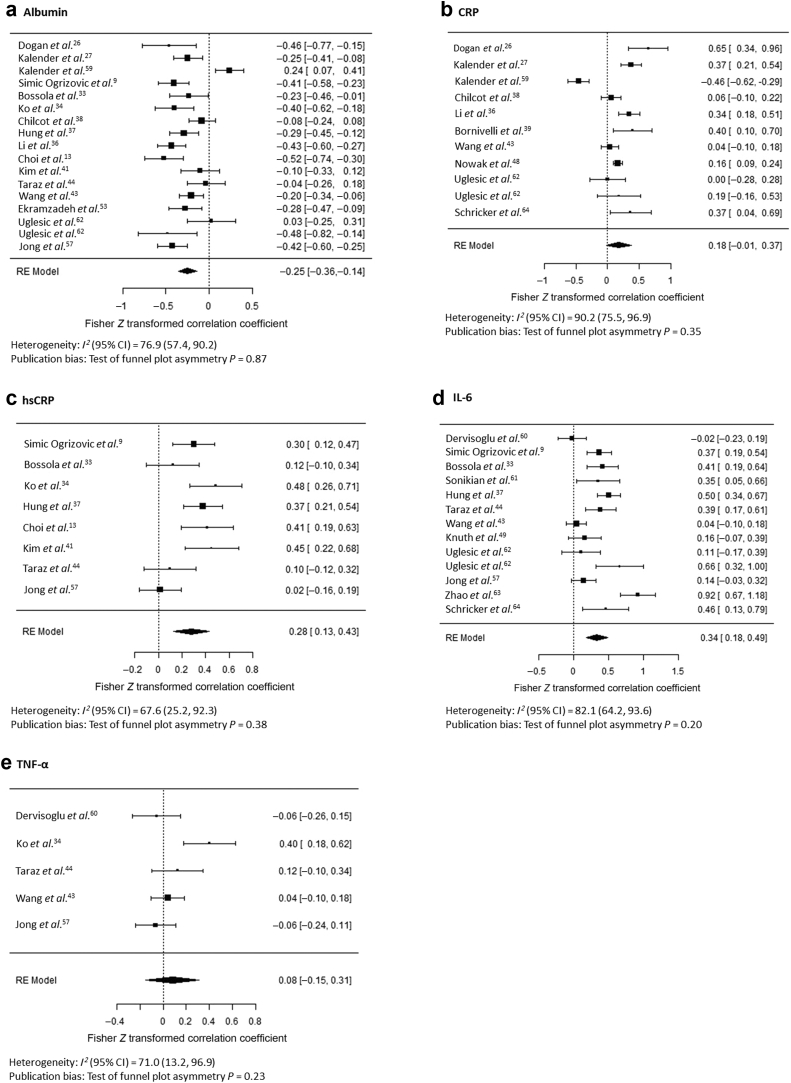
Thirty-four studies (5652 participants) compared biomarkers between depressed and nondepressed individuals. Individuals with depression had lower albumin levels (standardized mean difference, -0.37; 95% confidence interval [CI], -0.61 to -0.13), higher CRP levels (standardized mean difference, 0.76; 95% CI, 0.16-1.37), and higher IL-6 levels (standardized mean difference, 0.42; 95% CI, 0.21-0.63). Studies were heterogeneous for albumin, CRP, high-sensitivity CRP, and tumor necrosis factor-α. Twenty-three studies (3047 participants) investigated correlations between biomarkers and depressive symptoms. The severity of depressive symptoms correlated with albumin ( = -0.25; 95% CI, -0.36 to -0.14), high-sensitivity CRP ( = 0.28; 95% CI, 0.13-0.43), and IL-6 ( = 0.34; 95% CI, 0.18-0.49). There was heterogeneity across studies of IL-6. Only 6 studies (321 participants) investigated the effect of antidepressant treatment on inflammatory biomarkers, which was insufficient to combine in meta-analysis.
Lower albumin and higher IL-6 were associated with both the presence and severity of depression, CRP with the presence of depression, and high-sensitivity CRP with the severity of depressive symptoms. The effect of interventions to lower inflammation in patients with kidney disease and depression deserves investigation.
与慢性疾病共病的抑郁症可能由炎症介导。我们试图描述慢性肾脏病和终末期肾病患者炎症生物标志物与抑郁症状之间的关系。
截至2019年3月19日,由两位作者进行了一项系统的文献检索,以查找评估与慢性病抑郁相关的循环炎症生物标志物的慢性肾脏病或终末期肾病患者的研究:白蛋白、C反应蛋白(CRP)、高敏CRP、白细胞介素-6(IL-6)、肿瘤坏死因子-α和白细胞介素-1。计算有抑郁和无抑郁个体之间生物标志物的标准化平均差异,并使用混合效应模型进行分析。计算生物标志物与抑郁症状严重程度之间的相关性。
34项研究(5652名参与者)比较了抑郁和非抑郁个体之间的生物标志物。抑郁个体的白蛋白水平较低(标准化平均差异,-0.37;95%置信区间[CI],-0.61至-0.13),CRP水平较高(标准化平均差异,0.76;95%CI,0.16 - 1.37),IL-6水平较高(标准化平均差异,0.42;95%CI,0.21 - 0.63)。白蛋白、CRP、高敏CRP和肿瘤坏死因子-α的研究存在异质性。23项研究(3047名参与者)调查了生物标志物与抑郁症状之间的相关性。抑郁症状的严重程度与白蛋白(r = -0.25;95%CI,-0.36至-0.14)、高敏CRP(r = 0.28;95%CI,0.13 - 0.43)和IL-6(r = 0.34;95%CI,0.18 - 0.49)相关。IL-6的研究存在异质性。只有6项研究(321名参与者)调查了抗抑郁治疗对炎症生物标志物的影响,不足以进行荟萃分析。
较低的白蛋白和较高的IL-6与抑郁症的存在和严重程度相关,CRP与抑郁症的存在相关,高敏CRP与抑郁症状的严重程度相关。降低肾病和抑郁症患者炎症的干预措施的效果值得研究。