Praxis für interdisziplinäre Onkologie und Hämatologie, Freiburg, Germany.
Kompetenzzentrum für klinische Studien Bremen, Universität Bremen, Bremen, Germany.
JAMA Netw Open. 2020 Mar 2;3(3):e200643. doi: 10.1001/jamanetworkopen.2020.0643.
Mortality, morbidity, and health-related quality of life (HRQoL) are patient-relevant end points generally considered in the early benefit assessments of new cancer treatments. Progression-related end points, such as time to progression or progression-free survival, are not included, although patients and physicians testify to the detrimental association of disease progression with HRQoL.
To examine the association of disease progression and HRQoL in 4 prevalent solid-cancer entities in routine clinical practice.
DESIGN, SETTING, AND PARTICIPANTS: This cohort study evaluated data from 4 prospective, nonintervention, multicenter registries collected between 2011 and 2018 in 203 centers in Germany. Patients' HRQoL was assessed regularly for up to 5 years. The change in HRQoL scores after disease progression was examined with linear mixed models, adjusting for demographic and clinical covariates. Patients with metastatic breast, pancreatic, lung, and colorectal cancer were recruited at the start of systemic first-line treatment. Data analysis was performed from February 2019 to April 2019.
All patients received systemic, palliative first-line treatment according to their physician's choice.
The primary outcome was deterioration of HRQoL associated with disease progression, as measured by 4 validated questionnaires: Functional Assessment of Cancer Therapy-General version 4, European Organization for Research and Treatment of Cancer QLQ-C30 version 3.0, European Organization for Research and Treatment of Cancer QLQ-C15-PAL version 1, and Hospital Anxiety and Depression Scale.
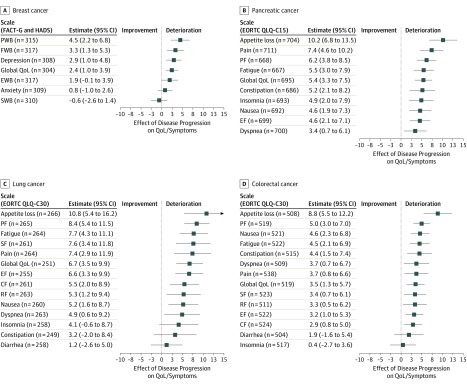
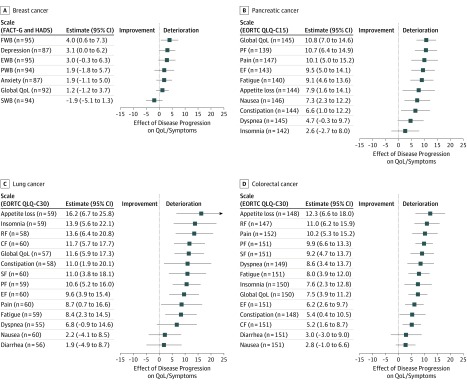
More than 8000 questionnaires from 2314 patients with 2562 documented disease progressions were analyzed. In total, 464 patients had breast cancer (464 [100.0%] female; median [range] age, 61.6 [26.4-90.1] years), 807 patients had pancreatic cancer (352 [43.6%] female; median [range] age, 70.0 [39.0-93.0] years), 341 patients had lung cancer (118 [34.6%] female; median [range] age, 65.9 [28.4-88.2] years), and 702 patients had colorectal cancer (248 [35.3%] female; median [range] age, 66.9 [26.9-92.1] years). The first disease progression was associated with a statistically significant worsening of 37 of 45 HRQoL scales; for 17 of these scales, the worsening was clinically meaningful. Scale scores for appetite loss (pancreatic cancer, 10.2 points [95% CI, 6.8-13.5 points]; lung cancer, 10.8 points [95% CI, 5.4-16.2 points]; colorectal cancer, 8.8 points [95% CI, 5.5-12.2]; all P < .001), physical functioning (pancreatic cancer, 6.2 points [95% CI, 3.8-8.5 points]; lung cancer, 8.4 points [95% CI, 5.4-11.5 points]; colorectal cancer, 5.0 points [95% CI, 3.0-7.0 points]; all P < .001), and fatigue (pancreatic cancer, 5.5 points [95% CI, 3.0-7.9 points]; lung cancer, 7.7 points [95% CI, 4.3-11.1]; colorectal cancer, 4.5 points [95% CI, 2.1-6.9 points]; all P < .001) were most affected, irrespective of the type of cancer. The association with global HRQoL was most pronounced in lung cancer (6.7 points [95% CI, 3.5-9.9 points]; P < .001) and pancreatic cancer (5.4 points [95% CI, 3.3-7.5 points]; P < .001) and less in colorectal cancer (3.5 points [95% CI, 1.3-5.7 points]; P = .002) and breast cancer (2.4 points [95% CI, 1.0-3.9 points]; P = .001). The second progression was associated with an even larger decrease in HRQoL.
These findings suggest that disease progression is associated with a deterioration in HRQoL among patients with metastatic breast, pancreatic, lung, and colorectal cancer. This evidence highlights the importance of progression-related end points, such as time to progression and progression-free survival, as additional patient-relevant end points when evaluating the benefit of new treatments for patients with metastatic cancer.
死亡率、发病率和健康相关生活质量(HRQoL)是一般在新癌症治疗早期获益评估中考虑的患者相关终点。进展相关终点,如进展时间或无进展生存期,并不包括在内,尽管患者和医生都证明疾病进展与 HRQoL 有不利关联。
在常规临床实践中检查 4 种常见实体瘤疾病进展与 HRQoL 的关联。
设计、设置和参与者:这项队列研究评估了 2011 年至 2018 年期间在德国 203 个中心的 4 个前瞻性、非干预、多中心登记处收集的数据。定期评估患者的 HRQoL 长达 5 年。使用线性混合模型调整人口统计学和临床协变量后,检查了 HRQoL 评分在疾病进展后的变化。招募转移性乳腺癌、胰腺癌、肺癌和结直肠癌患者开始接受系统一线治疗。数据分析于 2019 年 2 月至 2019 年 4 月进行。
所有患者均根据医生的选择接受了系统的、姑息性的一线治疗。
主要结局是疾病进展与 HRQoL 恶化相关,通过 4 个经过验证的问卷进行测量:功能性评估癌症治疗-一般版 4 号、欧洲癌症研究与治疗组织 QLQ-C30 版本 3.0、欧洲癌症研究与治疗组织 QLQ-C15-PAL 版本 1 和医院焦虑抑郁量表。
分析了来自 2314 名患者的 2562 份有记录疾病进展的超过 8000 份问卷。共有 464 名患者患有乳腺癌(100.0%女性;中位[范围]年龄,61.6[26.4-90.1]岁),807 名患者患有胰腺癌(352[43.6%]女性;中位[范围]年龄,70.0[39.0-93.0]岁),341 名患者患有肺癌(118[34.6%]女性;中位[范围]年龄,65.9[28.4-88.2]岁),702 名患者患有结直肠癌(248[35.3%]女性;中位[范围]年龄,66.9[26.9-92.1]岁)。第一次疾病进展与 45 个 HRQoL 量表中的 37 个统计学上显著恶化相关;其中 17 个量表的恶化具有临床意义。食欲丧失量表评分(胰腺癌,10.2 分[95%CI,6.8-13.5 分];肺癌,10.8 分[95%CI,5.4-16.2 分];结直肠癌,8.8 分[95%CI,5.5-12.2 分];所有 P < .001)、身体功能量表评分(胰腺癌,6.2 分[95%CI,3.8-8.5 分];肺癌,8.4 分[95%CI,5.4-11.5 分];结直肠癌,5.0 分[95%CI,3.0-7.0 分];所有 P < .001)和疲劳量表评分(胰腺癌,5.5 分[95%CI,3.0-7.9 分];肺癌,7.7 分[95%CI,4.3-11.1 分];结直肠癌,4.5 分[95%CI,2.1-6.9 分];所有 P < .001)受影响最大,而与癌症类型无关。肺癌(6.7 分[95%CI,3.5-9.9 分];P < .001)和胰腺癌(5.4 分[95%CI,3.3-7.5 分];P < .001)与全球 HRQoL 的相关性最显著,而结直肠癌(3.5 分[95%CI,1.3-5.7 分];P = .002)和乳腺癌(2.4 分[95%CI,1.0-3.9 分];P = .001)的相关性则较低。第二次进展与 HRQoL 更大程度的下降相关。
这些发现表明,疾病进展与转移性乳腺癌、胰腺癌、肺癌和结直肠癌患者的 HRQoL 恶化有关。这一证据强调了进展相关终点(如进展时间和无进展生存期)作为评估转移性癌症患者新治疗益处的额外患者相关终点的重要性。