Department of Orthopedics, Yidu Central Hospital of Weifang, Weifang, Shandong, China (mainland).
Health Management Center, Weifang People's Hospital, Weifang, Shandong, China (mainland).
Med Sci Monit. 2020 Mar 10;26:e921594. doi: 10.12659/MSM.921594.
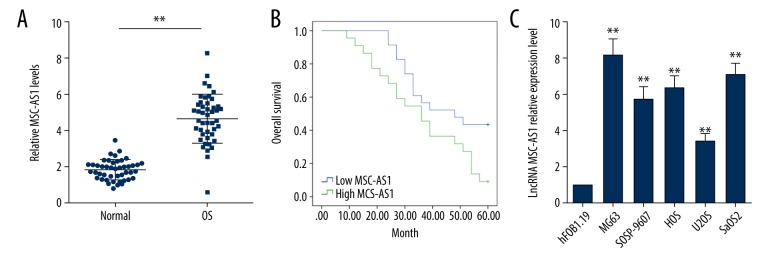
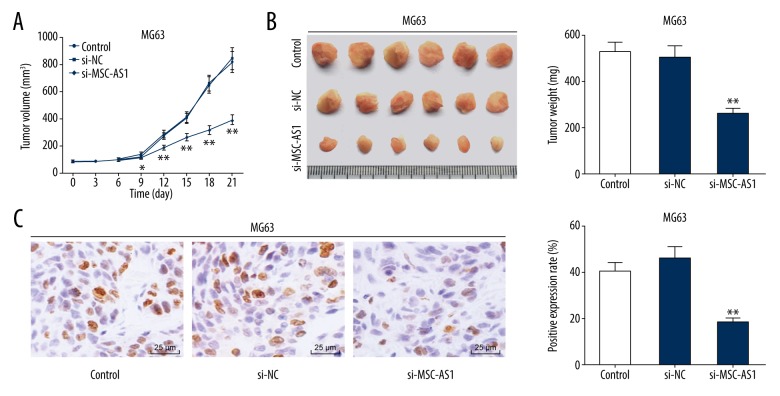
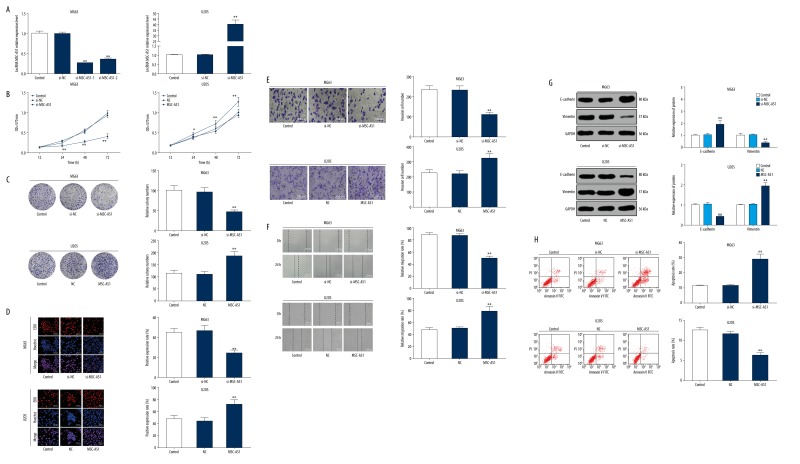
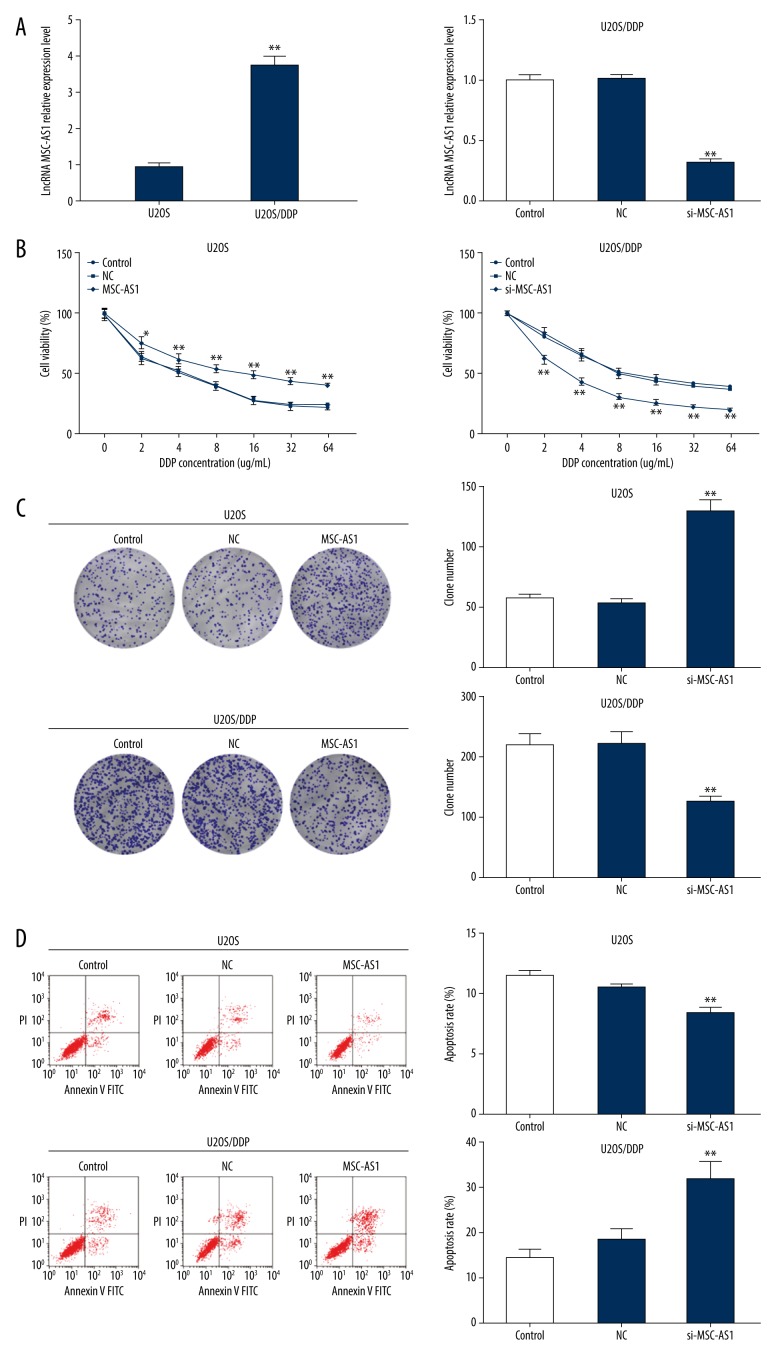
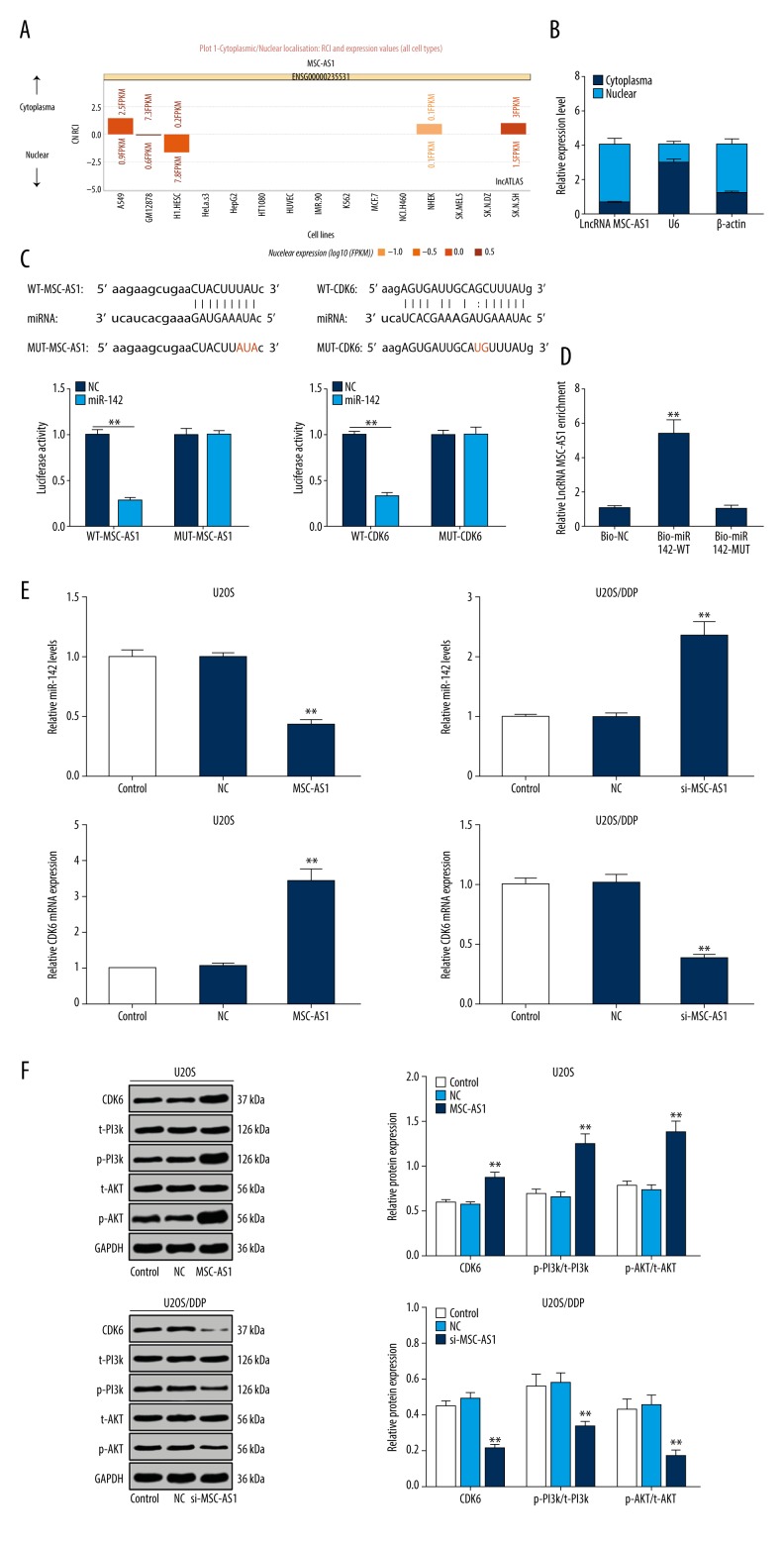
BACKGROUND Osteosarcoma (OS) is the most prevalent malignant primary bone tumor, resulting from severe transformation of primitive mesenchymal cells, which induces osteogenesis. Long non-coding RNA (lncRNA) MSC-AS1 triggers osteogenic differentiation by sponging microRNA (miR)-140-5p. The present study assessed the mechanism of lncRNA MSC-AS1 in OS biological features and sensitivity to cisplatin (DDP) by binding to miR-142. MATERIAL AND METHODS Firstly, lncRNA MSC-AS1 expression in OS tissues and cells was analyzed. OS cells were transfected with silenced MSC-AS1 to determine its role in OS biological behaviors, and we also assessed the effect of MSC-AS1 on OS sensitivity to DDP. Then, website prediction and dual-luciferase reporter gene assay were utilized for verification of the binding site between MSC-AS1 and miR-142. Reverse transcription-quantitative polymerase chain reaction (RT-qPCR) and Western blot analysis were performed to determine the effect of MSC-AS1 on expression of miR-142, cyclin-dependent kinase 6 (CDK6), and the PI3K/AKT signaling pathway. Xenograft transplantation was also applied to confirm the in vitro experiments. RESULTS Overexpressed MSC-AS1 was associated with poor prognosis of OS patients. OS cell proliferation, invasion, and migration were reduced after silencing MSC-AS1, while cell apoptosis was enhanced. Moreover, silencing MSC-AS1 made OS cells more sensitive to DDP. Interestingly, MSC-AS1 knockdown induced miR-142 expression and reduced CDK6 levels, thereby decreasing the protein expression of p-PI3K/t-PI3K and p-AKT/t-AKT. Silencing MSC-AS1 repressed OS progression in vivo. CONCLUSIONS Our study demonstrated that silencing MSC-AS1 inhibited OS biological behaviors by enhancing miR-142 to decrease CDK6 and inactivating the PI3K/AKT axis. Our results may provide new insights for OS treatment.
骨肉瘤(OS)是最常见的原发性恶性骨肿瘤,源于原始间充质细胞的严重转化,诱导成骨。长链非编码 RNA(lncRNA)MSC-AS1 通过海绵吸附 microRNA(miR)-140-5p 触发成骨分化。本研究通过与 miR-142 结合,评估 lncRNA MSC-AS1 在 OS 生物学特征和对顺铂(DDP)敏感性中的机制。
首先,分析 OS 组织和细胞中 lncRNA MSC-AS1 的表达。沉默 MSC-AS1 转染 OS 细胞,以确定其在 OS 生物学行为中的作用,还评估了 MSC-AS1 对 OS 对 DDP 敏感性的影响。然后,利用网站预测和双荧光素酶报告基因检测验证 MSC-AS1 与 miR-142 之间的结合位点。反转录-定量聚合酶链反应(RT-qPCR)和 Western blot 分析用于确定 MSC-AS1 对 miR-142、周期蛋白依赖性激酶 6(CDK6)和 PI3K/AKT 信号通路表达的影响。还进行了异种移植移植以验证体外实验。
过表达的 MSC-AS1 与 OS 患者的不良预后相关。沉默 MSC-AS1 后,OS 细胞增殖、侵袭和迁移减少,而细胞凋亡增强。此外,沉默 MSC-AS1 使 OS 细胞对 DDP 更敏感。有趣的是,MSC-AS1 敲低诱导 miR-142 表达并降低 CDK6 水平,从而降低 p-PI3K/t-PI3K 和 p-AKT/t-AKT 的蛋白表达。沉默 MSC-AS1 抑制了体内 OS 的进展。
本研究表明,沉默 MSC-AS1 通过增强 miR-142 降低 CDK6 并使 PI3K/AKT 轴失活来抑制 OS 生物学行为。我们的研究结果可能为 OS 治疗提供新的思路。